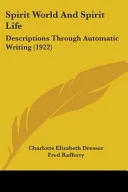
Spirit World and Spirit Life
 74
74

Spirit World and Spirit Life
Charlotte Elizabeth Dresser and Fred Rafferty's Spirit World and Spirit Life offers a systematic, if somewhat dated, exposition on the architecture of the unseen. Its strength lies in its detailed cataloging of spiritual phenomena, presenting concepts like the "astral body" and "thought-forms" with a methodical rigor that appeals to the rationalist impulse within occult study. The work attempts to demystify spiritual existence, treating it as a science. However, its primary limitation is the inherent challenge in verifying such esoteric claims, which remain speculative by nature. A notable passage discusses the "planes of consciousness" as distinct regions with specific vibrational frequencies, a concept that, while central to many esoteric systems, lacks empirical grounding. The book’s value is diminished by its facsimile nature, which offers little in terms of modern scholarly apparatus. Nevertheless, for those seeking to understand the Victorian and Edwardian era's approach to spiritualism and its theoretical frameworks, it provides an unvarnished look.
Spirit World and Spirit Life is a valuable historical document for students of occult theory, despite its speculative core.
📝 Description
74
Spirit World and Spirit Life, first published in 2008, examines unseen realms as a subject of study.
This book treats spiritual existence not as a matter of faith, but as a field for systematic investigation, much like natural philosophy. It details the nature and mechanics of what it calls the unseen realms and the entities that inhabit them. The work posits a universe governed by intelligent, subtle laws that can be understood through dedicated study and practice. It discusses the formation of spiritual bodies, the process of reincarnation, and the influence of thought-forms.
The text addresses the structure of the astral plane, the principles of spiritual evolution, and the interactions between the material and immaterial worlds. It is intended for serious students of esotericism, occultism, and comparative religion. Readers interested in the mechanics of spiritual planes, the nature of consciousness beyond the physical body, and the historical development of spiritualist thought will find substantial material here. It is for those who seek systematic explanations.
The concepts in Spirit World and Spirit Life likely emerged from the spiritualist movements and occult revivals of the late 19th and early 20th centuries. This era saw significant interest in mediums, psychic phenomena, and the exploration of non-physical realities. It engages with a tradition that sought to codify spiritual laws and understand non-physical existence through observation and reasoned analysis, influenced by broader Theosophical Society endeavors.
💡 Why Read This Book?
• Understand the mechanics of the "astral plane" as described in early 20th-century esoteric literature, offering a structured view of non-physical reality not commonly found in popular spiritualist accounts. • Grasp the concept of "thought-forms" and their alleged influence on spiritual development, providing a specific framework for analyzing mental constructs and their impact. • Examine the detailed explanations of "spiritual evolution" presented in the work, which offers a particular cosmological narrative distinct from modern scientific or purely religious perspectives.
⭐ Reader Reviews
Honest opinions from readers who have explored this book.
❓ Frequently Asked Questions
What is the original publication date of Spirit World and Spirit Life?
The facsimile reprint was published in 2008. However, the content itself originates from earlier writings, reflecting the spiritualist and occult interests prevalent in the late 19th and early 20th centuries.
What are 'thought-forms' according to Spirit World and Spirit Life?
The book describes thought-forms as semi-tangible entities created by concentrated human thought and emotion, capable of existing on the astral plane and influencing both the creator and others.
Does the book discuss reincarnation?
Yes, Spirit World and Spirit Life explores reincarnation as a fundamental process of spiritual evolution, detailing how souls progress through various physical and non-physical existences.
What is the 'astral plane' as presented in this book?
The astral plane is depicted as a subtle realm of existence, closely associated with human emotions and desires, serving as an intermediary between the physical world and higher spiritual planes.
Is this book suitable for beginners in esotericism?
While it offers foundational concepts, the systematic and detailed nature of the text might be more suited for intermediate students of esotericism seeking in-depth theoretical understanding.
Why is this book described as a 'facsimile reprint'?
A facsimile reprint means it is a close reproduction of an older edition. This indicates the original material is antiquarian and the publishers have sought to preserve its original format and content.
🔮 Key Themes & Symbolism
The Astral Plane
Spirit World and Spirit Life meticulously details the astral plane, presenting it not as a vague spiritual concept but as a structured environment with its own laws and inhabitants. The work elaborates on its connection to human consciousness, particularly emotions and desires, suggesting it acts as a bridge between the physical and higher spiritual dimensions. This detailed mapping offers a framework for understanding the immediate post-death experience and the nature of psychic phenomena.
Spiritual Evolution
The book posits a progressive journey for the soul, outlining a theory of spiritual evolution that extends beyond a single lifetime. It discusses reincarnation as a mechanism for learning and growth, detailing how experiences and choices in one life influence subsequent incarnations. This concept of continuous development through multiple existences provides a teleological perspective on the human condition and the purpose of earthly existence.
Thought-Forms and Their Creation
A significant focus is placed on "thought-forms" – entities or structures generated by concentrated mental energy. The work explains how these are formed on the astral plane by human thoughts, emotions, and intentions. It explores their persistence and potential influence, offering insights into the power of the mind and the responsibility that comes with directed consciousness in shaping one's spiritual environment.
The Nature of Spirit Life
The text provides a comprehensive view of life after physical death, describing the transition process and the existence of spirits on various planes. It discusses the "spiritual body" and its relationship to the physical form, as well as the potential for continued interaction and learning in the non-physical realms. This perspective aims to demystify death and present it as a natural phase in a larger existence.
💬 Memorable Quotes
“The astral body is not the physical body, but its ethereal counterpart.”
— This highlights the dualistic view of the self, presenting the astral body as a distinct, non-physical vehicle that carries consciousness and personal identity beyond the physical realm.
“Thought-forms are the fabric of the astral world.”
— This emphasizes the pervasive influence of mental activity on the spiritual landscape, suggesting that the very substance of the astral plane is composed of the emanations of conscious thought.
“Reincarnation is the schoolroom of the soul.”
— This metaphor frames multiple lifetimes not as punishment or accident, but as a structured educational process designed for the soul's advancement and purification.
“Each plane of existence has its own unique vibration.”
— This points to the idea that different realities, from the physical to the spiritual, are differentiated by their specific energetic frequencies, influencing how they interact or remain separate.
“The spirit world is governed by immutable laws.”
— This suggests that the unseen realms are not chaotic but operate under principles as consistent and understandable as those found in the physical sciences, inviting systematic study.
🌙 Esoteric Significance
Tradition
This work fits within the Western Esoteric tradition, particularly drawing from spiritualist and Theosophical underpinnings. It attempts to systematize concepts related to the subtle bodies and planes of existence, echoing efforts seen in early 20th-century occult literature to create a coherent cosmology accessible to a modern, rational mind.
Symbolism
Key symbols include the "astral body," representing the soul's vehicle for navigating non-physical realms, and "thought-forms," which symbolize the power of consciousness to manifest and shape spiritual reality. The concept of "vibrational frequencies" also functions symbolically, denoting the distinct energetic signatures that differentiate various planes of existence.
Modern Relevance
Contemporary practitioners in fields like consciousness studies, energy healing, and modern magical traditions that incorporate astral projection or visualization may find resonance with the structured approach to the unseen presented here. The detailed mechanics of thought-forms, in particular, inform modern discussions on manifestation and mental discipline.
👥 Who Should Read This Book
• Students of historical spiritualism seeking detailed theoretical explanations of the afterlife and spirit realms, moving beyond anecdotal accounts. • Occult practitioners interested in understanding the foundational concepts of astral projection and the nature of subtle bodies as explored in early 20th-century literature. • Comparative religion scholars examining the development of esoteric cosmologies and attempts to reconcile spiritual beliefs with a rational, systematic framework.
📜 Historical Context
Spirit World and Spirit Life emerges from the fertile ground of late 19th and early 20th-century spiritualism and occultism, a period marked by intense exploration of psychic phenomena and non-material realities. This era saw the rise of Theosophy, championed by Helena Blavatsky, which sought to synthesize Eastern and Western esoteric traditions. The work engages with a broader intellectual current that questioned the materialism of the age, offering alternative frameworks for understanding consciousness, death, and the universe. While figures like Arthur Conan Doyle championed spiritualism, mainstream science remained largely skeptical. This book reflects a specific attempt within that milieu to codify the perceived mechanics of spiritual existence, presenting a detailed, almost scientific, approach to the unseen, distinct from purely religious dogma or philosophical speculation.
📔 Journal Prompts
The astral plane's described characteristics and your personal experiences with altered states of consciousness.
Analyze the concept of thought-forms: how might their formation and persistence impact your daily life?
Reflect on the idea of spiritual evolution across multiple lifetimes as presented in the text.
Consider the "immutable laws" governing the spirit world and their potential implications for human action.
Examine the distinction between the physical body and the astral body presented in the book.
🗂️ Glossary
Astral Plane
A subtle realm of existence associated with emotions, desires, and psychic phenomena, serving as an intermediary between the physical and higher spiritual realms.
Astral Body
The non-physical counterpart or vehicle of the human being, believed to carry consciousness and personality beyond the physical body, particularly after death or during altered states.
Thought-Form
A semi-tangible entity or structure created by concentrated human thought, emotion, or intention, existing on the astral plane.
Spiritual Evolution
The concept of progressive development and refinement of the soul or consciousness through successive lifetimes and experiences, both physical and non-physical.
Vibration
In this context, refers to the specific energetic frequency or quality that characterizes different planes of existence and entities within them.
Reincarnation
The process by which a soul or consciousness is reborn into a new physical body after death, typically to continue a cycle of learning and growth.
Physical Body
The material, corporeal form that inhabits the Earth plane, considered by the work to be one of several bodies or vehicles of the individual.