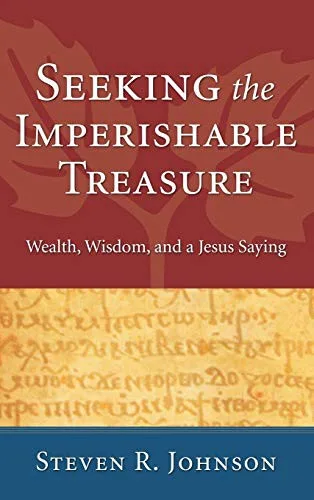
Seeking the Imperishable Treasure
 75
75

Seeking the Imperishable Treasure
Steven R. Johnson’s *Seeking the Imperishable Treasure* offers a welcome departure from the often-hazy narratives surrounding esoteric traditions. Johnson’s strength lies in his meticulous dissection of primary sources, presenting complex alchemical and Hermetic ideas with a clarity that belies their intricate nature. The chapter detailing the symbolism within the Rosarium Philosophorum, for instance, provides a particularly lucid breakdown of its allegorical layers. However, the book occasionally suffers from its own scholarly rigor, sometimes becoming dense for readers not already steeped in the specific terminology of Western esotericism. While the prose is generally precise, a more direct engagement with how these ancient concepts might inform contemporary spiritual seeking could have broadened its appeal. Nevertheless, for those committed to understanding the intellectual bedrock of these paths, it is an invaluable resource.
📝 Description
75
### What It Is Seeking the Imperishable Treasure by Steven R. Johnson, first published in 2008, is a scholarly examination of esoteric traditions. It offers a detailed exploration of foundational texts and concepts within Western esotericism, moving beyond superficial interpretations to engage with the core philosophical and spiritual underpinnings of these practices. The work aims to illuminate the consistent threads of ancient wisdom that persist across diverse occult and mystical movements.
### Who It's For This book is intended for serious students of esoteric history and philosophy, particularly those with an existing foundation in subjects like Hermeticism, Gnosticism, or alchemy. It appeals to readers who seek rigorous analysis and historical context rather than introductory overviews. Scholars, researchers, and dedicated practitioners looking to deepen their understanding of the lineage of Western mystical thought will find substantial material here.
### Historical Context Published in 2008, Johnson’s work emerged during a period of renewed academic and popular interest in esoteric studies. It engaged with scholarship building upon the foundational work of figures like Frances Yates and Antoine Faivre, who had previously mapped the terrain of Western esotericism. The book’s detailed analysis positions itself within ongoing scholarly debates about the definition and historical trajectory of occult traditions, offering a specific lens through which to view their development.
### Key Concepts The text investigates the concept of the 'Imperishable Treasure' not as a singular artifact, but as a metaphor for spiritual attainment and gnosis. It traces this idea through various historical expressions, including alchemical symbolism, Rosicrucian philosophy, and early modern mystical writings. Johnson highlights recurring archetypes and philosophical frameworks that underpin the pursuit of spiritual perfection and ultimate knowledge within these traditions.
💡 Why Read This Book?
• Gain a nuanced understanding of the 'Imperishable Treasure' as a spiritual goal, as explored through Johnson's analysis of alchemical texts like the Rosarium Philosophorum. • Grasp the historical lineage of Western esotericism, tracing concepts from Hermeticism and Gnosticism as detailed in the book's contextual sections. • Discover specific symbolic interpretations of alchemical processes, moving beyond metaphor to understand their philosophical implications as presented in the 2008 publication.
⭐ Reader Reviews
Honest opinions from readers who have explored this book.
❓ Frequently Asked Questions
What is the core philosophical concept of 'The Imperishable Treasure' in Steven R. Johnson's book?
In *Seeking the Imperishable Treasure*, the 'Imperishable Treasure' is presented not as a literal object, but as a metaphor for spiritual realization, ultimate knowledge (gnosis), and the attainment of spiritual perfection, central to many Western esoteric traditions.
What historical periods and movements does the book primarily focus on?
The book, published in 2008, largely focuses on the development of Western esotericism from the Renaissance through the early modern period, with significant attention to Hermeticism, Gnosticism, alchemy, and Rosicrucianism.
Is this book suitable for beginners in esoteric studies?
While offering clarity, the book assumes a certain familiarity with esoteric terminology and historical context. It is more suited for intermediate to advanced students seeking in-depth analysis rather than a general introduction.
Does Steven R. Johnson discuss specific alchemical texts?
Yes, the work engages with and analyzes key alchemical texts, notably the Rosarium Philosophorum, exploring their symbolic language and philosophical underpinnings in detail.
What distinguishes this book from other works on Western esotericism published around 2008?
Johnson's work is distinguished by its rigorous academic approach and its specific focus on the concept of spiritual attainment as an 'Imperishable Treasure,' offering a cohesive thematic analysis across diverse esoteric schools.
How does the book connect different esoteric traditions?
It bridges various traditions by identifying recurring philosophical motifs and symbolic language related to spiritual transformation, demonstrating how concepts from Hermeticism and Gnosticism informed later movements like Rosicrucianism.
🔮 Key Themes & Symbolism
The Alchemical Quest
The book meticulously unpacks the symbolic language of alchemy, portraying the Great Work not merely as material transmutation but as a profound spiritual journey. Johnson highlights how alchemical processes, from the Nigredo to the Rubedo, mirror stages of inner purification and the attainment of divine knowledge, a concept deeply rooted in Hermetic philosophy and Gnostic traditions.
Gnosis and Spiritual Attainment
Central to Johnson's thesis is the Gnostic pursuit of gnosis – direct, intuitive knowledge of the divine. The 'Imperishable Treasure' is framed as the ultimate goal of this quest, accessible through esoteric disciplines. The work explores how this concept manifests in various forms, from the alchemist's philosopher's stone to the mystic's direct apprehension of spiritual truths.
Hermetic Lineage
Johnson traces a clear lineage from ancient Hermetic texts, such as the Corpus Hermeticum, to later esoteric movements. He illustrates how the principles of 'as above, so below' and the pursuit of divine wisdom articulated by Hermes Trismegistus informed the philosophical underpinnings of Rosicrucianism and other Renaissance esoteric philosophies.
Symbolic Interpretation
A significant aspect of the book involves decoding the rich symbolic systems employed within esoteric traditions. Johnson delves into the meaning of specific symbols found in texts like the Rosarium Philosophorum, arguing that these are not arbitrary but represent precise stages and states of spiritual development and understanding.
💬 Memorable Quotes
“The true treasure is not found in external objects but in the internal transformation.”
— This paraphrased concept underscores the book's central theme: that the ultimate spiritual goal is an inner realization of divine knowledge, rather than an external achievement or material gain.
“Alchemy's stages mirror the soul's journey toward incorruptibility.”
— This captures the essence of Johnson's argument that alchemical symbolism is a map for spiritual development, where the processes described represent the purification and perfection of the human spirit.
“Gnosis is the key that unlocks the door to the Imperishable.”
— This highlights the Gnostic emphasis on direct, experiential knowledge as the means to achieve the ultimate spiritual state or the 'Imperishable Treasure' discussed in the book.
“Hermetic principles provide the foundational framework for later esoteric systems.”
— This interpretation emphasizes the book's exploration of how ancient Hermetic wisdom influenced subsequent mystical and occult traditions, providing a consistent philosophical bedrock.
“The symbols of the Art are keys to understanding the divine order.”
— This signifies the book's focus on the interpretive power of esoteric symbols, viewing them as encoded messages revealing fundamental truths about the cosmos and the spiritual path.
🌙 Esoteric Significance
Tradition
This work is firmly situated within the study of Western Esotericism, drawing heavily on Hermetic, Gnostic, and alchemical traditions. Johnson seeks to demonstrate the internal coherence and lineage of these often-disparate schools, presenting the 'Imperishable Treasure' as a unifying concept. It departs from purely historical accounts by emphasizing the practical and philosophical implications of these traditions for understanding spiritual attainment.
Symbolism
Key symbols explored include the Philosopher's Stone, representing ultimate spiritual perfection and wisdom, and the alchemical stages (Nigredo, Albedo, Rubedo), which symbolize the process of spiritual purification and transformation. The Ouroboros, often depicted in alchemical manuscripts, is also significant, representing cyclical completion and the eternal nature of the spiritual quest.
Modern Relevance
Contemporary practitioners of Hermeticism, ceremonial magic, and alchemical studies find value in Johnson's work for its detailed exploration of foundational concepts and symbolism. Thinkers and groups focused on comparative mysticism and the history of consciousness also draw upon its insights to understand the enduring appeal of spiritual quests across different eras.
👥 Who Should Read This Book
• Students of Hermeticism and Alchemy: Those seeking to understand the philosophical underpinnings and symbolic language of these traditions will find detailed analysis of core texts and concepts. • Researchers of Western Esotericism: Scholars and enthusiasts interested in the historical development and intellectual connections between Renaissance and early modern mystical movements will benefit from its contextualization. • Dedicated Spiritual Seekers: Individuals on a path of inner development who wish to explore the historical expressions of spiritual attainment and gnosis, moving beyond superficial interpretations.
📜 Historical Context
Steven R. Johnson’s *Seeking the Imperishable Treasure*, published in 2008, entered a scholarly landscape shaped by figures like Frances Yates, whose work illuminated the Renaissance esoteric tradition, and Antoine Faivre, who defined the field of Western Esotericism. Johnson’s book contributes to this ongoing academic discourse by providing a detailed examination of specific symbolic and philosophical threads. It emerged at a time when interest in occultism and mysticism was growing, both academically and among the general public. The work engages with the intellectual currents that sought to understand the historical continuity and evolution of esoteric thought, positioning itself as a rigorous exploration of primary sources. While not facing overt censorship, esoteric literature generally operates outside mainstream academic acceptance, often requiring careful contextualization within historical and philosophical frameworks, a task Johnson undertakes with precision, referencing the foundational importance of Hermeticism and Gnosticism.
📔 Journal Prompts
The alchemical journey as a metaphor for personal transformation.
Reflecting on the concept of gnosis in relation to personal spiritual experience.
The Hermetic principle of 'as above, so below' in everyday life.
Interpreting the symbolism of the Ouroboros in the context of cyclical change.
The pursuit of the 'Imperishable Treasure' in contemporary spiritual practice.
🗂️ Glossary
Gnosis
A Greek term referring to knowledge, particularly intuitive, experiential, or spiritual knowledge of the divine. In esoteric contexts, it signifies direct apprehension of ultimate truths.
Hermeticism
A religious, philosophical, and esoteric tradition based primarily upon writings attributed to Hermes Trismegistus. It emphasizes divine wisdom, the interconnectedness of all things, and spiritual ascent.
Alchemy
An ancient tradition practiced in Europe, Africa, and Asia. It involved the use of symbolic alchemical processes aimed at achieving spiritual transformation, often referred to as the Great Work, alongside material transmutation.
Rosicrucianism
A mystical and esoteric movement that originated in early 17th-century Europe. It is associated with secret brotherhoods, spiritual illumination, and the pursuit of esoteric knowledge, often blending Hermetic, alchemical, and Kabbalistic elements.
Nigredo
The first stage in the alchemical process, often symbolized by blackness or putrefaction. It represents dissolution, chaos, and the breakdown of the old self, a necessary precursor to spiritual regeneration.
Rubedo
The final stage in the alchemical process, symbolized by redness. It signifies perfection, the attainment of the Philosopher's Stone, and spiritual rebirth or enlightenment.
Corpus Hermeticum
A collection of twenty-one philosophical and religious treatises attributed to Hermes Trismegistus. These texts are foundational to Hermetic philosophy and Western esotericism.