Revolting rhymes
 80
80

Revolting rhymes
Roald Dahl’s *Revolting Rhymes* offers a bracingly irreverent take on fairy tales, transforming them into something far more jagged and amusing than their original forms. The sheer audacity of his reimagining, particularly in the late 20th century, is its primary strength. For instance, the reimagining of 'Little Red Riding Hood' where the wolf is graphically dispatched by a resourceful Red is both shocking and cathartic. However, the collection’s consistent tone, while effective, can occasionally feel a bit one-note, leaning heavily on shock value without always exploring deeper thematic implications beyond the initial subversion. The rapid-fire pacing leaves little room for lingering on the moral quandaries presented. Nevertheless, *Revolting Rhymes* remains a potent, darkly comic, and memorable literary prank.
📝 Description
80
Roald Dahl's *Revolting Rhymes* (1982) offers dark humor by twisting familiar fairy tales.
Published in 1982, Roald Dahl's *Revolting Rhymes* reimagines classic fairy tales with a cynical and violent humor that departs from traditional sanitized versions. These retellings are not for the easily unsettled; they challenge the moral assumptions in well-known narratives. Dahl injects a modern, adult sensibility into stories like those of Snow White, Cinderella, and Jack, flipping their archetypal roles and conventional endings.
The collection appeals to readers who enjoy satire and a sharp dismantling of cultural narratives. Those familiar with Dahl's distinct wit and macabre leanings will find those qualities present, amplified for a more mature audience. The book engages with how established folklore can be reshaped to reflect contemporary attitudes and question traditional storytelling structures.
While not strictly an esoteric text, *Revolting Rhymes* taps into a postmodern impulse to deconstruct and reframe established cultural narratives, including the foundational myths and fairy tales that shape collective understanding. Its early 1980s publication aligns with a period where questioning traditional authorities and forms was common in literature. Dahl's work, by exposing underlying moral ambiguities and injecting a more visceral, less sentimental tone, echoes a broader cultural shift towards embracing complex interpretations of stories that have long served as archetypal frameworks.
💡 Why Read This Book?
• Gain a fresh, critical perspective on the familiar fairy tales you grew up with, understanding how their narratives can be deconstructed and reinterpreted, as seen in the aggressive re-telling of 'Jack and the Beanstalk'. • Experience Dahl's signature dark humor and mordant wit applied to classic folklore, providing a unique comedic sensibility that challenges conventional storytelling, exemplified by the fate of the Big Bad Wolf in 'The Three Little Pigs'. • Appreciate how literary works can engage with and alter cultural touchstones, demonstrating the power of narrative to provoke and entertain simultaneously, a core function evident throughout the 1982 publication.
⭐ Reader Reviews
Honest opinions from readers who have explored this book.
❓ Frequently Asked Questions
What fairy tales are included in Roald Dahl's Revolting Rhymes?
The collection features retellings of several classic tales, including 'Snow White', 'Jack and the Beanstalk', 'Goldilocks and the Three Bears', 'Little Red Riding Hood', 'The Three Little Pigs', and 'Cinderella'. Each is presented with Dahl's characteristic dark humor and unexpected twists.
When was Revolting Rhymes first published?
Roald Dahl's Revolting Rhymes was first published in 1982 by Jonathan Cape, marking a significant year for his later works exploring more mature themes.
Is Revolting Rhymes suitable for young children?
While based on children's stories, Revolting Rhymes contains violence, dark humor, and adult themes not typically found in traditional fairy tales. It is generally considered more suitable for older children and adults.
What is Roald Dahl's writing style like in Revolting Rhymes?
Dahl's style here is characterized by witty, often biting, rhyme schemes, a cynical outlook, and a penchant for the macabre. He delights in subverting expectations and adding gruesome or humorous twists to familiar plots.
Who illustrated the original edition of Revolting Rhymes?
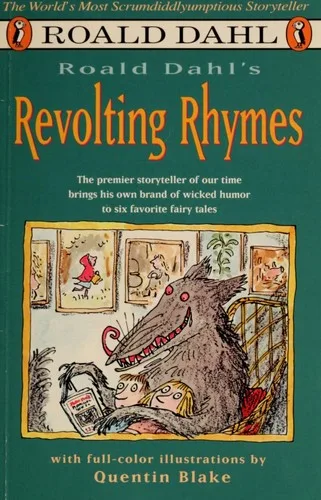
The original 1982 edition of Revolting Rhymes was illustrated by Quentin Blake, a frequent collaborator with Roald Dahl, whose distinctive style perfectly complemented Dahl's subversive text.
Does Revolting Rhymes offer any social commentary?
Yes, the collection implicitly comments on the sanitization of classic stories and the often-hidden violence or moral ambiguity within them. By exposing these elements, Dahl encourages a more critical engagement with traditional narratives.
🔮 Key Themes & Symbolism
Subversion of Archetypes
Dahl systematically dismantles the predictable roles of fairy tale characters. The meek become aggressive, the villainous are outsmarted in brutal ways, and the damsel in distress often proves more capable than her rescuer. This theme is central to the collection, challenging the reader's preconceived notions of heroism and villainy. For example, Snow White is depicted as a resourceful character who turns the tables on her hunter, a stark departure from her passive original portrayal.
Dark Humor and Morbidity
A pervasive element of black comedy infuses every rhyme. Dahl finds amusement in the grotesque and the unexpected, often juxtaposing childlike rhyme schemes with violent or unsettling outcomes. This creates a unique comedic effect that appeals to an adult sensibility. The graphic demise of the Big Bad Wolf in 'The Three Little Pigs' is a prime example, played for laughs despite its gruesome nature.
Narrative Expectation vs. Reality
The collection plays on the reader's familiarity with traditional fairy tale structures. Dahl sets up the expectation of a conventional plot progression, only to abruptly veer into a surprising, often grim, conclusion. This technique highlights the artificiality of narrative conventions and encourages a more critical, less passive, engagement with stories. The unexpected survival and subsequent actions of Cinderella's fairy godmother exemplify this manipulation of reader expectation.
Moral Ambiguity
By emphasizing the violent or self-serving actions of characters, Dahl blurs the lines between good and evil. The 'heroes' of his tales often achieve their ends through questionable means, while the 'villains' are sometimes victims of circumstance or their own predictable natures. This lack of clear moral didacticism encourages readers to question simplistic notions of right and wrong, reflecting a more complex, modern worldview.
💬 Memorable Quotes
Direct passages from the work, attributed to the author.
“So she took the wolf’s head and with a grin / She placed it on the Prince’s chin.”
— This demonstrates the shocking and often nonsensical twists Dahl introduces, subverting any expectation of a romantic or happy ending. It plays on the absurdity of the fairy tale logic.
“‘I’m going to be a dancer!’ she cried. / ‘And I shall have a baby,’ she cried.”
— This interpretation of Cinderella's post-ball aspirations shows a departure from traditional fantasy fulfillment, grounding her desires in more earthly, albeit still ambitious, pursuits.
“She cooked him in the oven hot / And gave him to the wolves to pot.”
— This chillingly pragmatic and violent end for the wolf in 'The Three Little Pigs' showcases Dahl's willingness to push boundaries, turning a children's story into a dark, almost cautionary, piece.
💡 Key Ideas
Editorial paraphrase of the work's core concepts — not direct quotes.
Now, it is a sad fact that not all wolves have been good; some have been very bad indeed.
This line sets the stage for Dahl's deconstruction, immediately signaling that the familiar, often-demonized wolf archetype will be presented with a more direct, perhaps even justified, brutality.
Then she took her sharpest knife / And cut the wolf’s guts out with glee.
This quote from the 'Little Red Riding Hood' retelling exemplifies the extreme violence and dark humor Dahl employs. The 'glee' highlights the subversive and adult nature of the humor, far removed from innocent children's tales.
🌙 Esoteric Significance
Tradition
While not directly aligned with a specific esoteric lineage like Hermeticism or Kabbalah, *Revolting Rhymes* engages with the archetypal power of folklore, a domain often explored within comparative mythology and Jungian psychology, which have strong ties to esoteric thought. The collection's deconstruction of fairy tales can be seen as a modern Gnostic act, stripping away comforting illusions to reveal a more raw, perhaps 'true,' underlying structure of human drama and morality.
Symbolism
The wolf, a recurring symbol, transforms from a simple predator into a figure of predictable fate or even a victim of circumstance, reflecting a departure from simplistic good-vs-evil symbolism. Fairy godmothers, typically benevolent guides, are depicted with agency and sometimes sinister undertones, questioning the nature of divine intervention or helpful magic. The 'golden eggs' from the Jack and the Beanstalk retelling, while seemingly a symbol of wealth, are presented in a context of ruthless acquisition, challenging the purity of such symbols.
Modern Relevance
Contemporary retellings in literature, film, and television frequently borrow from Dahl's approach of subverting familiar narratives with adult themes and dark humor. Thinkers and practitioners interested in Jungian archetypes or the psychological underpinnings of folklore find Dahl's work a provocative starting point for analyzing how these ancient stories continue to resonate and can be reshaped to reflect modern anxieties and moral complexities.
👥 Who Should Read This Book
• Readers interested in the deconstruction of Western folklore and fairy tales, who seek to understand how classic narratives can be critically re-examined through a modern, satirical lens. • Fans of Roald Dahl's distinct literary voice, particularly those who appreciate his blend of dark humor, macabre wit, and unconventional storytelling, and wish to see it applied to familiar children's classics. • Students of literature and cultural studies seeking examples of postmodern narrative techniques and the subversion of archetypes, using the 1982 publication as a case study.
📜 Historical Context
Roald Dahl's *Revolting Rhymes*, published in 1982, arrived during a period when postmodern literary techniques, including the deconstruction of familiar narratives, were gaining traction. While Dahl himself was not typically associated with academic postmodernism, his playful yet pointed subversion of classic fairy tales tapped into a cultural zeitgeist that questioned established forms and authorities. The book was published by Jonathan Cape, a respected house known for literary fiction, indicating its reception as more than just a children's novelty. Contemporaries like Angela Carter had already begun exploring darker, feminist retellings of fairy tales in works such as *The Bloody Chamber* (1979), creating a literary landscape where such reinterpretations were becoming more visible and accepted. Although not facing significant censorship, the book's reception highlighted a growing adult appreciation for challenging children's literature, pushing boundaries and provoking thought through humor and shock.
📔 Journal Prompts
The wolf's transformation from simple villain to a more complex figure.
Cinderella's redefined aspirations beyond marriage.
The ethical implications of Red Riding Hood's actions.
The symbolic meaning of the golden eggs in Jack's story.
The fairy godmother's shift in character portrayal.
🗂️ Glossary
Archetype
In literature and psychology, a universal, inherited pattern of thought or imagery derived from the collective unconscious. Fairy tales often rely heavily on archetypes like the hero, the villain, and the damsel in distress.
Subversion
The act of undermining or overthrowing an established system, belief, or tradition. In literature, this often involves twisting or inverting familiar tropes and narratives.
Deconstruction
A critical approach that analyzes the underlying assumptions and contradictions within a text, often revealing multiple or unstable meanings, and questioning binary oppositions.
Folklore
The traditional beliefs, customs, and stories of a community, passed through the generations by word of mouth. Fairy tales are a prominent form of folklore.
Macabre
Having a grim or ghastly atmosphere; dealing with or representing death in a way that involves a mixture of horror, amusement, and morbid fascination.
Satire
The use of humor, irony, exaggeration, or ridicule to expose and criticize people's stupidity or vices, particularly in the context of contemporary politics and other topical issues.
Postmodernism
A philosophical and cultural movement characterized by skepticism towards grand narratives, a focus on fragmentation, irony, and the interrelation of different forms of discourse.
🔮 Readers Also Liked
Browse all →









More by Roald Dahl
All books →





More Free Occult Philosophy Books
View all →