Pseudodoxia epidemica

 71
71

Pseudodoxia epidemica
Sir Thomas Browne's *Pseudodoxia Epidemica* offers a fascinating glimpse into the mind of a 17th-century intellectual grappling with an era's accepted truths. While its title suggests a focus on quaint curiosities, the work is a rigorous, if sometimes digressive, exercise in critical thinking. Browne's strength lies in his erudition and his elegant, often humorous, prose as he dismantles popular myths. For instance, his methodical dissection of the belief that Saint Anthony's fire was a singular phenomenon, rather than a symptom of ergotism, showcases his physician's eye for detail and his scholarly approach to historical accounts. However, the book's sheer breadth and the detailed nature of its arguments can occasionally overwhelm the modern reader, requiring significant patience and a deep interest in the specific errors being addressed. The limitation lies not in Browne's intellect, but in the density of his inquiry, which can sometimes obscure the broader methodological points. Ultimately, *Pseudodoxia Epidemica* is a valuable historical document demonstrating the early application of critical analysis to received wisdom.
📝 Description
71
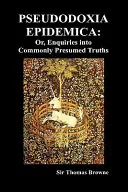
Sir Thomas Browne's Pseudodoxia Epidemica, published in 1669, dissects common 17th-century misconceptions.
Pseudodoxia Epidemica, published in 1669, is Sir Thomas Browne's detailed investigation into widely held but incorrect beliefs prevalent in his time. Browne, a physician and writer, applies his sharp intellect to examine a broad range of subjects, including biblical accounts, historical narratives, natural phenomena, and zoological oddities. He systematically questions popular notions, tracing their origins and showing their lack of factual support through careful research and references to both ancient and contemporary sources.
The book suits readers interested in early modern intellectual history, the development of science, and the history of critical thinking. It will appeal to those who observe how common ideas form, face scrutiny, and persist. Individuals who value learning, skepticism, and clear writing will find much to appreciate. It is for the diligent reader who enjoys detailed arguments and a thorough examination of topics that might seem minor.
While not a text of magic or occult practices, Pseudodoxia Epidemica engages with the broader intellectual currents of its time, a period where the lines between natural philosophy, folklore, and early scientific inquiry were still being drawn. Browne's method of critical examination of established beliefs, even those rooted in classical texts or religious tradition, reflects a nascent skepticism that would inform later scientific thought. His work sits within a tradition of intellectual challenge, where accepted verities were being questioned through observation and reason, a precursor to more focused esoteric traditions that would later emerge.
💡 Why Read This Book?
• Understand the historical roots of critical thinking by examining Browne's methods for debunking 'vulgar errors' prevalent in the 17th century, a practice vital for early scientific discourse. • Gain insight into the cultural and intellectual landscape of post-Restoration England through Browne's engagement with biblical interpretations, classical authorities, and contemporary folklore. • Appreciate the art of scholarly argumentation and elegant prose by studying Browne's detailed inquiries, such as his chapter on the age of the world, which reveals his meticulous research and witty style.
⭐ Reader Reviews
Honest opinions from readers who have explored this book.
❓ Frequently Asked Questions
What kind of 'epidemics' does Pseudodoxia Epidemica discuss?
The 'epidemics' Browne refers to are not diseases, but widespread, commonly held false beliefs or 'vulgar errors.' He meticulously investigates and debunks numerous popular misconceptions prevalent in 17th-century England, ranging from zoological myths to historical inaccuracies.
Is Pseudodoxia Epidemica a religious text?
While Browne engages with biblical narratives and theological concepts, *Pseudodoxia Epidemica* is primarily a work of skeptical inquiry and natural philosophy, not a devotional text. He uses scripture as one source among many to examine and correct erroneous popular interpretations.
What is Browne's primary method in Pseudodoxia Epidemica?
Browne's method involves tracing the origin of erroneous beliefs, examining historical and textual evidence, applying logical reasoning, and often referencing his own medical and scientific observations. He systematically questions commonly accepted 'truths'.
Who was Sir Thomas Browne, and when did he write Pseudodoxia Epidemica?
Sir Thomas Browne (1605-1682) was an English physician, philosopher, and writer. *Pseudodoxia Epidemica* was first published in 1669, during a period of significant intellectual and scientific advancement in England.
Does Pseudodoxia Epidemica contain esoteric or occult knowledge?
While Browne discusses various phenomena that might be considered unusual or superstitious by modern standards, the book's primary aim is to debunk errors, not to promote occult practices. Its value lies in its rational approach to knowledge.
What kind of topics does Browne debunk in Pseudodoxia Epidemica?
Browne addresses a vast range of topics, including the existence of griffins, the belief that ostriches digest iron, the age of the world according to various traditions, and the notion that salamanders can live in fire.
🔮 Key Themes & Symbolism
The Nature of Error
Browne meticulously dissects how popular beliefs, or 'vulgar errors,' become entrenched. He demonstrates that many widely accepted notions originate from a single misstatement, a mistranslation, or a faulty interpretation that gains authority through repetition. His approach isn't merely to correct facts but to understand the psychology and sociology of belief formation. He examines how tradition and deference to ancient authorities, even when flawed, contribute to the propagation of misinformation. This theme is central to his project of establishing a more reliable epistemology, grounding knowledge in verifiable evidence rather than hearsay.
Skepticism and Reason
A foundational theme is the application of rigorous skepticism and logical reasoning to challenge accepted wisdom. Browne, a physician trained in empirical observation, applies a critical lens to historical accounts, biblical interpretations, and natural phenomena. He advocates for verification and warns against blind acceptance of authority, whether classical or contemporary. His work serves as an early model for critical inquiry, demonstrating that even deeply ingrained beliefs warrant examination. This emphasis on rational investigation aligns with the burgeoning scientific spirit of the late 17th century, though Browne’s methods remain distinctly literary and philosophical.
The Authority of Texts
Browne critically examines the reliability of various sources of knowledge, from the Bible and classical literature to folklore and popular sayings. He highlights instances where mistranslations, misinterpretations, or the uncritical acceptance of ancient texts have led to widespread errors. His analysis often involves comparing different versions of accounts or tracing a statement back to its likely original source, revealing how texts themselves can become conduits for misinformation. This theme underscores the importance of source criticism and careful textual analysis in establishing accurate understanding.
Folklore and Superstition
The book looks at a wide array of folklore, superstitions, and popular beliefs prevalent in 17th-century England and Europe. Browne addresses myths about animals (like griffins and salamanders), supposed medicinal properties of objects, and historical legends. While he approaches these with a critical eye, his detailed exploration provides a valuable record of the beliefs that shaped the popular imagination of his time. His work can be seen as an early attempt to catalog and analyze the cultural narratives that underpinned everyday life, separating verifiable fact from imaginative embellishment.
💬 Memorable Quotes
Direct passages from the work, attributed to the author.
“To be of a believing disposition, without examination, is the ready way to be deceived.”
— Browne emphasizes the danger of uncritical acceptance. He suggests that a natural inclination to believe, without employing reason and evidence, makes individuals susceptible to misinformation and error.
“There are many things which seem probable, which are not true.”
— This highlights the deceptive nature of appearances and common opinion. Browne warns that plausibility alone is insufficient grounds for belief; rigorous investigation is necessary to discern truth from falsehood.
“That salamanders live in the fire, is an opinion of great antiquity, and hath been confirmed by divers authors.”
— Browne uses this example to illustrate a popular 'vulgar error' he proceeds to debunk. The quote shows his method of acknowledging a widespread belief and then systematically dismantling it with evidence.
“The Scripture is not so much to be esteemed for the antiquity thereof, as for the divinity.”
— Here, Browne argues that the value of religious texts lies in their divine origin and truth, not merely their age. This reflects his nuanced approach to scripture, valuing faith while insisting on rational understanding.
💡 Key Ideas
Editorial paraphrase of the work's core concepts — not direct quotes.
Many vulgar errors take their root from a single author, which being once spoken, is credited and presumed to be true by posterity.
This quote expresses Browne's core argument: that many widely accepted falsehoods originate from a single, unverified statement that gains traction and is assumed true simply because it has been repeated over time.
🌙 Esoteric Significance
Tradition
While not a text of occultism in the modern sense, *Pseudodoxia Epidemica* shares intellectual roots with Hermetic philosophy's emphasis on discerning truth and understanding the hidden workings of the world. Browne's meticulous deconstruction of errors can be seen as a form of purification of knowledge, akin to alchemical processes that refine base matter into gold. His work engages with traditions that sought hidden meanings, but it does so through rational critique rather than mystical invocation, marking a transition toward empirical verification within the broader Western intellectual heritage.
Symbolism
The 'vulgar errors' themselves function as symbols of corrupted knowledge or flawed perception. Browne's debunking of myths, such as the belief that salamanders live in fire, symbolizes the triumph of reason over superstition and the uncovering of natural truths obscured by folklore. The act of tracing an error's lineage can be seen as a symbolic journey through intellectual history, revealing how falsehoods propagate. His methodical approach represents the symbol of the physician-scholar diligently diagnosing and treating the 'diseases' of ignorance.
Modern Relevance
Contemporary thinkers in fields like the history of science, critical thinking, and media literacy find Browne's work profoundly relevant. His methods for analyzing the spread of misinformation and the psychology of belief are directly applicable to understanding modern phenomena like conspiracy theories and fake news. Scholars examining the transition from Renaissance humanism to the Scientific Revolution often cite *Pseudodoxia Epidemica* as a key text. The book continues to inspire those who advocate for evidence-based reasoning and the rigorous questioning of widely accepted narratives.
👥 Who Should Read This Book
• Early Modern Intellectual Historians: Those studying the 17th century will find a primary source revealing the intellectual currents, common beliefs, and nascent critical methodologies of the era. • Students of Skepticism and Epistemology: Readers interested in the development of critical thinking and how knowledge claims are validated will benefit from Browne's systematic approach to debunking errors. • Enthusiasts of Historical Medicine and Natural Philosophy: Individuals curious about how physicians and scholars understood the natural world and human ailments in the pre-modern scientific era will find detailed examinations of relevant topics.
📜 Historical Context
Published in 1669, *Pseudodoxia Epidemica* emerged during the Restoration period in England, a time marked by the re-establishment of monarchy and a flourishing of intellectual inquiry following the Commonwealth. The Royal Society, founded in 1660, championed empirical observation and the scientific method, creating an environment conducive to challenging traditional beliefs. Sir Thomas Browne, a respected physician and writer, participated in this intellectual climate by applying a critical, almost proto-scientific, methodology to a vast array of popular misconceptions. His work stands as a significant contribution to the history of skepticism and epistemology, predating the widespread dissemination of Enlightenment rationalism. While figures like Isaac Newton were beginning to lay the groundwork for modern physics, Browne focused on the critical examination of received knowledge. The book was well-received, going through multiple editions and influencing subsequent thinkers concerned with the discernment of truth.
📔 Journal Prompts
The propagation of 'vulgar errors' in Pseudodoxia Epidemica.
Browne's critique of relying solely on antiquity for truth.
The function of textual analysis in Browne's debunking method.
The role of physicians in challenging popular misconceptions.
Identifying a modern 'vulgar error' using Browne's investigative framework.
🗂️ Glossary
Vulgar Errors
Commonly held but incorrect beliefs or misconceptions that have become widespread within a society, often lacking factual or scientific basis.
Natural Philosophy
The historical term for the study of nature and the physical universe, encompassing what we now call science. It involved observation, experimentation, and theoretical reasoning.
Antiquity
The ancient past, typically referring to classical Greek and Roman civilizations, whose writings and perceived wisdom were often highly regarded in earlier periods.
Ergotism
A disease caused by consuming grains infected with the ergot fungus, leading to various symptoms including hallucinations, convulsions, and gangrene. Browne discusses it in relation to 'Saint Anthony's Fire'.
Griffin
A legendary creature with the body, tail, and back legs of a lion; the head and wings of an eagle; and an eagle's talons as its front feet. Browne investigates its supposed existence.
Salamander
In folklore, a lizard-like creature said to be able to live in fire. Browne addresses this popular myth as a 'vulgar error'.
Epistemology
The branch of philosophy concerned with the theory of knowledge, investigating its nature, scope, and justification. Browne's work engages with epistemological questions.
🔮 Readers Also Liked
Browse all →









More by Thomas Browne
All books →
More Free Occult Philosophy Books
View all →