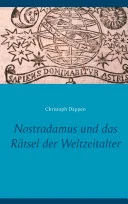
Nostradamus und das Rätsel der Weltzeitalter
 76
76

Nostradamus und das Rätsel der Weltzeitalter
Christoph Däppen’s "Nostradamus und das Rätsel der Weltzeitalter" challenges the prevalent view of Nostradamus as solely a prophet of doom. The book’s strength lies in its rigorous examination of the "Centuries," proposing that most quatrains refer to past events. Däppen’s argument hinges on identifying subtle anachronisms, a fascinating approach that reframes the seer’s work. However, the text occasionally feels overly academic, potentially alienating readers seeking more direct esoteric revelation. The analysis of specific quatrains, particularly those concerning temporal discrepancies, offers a compelling alternative to standard interpretations. While it doesn't shy away from the esoteric, its primary focus remains textual and historical analysis. This work offers a valuable, albeit demanding, perspective on a figure frequently relegated to sensationalism.
📝 Description
76
### Unpacking Nostradamus's Chronological Conundrums This work offers a re-evaluation of Michel de Nostredame's prophetic quatrains, moving beyond typical eschatological interpretations. It posits that the majority of his verses concern events already past, rather than future apocalypses. The central argument focuses on identifying subtle anachronisms within the "Centuries" that, when analyzed, suggest a re-contextualization of their historical timeline.
### For the Skeptical Seeker This book is suited for readers who approach prophecy with a critical eye, particularly those interested in the historical reception and analysis of Nostradamus's work. It appeals to individuals who question conventional timelines and seek to understand how historical narratives can be subtly reinterpreted through textual anomalies. It is for those who appreciate meticulous textual analysis applied to esoteric subjects.
### Historical Contextualization of Prophecy The book places Nostradamus's "Centuries," first published in 1555, within its historical milieu. It contrasts the common focus on future predictions with an examination of the text's relationship to known historical events preceding its composition. The work explores how the perceived accuracy of prophecies often stems from retroactive interpretation, but argues for a deeper chronological puzzle embedded within the quatrains themselves.
### The Anachronism Hypothesis The core concept explored is the "anachronism hypothesis," suggesting that certain phrases or allusions within the quatrains do not align with the period Nostradamus himself inhabited. By highlighting these temporal discrepancies, the book proposes that the quatrains may offer a coded commentary on historical periods other than the 16th century, prompting a re-examination of established historical understanding through the lens of prophetic literature.
💡 Why Read This Book?
• Gain a novel perspective on Nostradamus's "Centuries," understanding the author's hypothesis that most quatrains reference past events, not just future apocalypses. • Learn to identify subtle anachronisms within prophetic texts, a critical skill for deconstructing esoteric literature and understanding historical narrative manipulation. • Explore the historical context of Michel de Nostredame's work, appreciating how texts published in 1555 can be re-examined through a chronological lens beyond their immediate era.
⭐ Reader Reviews
Honest opinions from readers who have explored this book.
❓ Frequently Asked Questions
What is the main argument of "Nostradamus und das Rätsel der Weltzeitalter" regarding the quatrains?
The book argues that most of Nostradamus's quatrains refer to historical events already in the past, rather than solely predicting the future. It highlights subtle anachronisms within the text as evidence for this reinterpretation.
Who was Nostradamus and when did he live?
Michel de Nostredame, known as Nostradamus, was a French astrologer, physician, and reputed seer who lived from 1503 to 1566. He is famous for his book "Les Prophéties" (The Prophecies).
What does the book mean by 'anachronisms' in Nostradamus's work?
Anachronisms are elements in the text that are out of place chronologically. Däppen suggests Nostradamus included subtle references or language that doesn't fit the 16th century, implying a deeper, possibly coded, historical commentary.
Is this book about predicting the end of the world?
No, the book specifically moves away from the common focus on apocalyptic predictions. It proposes that the 'Weltzeitalter' (ages of the world) are better understood through historical analysis of the quatrains rather than eschatological forecasting.
What historical period does the book suggest Nostradamus's quatrains might primarily refer to?
While not exclusively limited, the book implies that many quatrains, due to the identified anachronisms, may be re-contextualized to refer to events significantly preceding or surrounding Nostradamus's lifetime, challenging the standard historical narrative.
What is the significance of the 'Centuries' mentioned in the book?
The 'Centuries' refers to Nostradamus's collection of quatrains, organized into groups of one hundred. This is the primary text analyzed in the book to uncover its chronological riddles and historical dimensions.
🔮 Key Themes & Symbolism
Chronological Anachronisms
The work centers on the hypothesis that Nostradamus's "Centuries" contain subtle anachronisms – details that do not align with the 16th century. Däppen argues these are not errors but deliberate clues suggesting the quatrains relate more to past events than future ones. This challenges interpretations focused solely on eschatology, proposing a sophisticated chronological puzzle within the prophetic verses themselves, inviting a re-evaluation of historical timelines through textual anomalies.
Reinterpreting Prophecy
Rather than viewing Nostradamus as a pure predictor of future cataclysms, this book reframes his work as a commentary on history. It suggests that the perceived accuracy of his prophecies often arises from retroactive interpretation of past events. By focusing on internal textual inconsistencies, the book offers a method for understanding prophecy not as foretelling, but as a coded reflection on historical epochs.
Historical Dimensions
The book emphasizes uncovering the 'true historical dimension' of Nostradamus's prophecies. It moves beyond sensationalism to engage with the "Centuries" as a text deeply embedded in its historical context, yet possessing layers that transcend it. The analysis aims to reveal how these quatrains might offer a different perspective on well-known historical periods by highlighting overlooked chronological details.
The Riddle of Ages
The 'Rätsel der Weltzeitalter' (Riddle of the Ages) refers to the complex temporal puzzle presented by the quatrains. Däppen suggests that Nostradamus encoded a unique understanding of historical cycles and events within his verses. Solving this riddle involves deciphering the anachronisms to understand which historical periods the "Centuries" truly illuminate, prompting a deeper contemplation of time and history itself.
💬 Memorable Quotes
“His famous quatrains deal almost exclusively with events that are already long past.”
— This statement encapsulates the book's core thesis: that the common focus on Nostradamus as a future-seer is misguided. Däppen posits that the majority of the seer's verses are historical commentaries, not predictions.
“Subtle anachronisms slumber deep within the Centuries.”
— This highlights the central methodology of the book. It suggests that the clues to reinterpreting Nostradamus are not obvious but hidden within linguistic or conceptual inconsistencies that require careful analysis.
“Throwing a completely different light on supposedly well-known history.”
— This phrase points to the transformative potential of Däppen's analysis. By identifying anachronisms, the book aims to fundamentally alter our understanding of historical events and narratives previously considered settled.
“The work offers the opportunity to discover the true historical dimension of Nostradamus's prophecies.”
— This is an interpretation of the book's stated goal. It emphasizes that the research provides a pathway to a more accurate, historically grounded understanding of the seer's cryptic verses.
“We will, based on the chronology hidden in the Centuries...”
— This suggests a method of investigation. The book proposes that a hidden chronological framework exists within Nostradamus's work, which, when uncovered, reveals its true meaning and historical scope.
🌙 Esoteric Significance
Tradition
This work engages with the Hermetic tradition by focusing on textual interpretation and hidden meanings, akin to alchemical exegesis. While not strictly Kabbalistic, its approach to deciphering coded language within a historical text aligns with methods used in esoteric studies. It departs from purely predictive modes often associated with popular prophecy, instead offering a method of historical and symbolic analysis applicable to esoteric literature.
Symbolism
The 'anachronism' itself functions as a key symbol, representing a subtle disruption in the perceived historical continuum. The 'Centuries' (Centuries) symbolize the vast scope of historical time Nostradamus purportedly addresses. The 'riddle' (Rätsel) symbolizes the hidden knowledge or deeper truth embedded within the text, waiting to be unlocked through critical analysis and esoteric interpretation.
Modern Relevance
Däppen's approach resonates with contemporary scholars and practitioners interested in critical esotericism and the history of ideas. It offers a framework for analyzing occult texts not just for their predictive power, but for their historical context and internal logic. Thinkers exploring the philosophy of history or the semiotics of prophecy might find value in its method of deconstruction.
👥 Who Should Read This Book
• Students of Western Esotericism interested in textual analysis methods applied to prophetic literature. • Historians and researchers of Renaissance occultism seeking alternative interpretations of Michel de Nostredame's work beyond standard eschatology. • Critical thinkers who appreciate rigorous arguments questioning established historical narratives through detailed textual examination.
📜 Historical Context
Christoph Däppen’s "Nostradamus und das Rätsel der Weltzeitalter," published in 2017, emerges in an era saturated with popular interest in Nostradamus, often focused on apocalyptic predictions. This work contrasts sharply with sensationalist interpretations and the more academic historical analyses prevalent since the mid-20th century, such as those by scholars like Frances Yates who explored Nostradamus in the context of Renaissance occultism. Däppen’s book engages with the "Centuries," first published in 1555 by Michel de Nostredame. While scholars like Yates contextualized Nostradamus within Hermeticism and Renaissance esotericism, Däppen's contribution lies in proposing a specific chronological reinterpretation based on textual anachronisms. The book implicitly engages with historical skepticism towards prophecy while offering a unique analytical lens, diverging from contemporaries who might focus on numerology or astrological alignments alone.
📔 Journal Prompts
The concept of chronological anachronisms in Nostradamus's quatrains.
Nostradamus's "Centuries" as a historical commentary versus a prophetic text.
The implications of identifying anachronisms for understanding historical periods.
The role of retroactive interpretation in validating prophecies.
How subtle textual clues can challenge established historical understanding.
🗂️ Glossary
Anachronism
An element (e.g., word, object, idea) in a text or narrative that belongs to a different historical period than the one being depicted or discussed.
Quatrain
A stanza of four lines, especially one having a rhyme scheme in which the first and third lines rhyme, and the second and fourth lines rhyme (ABAB) or alternate rhymes (ABCB).
Centuries
Refers to Nostradamus's collection of quatrains, organized into groups of one hundred, titled "Les Prophéties" (The Prophecies).
Weltzeitalter
German for 'ages of the world' or 'epochs'. In this context, it refers to the historical periods Nostradamus's prophecies are believed to address.
Eschatology
The theological study of the end times, final events of history, or the ultimate destiny of humanity and the world.
Retroactive Interpretation
The practice of interpreting past events or texts in light of knowledge or understanding gained later, often leading to perceived confirmations of predictions.
Historical Dimension
The aspect of a text or event that relates to its specific historical context, influences, and impact on the course of history.