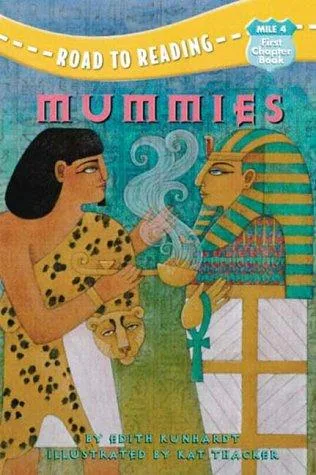
Mummies
 83
83

Mummies
Edith Kunhardt’s *Mummies* presents a straightforward account of a subject often sensationalized. The book’s strength lies in its unadorned, factual presentation of the mummification process, particularly within its primary context of Ancient Egypt. Kunhardt avoids speculative leaps, grounding the narrative in archaeological and historical evidence. A particularly effective section details the specific stages of organ removal and preservation, demystifying the procedure. However, the work occasionally feels too focused on the mechanical aspects, sometimes neglecting to fully explore the broader philosophical or spiritual implications that have made mummies such enduring cultural touchstones. While Kunhardt meticulously describes the 'how,' the 'why' from a deeply personal, humanistic perspective could have been further illuminated. Nonetheless, for a clear, concise overview of the physical realities of mummification, it is a dependable resource.
📝 Description
83
### What It Is Mummies by Edith Kunhardt, first published in 1999, offers a direct examination of the ancient practice of mummification. This work focuses on the physical processes and cultural significance of preserving bodies, primarily within the context of Ancient Egypt. It moves beyond mere description to explore the rituals, beliefs, and societal structures that necessitated and surrounded mummification. The book details the steps involved, from the removal of organs to the wrapping of the body, presenting this information with clarity and precision.
### Who It's For This book serves as an accessible entry point for those curious about funerary practices and ancient civilizations. It is particularly suited for students of history, archaeology, and comparative religion who seek factual accounts of mummification. Readers interested in the intersection of death rituals and societal beliefs will find its detailed explanations valuable. It is also for anyone who has encountered the imagery of mummies in popular culture and wishes to understand the historical reality behind the myth.
### Historical Context The practice of mummification, most famously in Ancient Egypt, spans millennia, with early examples dating back to the predynastic period around 5000 BCE. The elaborate processes detailed in Kunhardt's work were most prominent during the Old, Middle, and New Kingdoms. The Egyptians believed mummification was essential for the deceased's journey into the afterlife, a concept central to their religious cosmology. This practice contrasted sharply with other ancient cultures' burial customs, such as the cremation rites common in parts of ancient Greece and Rome, highlighting diverse approaches to death and remembrance across the ancient world.
### Key Concepts The central concept is mummification itself, understood not just as a physical procedure but as a deeply symbolic act. The book explores the Egyptian belief in the *ka* (life force) and *ba* (soul), and how preserving the physical body was thought to ensure the survival of these spiritual components. The use of natron salt for desiccation, the careful placement of amulets, and the intricate wrapping with linen bandages are presented as tangible expressions of this complex theological framework. The journey to the afterlife, guided by deities like Anubis, is also a pervasive theme.
💡 Why Read This Book?
• Gain a clear, step-by-step understanding of the physical process of Egyptian mummification, including the use of natron salt and the specific organs removed, as detailed in the book’s examination of funerary rites. • Appreciate the historical context of mummification, learning about its origins around 5000 BCE and its importance to the Ancient Egyptian belief system concerning the afterlife. • Understand the symbolic significance of mummification beyond mere preservation, recognizing its connection to Egyptian concepts like the *ka* and *ba* and the journey to the afterlife.
⭐ Reader Reviews
Honest opinions from readers who have explored this book.
❓ Frequently Asked Questions
What is the earliest evidence of mummification mentioned in the book?
The book points to the predynastic period of Ancient Egypt, with early examples of mummification practices dating back as far as 5000 BCE, indicating a long-standing cultural tradition.
Which specific ancient Egyptian belief system is central to the concept of mummification discussed?
The core belief system involves the preservation of the physical body to ensure the survival of the deceased's spiritual components, such as the *ka* (life force) and *ba* (soul), for their journey into the afterlife.
What materials did the ancient Egyptians primarily use for desiccation during mummification?
The book highlights the crucial role of natron, a naturally occurring salt mixture found in Egypt, which was used to thoroughly dry out the body, a critical step in the preservation process.
How does Kunhardt's book contrast mummification with other ancient burial practices?
It implicitly contrasts the elaborate preservation rituals of Egypt with other ancient cultures, such as the cremation rites common in parts of ancient Greece and Rome, emphasizing diverse approaches to death.
When was Edith Kunhardt's book 'Mummies' first published?
Edith Kunhardt's work 'Mummies' was first published in 1999, offering a comprehensive look at the subject from a historical and archaeological perspective.
What role did deities play in the context of mummification as presented in the book?
Deities, particularly Anubis, the jackal-headed god associated with embalming and the afterlife, played a guiding role in the deceased's transition and journey, a concept integral to the mummification ritual.
🔮 Key Themes & Symbolism
The Physicality of Preservation
This theme centers on the meticulous, often graphic, details of the mummification process itself. Kunhardt outlines the extraction of organs, the use of natron for dehydration, and the intricate wrapping with linen. The Esoteric Library views this not merely as a historical procedure but as a practical application of a profound desire to transcend physical decay, linking the material act to the spiritual imperative of enduring beyond death. The precise steps taken reflect a deep-seated belief in the body's role in the afterlife.
Belief in the Afterlife
Central to the practice of mummification is the Ancient Egyptian conviction that death is not an end but a transition. The book explores how preserving the body was essential for the deceased's continued existence in the next world. This aligns with esoteric traditions that view the physical form as a vessel, whose integrity must be maintained for the spirit's journey. The elaborate tomb furnishings and spells accompanying mummies underscore this profound focus on eternal life and the preparations required.
Ritual and Symbolism
Mummification was far more than a sanitary procedure; it was a sacred ritual imbued with symbolic meaning. Kunhardt details the religious ceremonies and the protective amulets placed within the wrappings. From an esoteric perspective, these elements are not arbitrary but serve to magically protect and guide the deceased. The act of wrapping itself can be seen as a symbolic re-creation, a ritualistic return to a primordial state, ensuring safe passage and rebirth in the afterlife.
The Role of the Body
The book emphasizes the Egyptians' view of the physical body as a crucial component for eternal life, directly linked to spiritual survival. This challenges purely materialistic or ephemeral views of existence. In esoteric thought, the body, when properly understood and prepared, can serve as a conduit for spiritual energy and a vessel for ascension. The care taken with the mummy reflects a holistic worldview where the physical and spiritual realms are inextricably linked, each dependent on the other for continuity.
💬 Memorable Quotes
“Preservation of the body was essential for the deceased's journey into the afterlife.”
— This statement encapsulates the core motivation behind mummification, highlighting the Egyptian belief that the physical form played a vital role in ensuring continued existence beyond mortal life.
“Natron was the key desiccant used to dry the body.”
— This highlights a specific, crucial material element in the mummification process, underscoring the practical, chemical knowledge employed by the ancient Egyptians in their quest for eternal preservation.
“The removal of internal organs was a standard part of the procedure.”
— This points to a consistent and detailed methodology within mummification, revealing the structured approach ancient Egyptians took to preparing the body for its transition to the next world.
“Mummification ensured the survival of the *ka* and *ba*.”
— This interpretation points to the theological underpinnings of the practice, linking the physical preservation of the body to the continued existence of essential spiritual components for the deceased.
“Ancient Egyptian burial customs differed significantly from cremation rites elsewhere.”
— This highlights the unique cultural and religious perspective of the Egyptians regarding death and the body, setting their practices apart from those of other contemporary civilizations.
🌙 Esoteric Significance
Tradition
While not explicitly aligned with a single esoteric lineage, *Mummies* engages with themes resonant in Hermeticism and Theosophy concerning the preservation of form for spiritual continuity. The Egyptian practice of mummification can be seen as a pre-Hermetic or parallel tradition focused on maintaining the physical vehicle for an eternal afterlife. It speaks to a universal esoteric concern: the relationship between the physical body, the soul, and the possibility of post-mortem existence, viewing the mummy as a sophisticated artifact of this belief.
Symbolism
The primary symbols explored are the preserved body itself and the accompanying funerary objects. The mummy represents the enduring physical shell necessary for the *ka* and *ba* to reunite and function in the afterlife. The linen wrappings symbolize protection and the ritualistic journey. Canopic jars, holding the removed organs, are also symbolic, representing specific deities and ensuring the integrity of the deceased's being. These elements collectively form a complex symbolic language aimed at navigating and ensuring success in the perilous journey to immortality.
Modern Relevance
Contemporary esoteric practitioners and scholars continue to draw inspiration from ancient Egyptian beliefs regarding death and the afterlife. Concepts of astral projection, the soul's journey, and the importance of energetic preservation find echoes in the mummification rituals. Modern ceremonial magic and occult studies often reference Egyptian mythology and funerary texts. The enduring fascination with mummies reflects a continued interest in understanding the mechanisms of consciousness, the nature of the soul, and the potential for transcending physical limitations, areas explored by thinkers in fields ranging from transpersonal psychology to comparative mythology.
👥 Who Should Read This Book
• Students of Ancient Egyptian history and religion seeking a factual overview of mummification processes and their cultural significance. • Comparative religion scholars interested in diverse ancient beliefs surrounding death, the afterlife, and bodily preservation rituals. • General readers curious about the historical realities of mummification beyond popular sensationalism, looking for clear explanations of the procedures and beliefs involved.
📜 Historical Context
Edith Kunhardt's *Mummies*, published in 1999, enters a discourse on ancient preservation that has captivated scholars and the public for centuries. The practice of mummification in Ancient Egypt flourished for millennia, with its peak during the New Kingdom (c. 1550–1070 BCE). This era saw the development of increasingly elaborate rituals and theological justifications for preserving the body, deeply entwined with beliefs about the afterlife and the divine nature of the pharaohs. While Kunhardt focuses on the Egyptian context, it is important to note the contrasting burial practices prevalent in other cultures, such as the Greek and Roman traditions that often favored cremation or simpler inhumation. The reception of Egyptian mummies in the West, particularly from the 19th century onwards, often veered into sensationalism, making works like Kunhardt's, which aim for factual clarity, a valuable counterpoint. The academic study of Egyptology itself, gaining momentum in the 19th century following Napoleon's Egyptian campaign and the decipherment of hieroglyphs, provided the framework for understanding these practices within their original cultural milieu.
📔 Journal Prompts
The physical process of mummification and its connection to Egyptian beliefs about the afterlife.
Reflect on the concept of the *ka* and *ba* in relation to bodily preservation.
Analyze the symbolic meaning of the linen wrappings and amulets used in mummification.
Compare the Egyptian approach to death with other ancient burial practices.
Consider the role of natron in the desiccation process and its importance for preservation.
🗂️ Glossary
Mummification
The process of preserving a deceased body, typically through chemical means and wrapping, to prevent decay and allow for passage into the afterlife, as practiced extensively in Ancient Egypt.
Natron
A naturally occurring mixture of sodium carbonate and sodium bicarbonate found in dried lake beds in Egypt. It was crucial for desiccating bodies during the mummification process.
*Ka*
In Ancient Egyptian belief, the life force or spiritual double of a person, which needed sustenance and a preserved body to continue existing after death.
*Ba*
Another aspect of the soul in Ancient Egyptian thought, often depicted as a human-headed bird, representing personality and mobility, which could travel between the tomb and the world of the living.
Canopic Jars
Containers used by ancient Egyptians to store the deceased's internal organs (stomach, intestines, lungs, liver) during the mummification process, each protected by a specific deity.
Predynastic Period
The era in Ancient Egyptian history preceding the unification of Upper and Lower Egypt and the establishment of the first dynasty, roughly before 3100 BCE. Mummification practices began in this period.
Afterlife
The existence or continuation of life after death, a central concept in Ancient Egyptian religion that heavily influenced their elaborate funerary practices, including mummification.