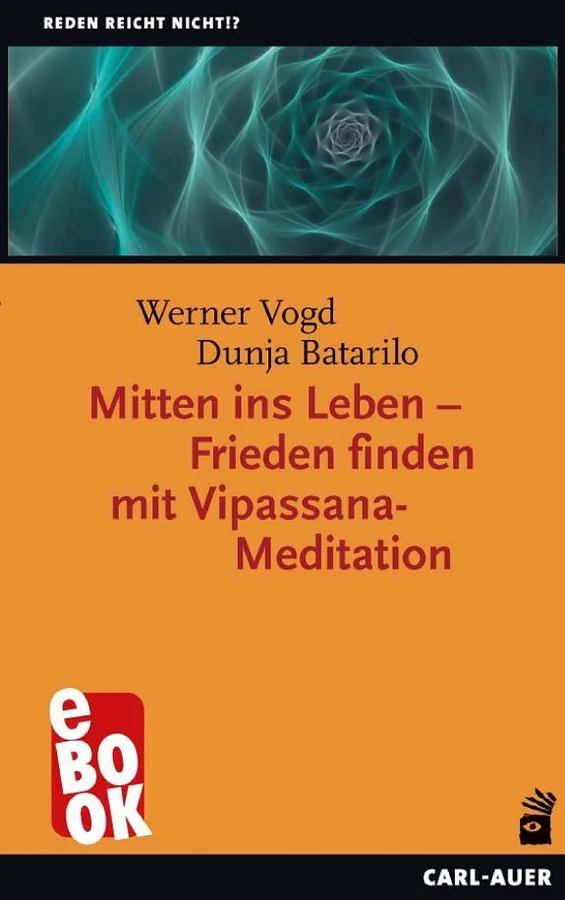
Mitten ins Leben – Frieden finden mit Vipassana-Meditation
 81
81

Mitten ins Leben – Frieden finden mit Vipassana-Meditation
Werner Vogd and Dunja Batarilo’s "Mitten ins Leben" eschews the common self-help platitudes by focusing on a stark but liberating core message: the present moment is all there is. The strength of this work lies in its directness, particularly in its critique of future-chasing and past-clinging as fundamental obstacles to peace. The concept of "leiblichkeit" as the ground for self-relationship is compellingly articulated. However, the book occasionally feels slightly constrained by its adherence to specific Buddhist framing, which might alienate readers seeking a purely secular approach without the philosophical underpinnings. A passage discussing the "subjective quality of living relationships" offers a particularly sharp illustration of the authors' point about finding fulfillment not in grand gestures, but in the texture of everyday connection. Ultimately, it's a valuable guide for those ready to confront the immediacy of their own existence.
📝 Description
81
Published in 2022, Mitten ins Leben argues that peace comes from present awareness, not future hopes.
Werner Vogd and Dunja Batarilo’s 2022 book, Mitten ins Leben, proposes finding peace through Vipassana meditation. It challenges the common tendency to seek happiness in future accomplishments or dwell on past ideals. Instead, the authors guide readers to focus on the present moment, stressing the value of immediate relationships and one's inner state. This work is for people dissatisfied with a life focused too much on future goals or past regrets. It speaks to those who feel life passes them by and seek a practical way to achieve inner calm. Readers interested in Buddhist philosophy who want a modern, accessible interpretation will find this valuable. It is especially relevant for those examining their relationship with themselves and cultivating embodied presence.
The core idea is that true peace is found in present experience, not in external achievements or imagined future states. The authors emphasize 'leiblichkeit,' or embodiment, as central to self-relationship. This involves grounding oneself in physical sensation and immediate awareness, moving away from abstract thought or future projections. The subjective quality of experience becomes the focus. The book connects this practice to the long history of Vipassana meditation.
Vipassana meditation, originating in Buddhist traditions over 2500 years ago, has gained traction in Western spiritual and psychological circles since the mid-20th century. Figures like S.N. Goenka adapted its secular applications for stress reduction and self-awareness. Vogd and Batarilo’s work engages with this lineage, positioning Vipassana as a tool for subjective well-being within contemporary life. It enters a crowded field of mindfulness literature but distinguishes itself through direct engagement with core Buddhist principles.
💡 Why Read This Book?
• Learn to anchor your well-being in the present moment, moving beyond the pursuit of future ideals, a concept central to the book's exploration of "leiblichkeit" as detailed in the 2022 publication. • Discover how cultivating a deeper relationship with your own embodied self, rather than seeking external validation, can lead to genuine peace, as advocated by Vogd and Batarilo. • Understand the Buddhist principle that "there is nothing to achieve" not as nihilism, but as an invitation to find contentment in the immediate quality of your lived experience and relationships.
⭐ Reader Reviews
Honest opinions from readers who have explored this book.
❓ Frequently Asked Questions
What is the core message of "Mitten ins Leben – Frieden finden mit Vipassana-Meditation"?
The book's core message, published in 2022, is that true peace is found not by striving for future goals or clinging to the past, but by fully inhabiting the present moment and cultivating a healthy relationship with oneself and others.
Who are the authors of "Mitten ins Leben"?
The authors are Werner Vogd and Dunja Batarilo. Their 2022 work offers a modern perspective on Vipassana meditation, drawing from Buddhist teachings.
What does "leiblichkeit" mean in the context of this book?
"Leiblichkeit" refers to embodiment – the state of being present in one's physical body and sensory experience. The book emphasizes this as a crucial foundation for self-relationship and finding peace.
How does this book differ from other mindfulness guides?
Unlike many secular mindfulness guides, "Mitten ins Leben" directly engages with core Buddhist tenets, such as the idea that "there is nothing to achieve," framing Vipassana as a path to present-moment awareness and subjective well-being.
What is Vipassana meditation?
Vipassana, meaning "insight" or "clear seeing" in Pali, is an ancient Buddhist meditation technique focused on observing reality as it is, cultivating awareness of impermanence, suffering, and non-self.
When was "Mitten ins Leben" first published?
The book "Mitten ins Leben – Frieden finden mit Vipassana-Meditation" by Werner Vogd and Dunja Batarilo was first published on March 15, 2022.
🔮 Key Themes & Symbolism
The Present Moment
The book strongly advocates for presence, asserting that true fulfillment arises not from future aspirations or past attachments, but from a deep engagement with 'now'. This theme directly challenges societal conditioning that often prioritizes achievement and forward planning over immediate subjective experience. Vogd and Batarilo present the present as the sole locus of reality and the only place where genuine peace can be cultivated, emphasizing the quality of one's conscious awareness.
Embodiment and Self-Relationship
Central to the authors' approach is the concept of "leiblichkeit," or embodiment. This theme posits that a robust and peaceful relationship with oneself is grounded in a conscious connection to the physical body and sensory experience. Rather than escaping into abstract thought or spiritual transcendence, the book encourages readers to find their center within their physical being. This embodied presence is presented as the foundation for authentic living and the quality of one's relationships.
The Illusion of Achievement
A core tenet drawn from Buddhist philosophy is the idea that "there is nothing to achieve." This theme critiques the relentless pursuit of external goals and spiritual attainments as a source of suffering. Vogd and Batarilo interpret this not as a call to passivity, but as an invitation to recognize that peace is not a future reward but a present state of being. Fulfillment is found in the lived quality of experience, not in reaching a hypothetical destination.
Quality of Relationships
The book highlights the "subjective quality of living relationships" as a primary indicator of inner peace. It suggests that our connections with others are not merely external events but are deeply intertwined with our internal state. Cultivating mindful awareness and embodied presence, as promoted through Vipassana, directly impacts how we relate to others, fostering more authentic and satisfying interactions. The focus shifts from changing circumstances to transforming one's relational experience.
💬 Memorable Quotes
“Wer sein Glück in der Zukunft sucht oder sich an überkommene Ideen aus der Vergangenheit klammert, läuft Gefahr, dass ihm das Leben entgleitet.”
— This opening statement encapsulates the book's central premise: happiness and fulfillment are lost when we chase after future possibilities or remain fixated on past notions, leading to a disconnect from present reality.
“Es gibt nichts zu erreichen. Kein Paradies, keinen Fluchtpunkt in einer höheren Transzendenz – nur die Gegenwart...”
— This quote directly challenges conventional spiritual and secular goals, suggesting that peace isn't a destination to be reached but a state to be realized in the here and now, free from the need for external validation or escape.
“Das Heil liegt in einer gelungenen Beziehung zu sich selbst, in einer Leiblichkeit, in der ein Mensch sich (wieder) selbst in der Mitte”
— This highlights the book's focus on embodiment ('Leiblichkeit') as the core of self-relationship. True well-being, it suggests, comes from finding one's center within the physical self, not through external achievements or spiritual flights.
“...nur die Gegenwart und die subjektive Qualität lebendiger Beziehungen.”
— This emphasizes that the only true reality is the present moment, and the quality of our immediate connections with others is paramount to our sense of peace and fulfillment, rather than abstract ideals.
“Die Kernbotschaft buddhistischer Lehren lautet deshalb: Es gibt nichts zu erreichen.”
— This paraphrased core message from Buddhist teachings redirects the reader's focus from striving and goal-orientation towards acceptance and presence, suggesting that peace is already available within the current experience.
🌙 Esoteric Significance
Tradition
While Vipassana meditation originates within the Theravada Buddhist tradition, its application in "Mitten ins Leben" leans towards a modern, psychological interpretation rather than a strictly sectarian one. The work engages with core Buddhist concepts like impermanence and non-attachment, but frames them through the lens of contemporary well-being and self-relationship. It doesn't strictly align with Western esoteric lineages like Hermeticism or Theosophy, but shares their interest in inner transformation and subjective experience as paths to understanding reality.
Symbolism
The book's primary symbolic focus is the concept of 'Leiblichkeit' (embodiment). This is not a visual symbol in the traditional sense but a symbolic state of being – the grounded presence within one's physical form. The "Mitte" (center) that one finds within this embodiment acts as a symbol of stability and inner peace amidst the flux of life. The 'present moment' itself functions symbolically, representing the only true reality, a space free from the illusions of past regret and future desire.
Modern Relevance
The work's emphasis on embodied presence and finding peace in the immediate quality of lived experience resonates strongly with contemporary trends in somatic psychology, mindfulness-based cognitive therapy (MBCT), and acceptance and commitment therapy (ACT). Thinkers and practitioners exploring the integration of Eastern contemplative practices with Western psychological frameworks will find its directness valuable. Its critique of achievement-oriented culture also speaks to current discussions around burnout and the search for more meaningful ways of living.
👥 Who Should Read This Book
• Individuals feeling overwhelmed by the pressure to achieve future goals or haunted by past regrets, seeking a practical method to anchor themselves in the present. • Practitioners of meditation, including mindfulness and Vipassana, who desire a deeper understanding of the philosophical underpinnings beyond mere stress reduction techniques. • Those interested in exploring the concept of "leiblichkeit" (embodiment) as a path to improved self-relationship and authentic living, moving beyond purely intellectual or spiritual pursuits.
📜 Historical Context
Vipassana meditation, a practice with roots in ancient India dating back over 2,500 years, experienced a significant Western popularization in the latter half of the 20th century. Thinkers like S.N. Goenka played a pivotal role in disseminating secularized versions of Vipassana, emphasizing its benefits for stress reduction and mental clarity, often presented as an alternative to the more complex philosophical underpinnings of Theravada Buddhism. Werner Vogd and Dunja Batarilo's "Mitten ins Leben" (2022) enters this landscape as a contemporary exploration. Published amidst a global surge in mindfulness culture, the book distinguishes itself by directly engaging with foundational Buddhist concepts, such as the radical notion that "there is nothing to achieve." This contrasts with purely therapeutic or productivity-focused mindfulness trends. While figures like Jon Kabat-Zinn had already established secular mindfulness in mainstream psychology by the 1990s, Vogd and Batarilo's work revisits the direct Buddhist message, framing it within the context of modern anxieties about life slipping away.
📔 Journal Prompts
The "subjective quality of living relationships" and its connection to present-moment awareness.
Finding one's "Mitte" (center) through "Leiblichkeit" (embodiment) as described by Vogd and Batarilo.
The Buddhist concept that "there is nothing to achieve" and its implications for personal peace.
Life feeling like it's "slipping away" due to future-chasing or past-clinging.
The direct experience of the present moment versus the pursuit of future happiness.
🗂️ Glossary
Vipassana-Meditation
A Buddhist meditation technique, meaning "insight" or "clear seeing," focused on observing reality as it is, cultivating awareness of impermanence and equanimity.
Leiblichkeit
German term for embodiment, referring to the conscious experience and awareness of one's physical body and its sensations, central to the book's concept of self-relationship.
Gegenwart
The German word for "present" or "presence," emphasizing the immediate moment as the sole reality and the locus of peace.
Beziehung zu sich selbst
Literally "relationship with oneself." The book posits that a healthy and peaceful relationship with oneself, grounded in embodiment, is fundamental to overall well-being.
Subjektive Qualität
Subjective quality. Refers to the personal, internal experience of phenomena, particularly relationships, as opposed to objective or external measures.
Es gibt nichts zu erreichen
A core Buddhist teaching paraphrased as "there is nothing to achieve." It challenges the human tendency to seek fulfillment through future goals or attainments, redirecting focus to present experience.
Mitte
German for "center" or "middle." In the context of the book, it refers to the inner core or stable point of being found through embodiment and present-moment awareness.