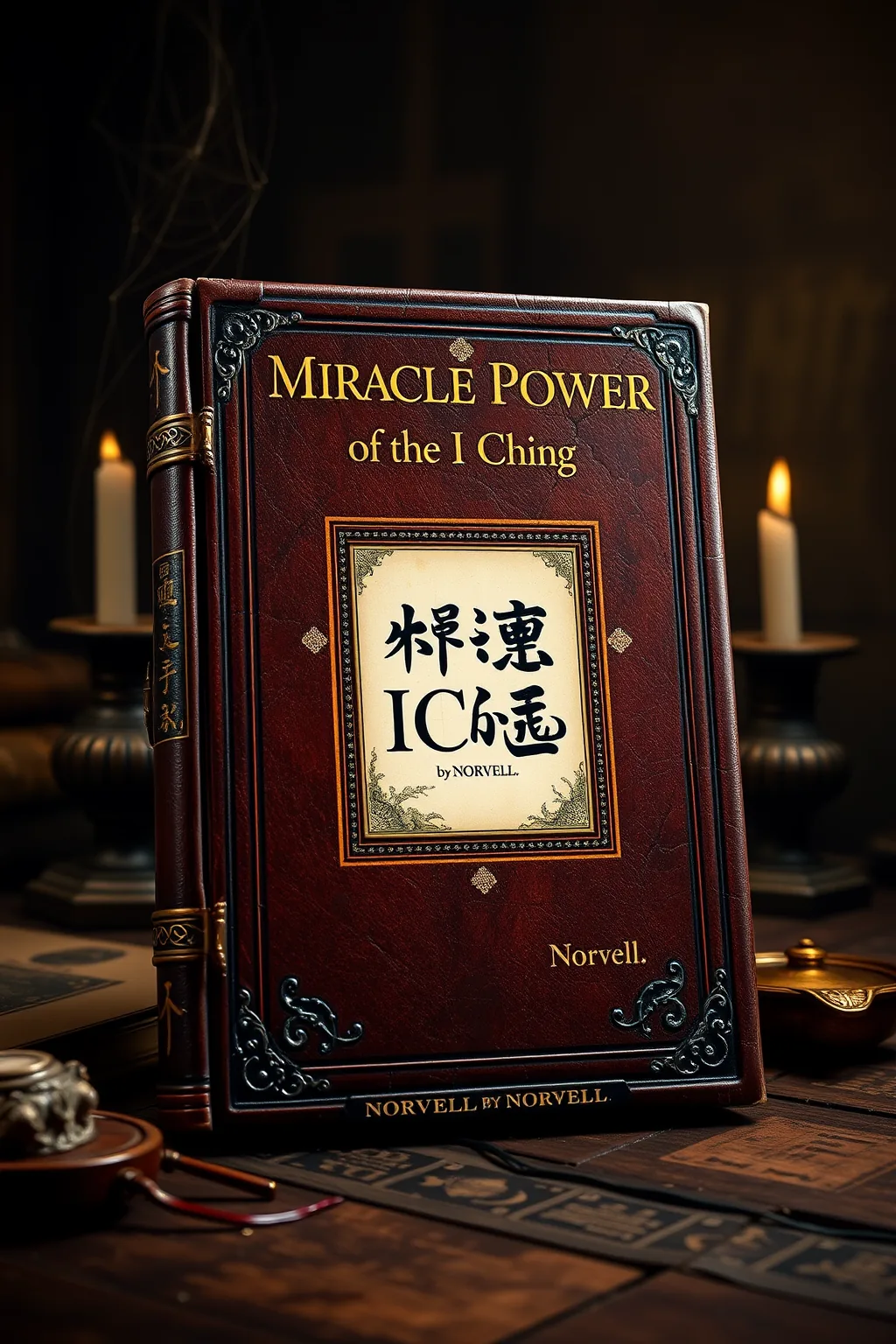
Miracle Power of the I Ching
 79
79

Miracle Power of the I Ching
Norvell's attempt to fuse the ancient wisdom of the I Ching with the tenets of New Thought is ambitious, and in "Miracle Power of the I Ching," he largely succeeds in creating a unique blend of divination and self-empowerment. The strength of this work lies in its accessible interpretation of complex I Ching symbolism, making it digestible for a Western audience already familiar with mind-over-matter philosophies. Norvell's characteristic optimistic and directive tone is present throughout, guiding the reader toward actively shaping their reality. However, a significant limitation is the occasional oversimplification of the I Ching's nuanced philosophy, which, in its original context, carries a deeper philosophical and historical weight than solely a tool for personal manifestation. The section exploring the "Great Simplicity" hexagram, for instance, frames it primarily as a blueprint for achieving goals, potentially overlooking its broader commentary on cosmic order. Despite this, the book offers a compelling perspective for those seeking practical, spiritually-aligned methods for personal growth.
📝 Description
79
Published in 1981, Norvell's "Miracle Power of the I Ching" claims readers can influence outcomes using mind power.
Norvell's 1981 book connects the I Ching's ancient Chinese divination system with New Thought principles. The author argues that individuals can harness universal energies and their own mental faculties to shape events. This approach draws parallels between the I Ching's hexagrams and concepts like the law of attraction and positive thinking.
The book aims to equip readers with an understanding of how to consciously create desired realities. It interprets the sixty-four hexagrams as archetypal patterns reflecting life's possibilities and challenges. By studying these patterns and applying focused thought, affirmations, and spiritual alignment, readers are encouraged to manifest their goals.
This work emerges from the New Age milieu of the late 20th century, a period that saw renewed interest in integrating Eastern spiritual practices with Western metaphysical thought. Norvell, a figure in the New Thought movement, positions the I Ching not simply as a predictive tool but as a system for actively shaping one's reality. It aligns with a broader cultural trend that explored ancient wisdom through the lens of modern psychology and personal empowerment.
💡 Why Read This Book?
• Understand how the 64 hexagrams of the I Ching can be seen as archetypal patterns for personal manifestation, moving beyond simple fortune-telling as presented by Norvell. • Learn to apply New Thought principles, such as positive affirmation and mental focus, to interpret and utilize the wisdom found within the I Ching's symbolic language. • Discover Norvell's unique approach to spiritual technology, integrating ancient Chinese divination with 20th-century metaphysical teachings to foster belief in personal miracle-working capabilities.
⭐ Reader Reviews
Honest opinions from readers who have explored this book.
❓ Frequently Asked Questions
When was "Miracle Power of the I Ching" first published?
The book "Miracle Power of the I Ching" by Norvell was first published in 1981, reflecting the popular interest in esoteric and self-help literature during that era.
What is the core philosophy behind Norvell's approach to the I Ching?
Norvell's approach integrates the I Ching's ancient wisdom with New Thought principles, emphasizing that individuals can actively manifest their desires by understanding universal laws and harnessing their mental and spiritual power.
Does this book offer traditional I Ching readings?
While it uses the I Ching as a framework, the book focuses more on using its hexagrams as symbolic guides for personal empowerment and manifestation rather than providing traditional divination readings.
Who was Norvell?
Norvell was a renowned American author and speaker associated with the New Thought movement, known for his inspirational writings on success, prosperity, and spiritual power.
What makes this book different from other I Ching interpretations?
Its uniqueness lies in its explicit connection to New Thought philosophy, framing the I Ching's archetypes as tools for consciously creating one's reality and achieving personal "miracles."
Is the I Ching itself a 1981 invention?
No, the I Ching (Book of Changes) is an ancient Chinese classic text dating back over 3,000 years, long predating Norvell's 1981 interpretation.
🔮 Key Themes & Symbolism
Mind-Body Manifestation
The work posits that the universe operates on predictable laws that can be influenced by one's mental state and spiritual attunement. Norvell connects the symbolic language of the I Ching's 64 hexagrams to these laws, suggesting that by understanding and aligning with these archetypal patterns through focused thought and positive belief, individuals can manifest desired outcomes and 'miracles' in their lives, demonstrating a core tenet of New Thought applied to an ancient oracle.
Archetypal Patterns of Existence
Norvell interprets the hexagrams not just as predictive symbols but as representations of fundamental human experiences and universal forces. Each hexagram is presented as a blueprint or a dynamic principle at play in life. By contemplating these patterns, readers are encouraged to gain self-awareness and understand the underlying currents of their circumstances, thereby empowering them to act in accordance with universal principles.
Spiritual Technology Integration
This book represents an effort to create a synthesis of Eastern philosophical tools (the I Ching) and Western metaphysical practices (New Thought). It frames the I Ching as a form of spiritual technology, a system that, when operated with the correct mental and spiritual input—belief, affirmation, and focused intent—can yield tangible results, aligning with the era's fascination with combining diverse spiritual disciplines for practical application.
The Power of Affirmation
A central theme is the efficacy of positive affirmations and conscious declaration in shaping reality. Norvell guides readers to use affirmations in conjunction with their understanding of the I Ching's hexagrams. The idea is to consciously declare desired outcomes, reinforcing them through mental imagery and belief, thereby influencing the flow of energy and events in a way that leads to beneficial manifestations.
💬 Memorable Quotes
Direct passages from the work, attributed to the author.
“The I Ching's wisdom reveals the patterns of existence that your own mind can influence.”
— This statement captures the book's core thesis: that the ancient Chinese divination system provides a map of reality, and through the application of mental power, one can navigate and alter their path.
“Your thoughts are seeds; the hexagrams show the soil and the climate.”
— This metaphor highlights how Norvell views the I Ching. The hexagrams represent the conditions and possibilities of a situation, while one's thoughts and beliefs are the active forces that can cultivate specific outcomes.
“Manifestation is not magic; it is the intelligent application of universal laws.”
— Norvell distinguishes his approach from mere wishful thinking, framing manifestation as a systematic process based on understanding and utilizing spiritual principles, much like a scientist uses physical laws.
“Embrace the 'Great Simplicity' to clear the path for your desires.”
— This refers to a specific hexagram's principle, interpreted here as a call to simplify one's approach and mental clutter to more effectively bring forth desired outcomes through focused intent.
“Every challenge presented by a hexagram is an opportunity for spiritual growth and creation.”
— This interpretation emphasizes the optimistic and empowering perspective of the book, viewing the insights gained from the I Ching not as deterministic predictions but as catalysts for personal development and active creation.
🌙 Esoteric Significance
Tradition
This work fits within the broader New Thought tradition, which emphasizes the power of thought and belief to influence one's reality and health. While the I Ching originates from Taoist and Confucian philosophies, Norvell reinterprets its symbolic language through a New Thought lens, focusing on divine potential within the individual and the universe as a benevolent source of supply, departing from traditional Chinese interpretations that might focus more on cosmic balance and cyclical change.
Symbolism
The sixty-four hexagrams are the primary symbols, re-contextualized by Norvell as archetypal patterns representing universal forces and life's possibilities. The Yin and Yang, fundamental to Taoism and the I Ching, are implicitly understood as dynamic forces whose interplay creates reality, but Norvell emphasizes how conscious intent (Yang) can direct this interplay towards desired outcomes, transforming the symbols into tools for personal empowerment.
Modern Relevance
Contemporary thinkers and practitioners interested in manifestation, the law of attraction, and applied spirituality can find resonance in Norvell's approach. His work offers a historical example of how ancient wisdom systems are adapted to modern psychological and metaphysical frameworks. Modern proponents of conscious creation, digital mystics, and those exploring syncretic spiritual paths may draw inspiration from his method of integrating divination with intentional living.
👥 Who Should Read This Book
• Students of New Thought and metaphysical principles seeking to understand how ancient divination systems can be aligned with mind-power philosophies. • Individuals interested in the I Ching who want a perspective that emphasizes personal agency and manifestation over deterministic prediction. • Seekers of spiritual tools for personal empowerment who are open to integrating Eastern philosophical concepts with Western self-help methodologies.
📜 Historical Context
Published in 1981, "Miracle Power of the I Ching" emerged during a period of significant cultural exploration in the West, where Eastern philosophies and esoteric traditions saw a surge in popularity. This era, often characterized as the New Age movement, was marked by a synthesis of diverse spiritual ideas, often seeking practical applications for personal transformation. Norvell, a prominent voice in the New Thought movement founded by figures like Phineas Quimby and Emma Curtis Hopkins, aimed to bridge the ancient Chinese wisdom of the I Ching with contemporary metaphysical concepts of mind power and spiritual manifestation. While Carl Jung explored the I Ching's synchronicity and archetypal psychology in the mid-20th century, Norvell's work shifted the focus towards conscious creation and the generation of "miracles." This period also saw a broader interest in comparative religion and the integration of psychological principles with spiritual practices, making Norvell's fusion of Chinese divination and American self-help philosophy particularly relevant.
📔 Journal Prompts
The hexagram's depiction of 'The Great Simplicity': How can simplifying your focus manifest your intentions?
Norvell's concept of 'miracle power': What specific belief about yourself needs strengthening to activate it?
Reflect on the interplay of Yin and Yang as described in the I Ching's context: How do these forces manifest in your daily decisions?
The principle of 'conscious creation': Identify one area where you currently feel passive and one where you can apply active intent.
Interpreting the I Ching's archetypes: How does a specific hexagram pattern mirror a challenge or opportunity you are currently facing?
🗂️ Glossary
I Ching
An ancient Chinese divination text and one of the oldest of the Chinese classics, traditionally considered a manual of divination based on a system of 64 hexagrams.
Hexagram
A figure composed of six horizontal lines, each line being either solid (Yang) or broken (Yin). There are 64 possible hexagrams in the I Ching.
New Thought
A spiritual movement that emerged in the United States in the 19th century, emphasizing the healing power of positive thinking and the ability of the mind to influence material circumstances.
Manifestation
In metaphysical contexts, the process of bringing something into physical reality through conscious thought, belief, and intention.
Yin and Yang
The Taoist concept of dual, complementary, and interdependent forces that exist in all things. Yin is typically associated with the feminine, passive, dark, and receptive; Yang with the masculine, active, light, and assertive.
Attunement
The state of being in harmony or alignment with a particular energy, principle, or consciousness, often achieved through focused thought or spiritual practice.
Archetype
In this context, a universal, archaic symbol or model of character, action, or situation that is derived from the collective unconscious and serves as a pattern in literature and human experience.
🔮 Readers Also Liked
Browse all →







More by Norvell.
All books →





More Free Occult Philosophy Books
View all →