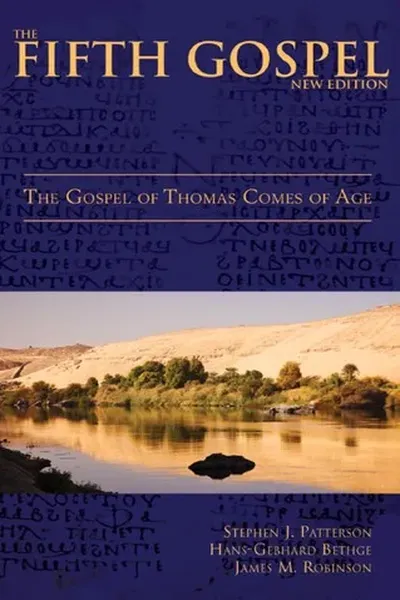
Gospel of Thomas and Christian Origins

 84
84

Gospel of Thomas and Christian Origins
Patterson's examination of the Gospel of Thomas moves beyond sensationalism, grounding its analysis in careful textual scholarship. He effectively highlights how the sayings collection, freed from narrative constraints, presents a compelling case for an alternative stream of early Christian thought. A particular strength lies in his detailed comparison of Thomasic sayings with their counterparts in the canonical gospels, revealing subtle but significant shifts in emphasis. For instance, his treatment of Saying 3 ('Jesus said, “Men suppose that it is I who will give them peace, but they do not know that it is the Father who will give them peace…”') underscores a radical departure from institutionalized salvation. However, the book occasionally leans heavily on scholarly jargon, which may create a barrier for the less initiated reader. Despite this, Patterson's work offers a lucid argument for Thomas's significance in understanding the broad spectrum of early Christian discourse.
📝 Description
84
### The Gospel of Thomas: A Window into Early Christian Thought Stephen J. Patterson's work revisits the Gospel of Thomas, a non-canonical text offering a distinct perspective on the teachings attributed to Jesus. Unlike the synoptic gospels (Matthew, Mark, and Luke), Thomas presents a collection of sayings, often esoteric and requiring interpretation, rather than a narrative account of Jesus's life and ministry. This approach positions the text as crucial for understanding the diversity of early Christian beliefs and the varied ways Jesus's message was understood and transmitted in the first and second centuries CE.
### Who Benefits from Patterson's Analysis? This book is designed for individuals seeking a deeper, critical understanding of early Christianity beyond the standard New Testament accounts. Scholars of religious studies, theology students, and those interested in Gnosticism and apocryphal texts will find Patterson's rigorous textual analysis invaluable. It is also for the general reader drawn to the mystical or philosophical dimensions of Jesus's purported words, particularly those intrigued by sayings that emphasize inner knowledge and spiritual awakening.
### The Historical Landscape of the Gospels Published in 2013, Patterson's book emerges in an academic environment that has long debated the origins and dating of the Gospel of Thomas. Its existence and relationship to the canonical gospels have been subjects of intense scholarly discussion since its discovery in the Nag Hammadi library in 1945. Patterson situates his work within this ongoing conversation, examining how Thomas might reflect an independent tradition of Jesus's sayings, potentially predating or running parallel to the canonical narratives, challenging conventional views of the development of Christian doctrine.
### Unpacking the Sayings Patterson's exploration centers on the unique character of the sayings within the Gospel of Thomas. These are not simple moral exhortations but often cryptic aphorisms and parables that hint at a hidden, spiritual reality accessible through inner understanding. The work delves into concepts such as the Kingdom of God as an internal state, the importance of 'seeking and finding,' and the idea of recognizing one's true spiritual identity. The analysis aims to illuminate the theological and philosophical underpinnings of these sayings, offering a pathway to their original intended meaning.
💡 Why Read This Book?
• Gain insight into an alternative Jesus tradition, distinct from the canonical Gospels, by examining Patterson's analysis of the Gospel of Thomas's unique sayings structure, potentially dating back to the mid-1st century CE. • Understand the esoteric interpretation of the "Kingdom of God" as an internal, realized state, as explored through Patterson's discussion of specific Thomasic sayings like Saying 3. • Appreciate the critical scholarly debate surrounding the Gospel of Thomas's relationship to early Christianity, informed by Patterson's engagement with the findings from the Nag Hammadi library discovery in 1945.
⭐ Reader Reviews
Honest opinions from readers who have explored this book.
❓ Frequently Asked Questions
What is the Gospel of Thomas and why is it important?
The Gospel of Thomas is a collection of 114 sayings attributed to Jesus, discovered among the Nag Hammadi texts in 1945. It is crucial for understanding the diversity of early Christian beliefs, offering a perspective distinct from the canonical Gospels.
When was the Gospel of Thomas likely written?
Scholarly debate continues, but many, including Stephen J. Patterson, suggest a potential early date, possibly in the mid-1st century CE, making it contemporary with or even earlier than some canonical texts.
How does Patterson's book differ from standard New Testament studies?
Patterson focuses on the Gospel of Thomas as a distinct source of Jesus's sayings, analyzing its unique theological and philosophical content, which often emphasizes inner knowledge and spiritual realization over narrative events.
What is the significance of the Nag Hammadi discovery for this book?
The discovery of the Gospel of Thomas in the Nag Hammadi library in 1945 provided the primary textual basis for its study. Patterson's work is a modern scholarly engagement with these rediscovered texts.
Does Patterson present the Gospel of Thomas as Gnostic?
While Thomas shares themes with Gnosticism, Patterson explores its potential independent origins. He highlights how its sayings emphasize spiritual insight and self-knowledge, which are common in various early Christian and Hellenistic traditions.
What does 'esoteric' mean in the context of the Gospel of Thomas?
Esoteric refers to teachings intended for a select group or requiring inner understanding. In Thomas, this often relates to the interpretation of sayings that point towards hidden spiritual truths and personal spiritual awakening.
🔮 Key Themes & Symbolism
The Kingdom Within
Patterson highlights how the Gospel of Thomas reorients the concept of the 'Kingdom of God' from an external, future event to an internal, present reality. Sayings like 'The Kingdom of the Father is within you' (Saying 3) suggest that spiritual attainment is a matter of inner recognition and self-discovery, rather than adherence to external doctrines or waiting for a messianic intervention. This contrasts sharply with the more eschatologically focused narratives found in the canonical Gospels, positioning Thomas as a text emphasizing immanent spiritual experience.
Recognition and Awakening
A central theme is the imperative to 'seek and find' and 'recognize' the divine within oneself and the world. Patterson interprets many sayings as calls to a profound awakening, urging readers to perceive the spiritual reality underlying the mundane. The emphasis is on gnosis – inner knowledge – rather than faith alone. This theme resonates with other mystical traditions that posit a hidden divinity accessible through heightened awareness and introspection, moving beyond simple belief systems.
Jesus as the Revealer of Hidden Wisdom
Within the Gospel of Thomas, Jesus functions primarily as the dispenser of secret sayings and esoteric wisdom, rather than solely a healer or prophet of doom. Patterson explores how the text presents Jesus as one who reveals the true nature of God and the self. This portrayal is crucial for understanding the diverse Christologies developing in the early centuries, suggesting a perception of Jesus as a spiritual guide whose words unlock profound truths for those ready to receive them.
The Role of Interpretation
The aphoristic and often enigmatic nature of the sayings in Thomas necessitates interpretation. Patterson's work emphasizes that the text itself is a prompt for contemplation and personal spiritual insight. Unlike narrative Gospels that guide through stories, Thomas requires the reader to engage actively with the meaning of each saying, making the process of reading a form of spiritual practice. This active engagement is key to unlocking the esoteric dimensions of Jesus's teachings.
💬 Memorable Quotes
“Jesus said, 'If you bring forth what is within you, what you bring forth will save you. If you do not bring forth what is within you, what you do not bring forth will destroy you.'”
— This saying underscores the critical importance of self-knowledge and inner realization. Patterson interprets it as a core tenet of Thomas: salvation or destruction hinges on one's ability to access and manifest their inner spiritual truth.
“His disciples said to him, 'When will you appear to us and when will we see you?' Jesus said, 'When you unwrap yourselves when you are naked, and do not be ashamed, and tread upon the place of shame, and tread upon it, and you will not feel it.'”
— This obscure saying, as analyzed by Patterson, points towards shedding egoic defenses and societal inhibitions. It suggests a state of unadulterated being, free from shame, as a prerequisite for spiritual perception.
“Jesus said, 'Blessed is the man who has suffered, he has found life.'”
— Patterson suggests this saying implies that enduring hardship can lead to a deeper understanding and appreciation of life's true value. It hints at a spiritual purification through tribulation, a common theme in mystical thought.
“Jesus said, 'Know what is in front of your face, and what is hidden from you will be revealed to you.'”
— This aphorism, central to Patterson's interpretation, emphasizes the power of present awareness. By focusing on the immediately apparent, one can unlock deeper, hidden truths about reality and oneself.
“Jesus said, 'The Yoke of the Heavenly Kingdom is light.'”
— Patterson interprets this as contrasting the burden of conventional religious law with the liberating nature of true spiritual understanding. The teachings of Thomas, when grasped, are presented as freeing rather than oppressive.
🌙 Esoteric Significance
Tradition
The Gospel of Thomas is intrinsically linked to early Christian Gnosticism, though its precise relationship remains debated. Patterson's work explores its potential as a source that predates or runs parallel to developed Gnostic systems, emphasizing its focus on inner knowledge (gnosis) and spiritual awakening. It departs from later, more systematized Gnostic cosmologies by presenting a collection of sayings that directly channel Jesus's wisdom, functioning as a foundational text for esoteric interpretations of his message.
Symbolism
Key symbols include the "Kingdom of God" as an internal state, signifying spiritual immanence rather than external dominion. The act of "seeking and finding" represents the Gnostic quest for hidden truth and self-knowledge. "Nakedness" and the shedding of "shame" (Saying 28) symbolize the stripping away of egoic defenses and societal conditioning to reveal one's true, unadulterated spiritual essence.
Modern Relevance
Contemporary esoteric practitioners and comparative religion scholars continue to draw from the Gospel of Thomas. Its emphasis on personal spiritual realization resonates with modern mindfulness practices, New Age spirituality, and various forms of Western Esotericism that prioritize inner experience over dogma. Thinkers exploring alternative interpretations of Jesus's teachings often reference Thomas for its unique perspective on immanent divinity and the path to enlightenment.
👥 Who Should Read This Book
• Students of early Christianity and comparative religion will find Patterson's detailed textual analysis and historical contextualization essential for understanding the breadth of early Jesus movements. • Seekers of esoteric wisdom and alternative spiritual paths will benefit from the exploration of the Gospel of Thomas's emphasis on inner knowledge, self-realization, and the immanent nature of the divine. • Scholars and practitioners interested in Gnosticism will gain a nuanced perspective on the Gospel of Thomas's potential origins and its thematic connections to Gnostic thought, distinct from purely narrative Gospels.
📜 Historical Context
Stephen J. Patterson's "Gospel of Thomas and Christian Origins" (2013) enters a scholarly arena deeply shaped by the 1945 discovery of the Nag Hammadi library. The Gospel of Thomas, a collection of sayings attributed to Jesus, immediately challenged prevailing views of early Christianity. Its existence suggested a vibrant diversity of belief and practice, potentially independent of the developing orthodoxies centered around the four canonical Gospels. Scholars like Elaine Pagels and Bart Ehrman have extensively debated Thomas's relationship to the earliest Christian traditions and its potential Gnostic connections. Patterson's work engages with this ongoing discourse, examining textual evidence to argue for the significance of Thomas as a repository of early Jesus traditions. The reception of these non-canonical texts has been complex, with some movements embracing them as authentic, while others, particularly within established Christianity, have historically marginalized or suppressed them.
📔 Journal Prompts
The imperative to "bring forth what is within you" as presented in Saying 65.
Reflecting on the concept of the "Kingdom of God" as an internal state, distinct from external doctrines.
How does the emphasis on "seeking and finding" in the Gospel of Thomas parallel personal spiritual quests?
Consider the implications of Jesus functioning as a revealer of hidden wisdom in Saying 1.
The interpretation of "nakedness" and shedding "shame" as presented in Saying 28.
🗂️ Glossary
Gospel of Thomas
A non-canonical collection of 114 sayings attributed to Jesus, discovered in the Nag Hammadi library in 1945. It lacks narrative and focuses on Jesus's teachings.
Nag Hammadi Library
A collection of Gnostic and other early Christian texts discovered in Egypt in 1945, providing crucial primary sources for understanding diverse early religious thought.
Saying
In the context of the Gospel of Thomas, a discrete unit of Jesus's purported teaching, often aphoristic or parabolic, rather than part of a narrative sequence.
Gnosis
Greek for 'knowledge.' In esoteric contexts, it refers to intuitive, spiritual knowledge or insight, often seen as liberating or salvific.
Canonical Gospels
The four Gospels (Matthew, Mark, Luke, and John) included in the New Testament, accepted as authoritative by mainstream Christianity.
Esoteric
Intended for or likely to be understood by only a small number of people with a specialized knowledge or interest; inner teachings.
Aphorism
A concise, pithy statement expressing a general truth or principle, often in a memorable form.