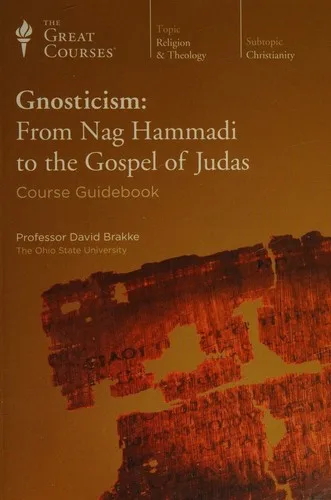
Gnosticism
 71
71

Gnosticism



David Brakke's "Gnosticism" offers a scholarly dissection of a perennial enigma in religious studies. Rather than rehashing popular notions, Brakke grounds his analysis in textual evidence, particularly the Nag Hammadi library, and engages directly with the scholarly debates that have shaped our understanding of these movements since their rediscovery. The work excels in its detailed exploration of the diverse theological and cosmological systems attributed to Gnostics, moving beyond simplistic categorizations. A particular strength lies in its nuanced portrayal of the historical context, demonstrating Gnosticism's complex relationship with both Judaism and the developing Christian traditions. The book’s limitation, perhaps inherent in its academic scope, is its density; readers unfamiliar with the foundational scholarship might find the intricate arguments challenging. Brakke's examination of the Sethian Gnostic texts, for instance, highlights the sophisticated mythological frameworks employed to explain cosmic origins and human alienation. The work serves as a crucial, if demanding, resource for serious students of early religious history.
📝 Description
71
### What Gnosticism Is
This work presents Gnosticism not as a monolithic religion, but as a diverse set of religious and philosophical movements flourishing primarily in the 2nd and 3rd centuries CE. It examines the origins and development of these complex systems, which often posited a radical dualism between a transcendent, unknowable God and a flawed creator deity responsible for the material world. The book details how Gnostic systems interpreted scripture, mythology, and cosmology through a lens of esoteric knowledge (gnosis) as the path to salvation.
### Who Gnosticism Is For
This study is aimed at individuals seeking a rigorous academic understanding of early Gnostic movements. It will appeal to students of comparative religion, ancient history, and the history of philosophy, particularly those interested in the Hellenistic period and the emergence of early Christianity. Scholars and advanced enthusiasts will find value in its detailed analysis of primary sources and its engagement with scholarly debates surrounding Gnosticism's precise nature and influence.
### Historical Context of Gnosticism
The book situates Gnostic movements within the vibrant intellectual and religious landscape of the Roman Empire, particularly from the 1st to the 4th centuries CE. It explores their interactions with nascent Christianity, Judaism, and various Hellenistic philosophical schools like Platonism. The emergence of Gnosticism is understood as a complex phenomenon arising from this milieu, not solely as a Christian heresy, though its relationship with emerging orthodoxy was often contentious. The Council of Nicaea in 325 CE marked a significant point in the consolidation of a counter-Gnostic Christian orthodoxy.
### Key Concepts in Gnosticism
Central to Gnostic thought is the concept of 'gnosis,' a salvific knowledge that liberates the divine spark trapped within the human soul. The work details the figure of the Demiurge, often identified with the Old Testament God, who is seen as a lesser, ignorant creator. It also explores the complex cosmologies involving aeons, divine emanations, and the role of figures like Sophia. The interpretation of myths, such as the fall of Sophia, provides a framework for understanding humanity's predicament and the means of redemption.
💡 Why Read This Book?
• Gain a precise understanding of 'gnosis' as salvific knowledge, differentiating it from mere intellectual understanding, as explored in the book's analysis of Gnostic texts from the Nag Hammadi library. • Grasp the specific historical context of Gnosticism's rise, understanding its interactions with 2nd and 3rd century CE Christianity and Hellenistic philosophy, moving beyond broad generalizations. • Discern the roles of key figures and concepts like the Demiurge and Sophia within Gnostic cosmologies, recognizing their function in explaining cosmic order and human alienation.
why_read
⭐ Reader Reviews
Honest opinions from readers who have explored this book.
❓ Frequently Asked Questions
What is the primary focus of David Brakke's "Gnosticism"?
The book focuses on Gnosticism as a diverse set of religious and philosophical movements in the 2nd and 3rd centuries CE, examining their origins, beliefs, and historical context, particularly in relation to early Christianity and Hellenistic thought.
When was David Brakke's "Gnosticism" first published?
David Brakke's "Gnosticism" was first published in 2015, offering a contemporary scholarly assessment of the subject.
What are some key Gnostic concepts discussed in the book?
Key concepts include 'gnosis' (salvific knowledge), the Demiurge (a flawed creator deity), and complex cosmologies involving aeons and divine emanations, as detailed in the work's thematic sections.
Does the book cover the Nag Hammadi library?
Yes, the work draws significantly on the texts discovered at Nag Hammadi, which are crucial primary sources for understanding Gnostic thought and practice.
Is this book suitable for beginners interested in Gnosticism?
While informative, the book is written for a scholarly audience and may be dense for absolute beginners. However, its clear structure and detailed explanations can still benefit dedicated newcomers to the subject.
How does Brakke differentiate Gnosticism from mainstream Christianity?
Brakke highlights Gnosticism's radical dualism, its emphasis on esoteric knowledge for salvation, and its often-critical view of the material world and its creator, contrasting these with emerging orthodox Christian doctrines.
🔮 Key Themes & Symbolism
The Nature of Gnosis
The book critically examines 'gnosis' not as simple intellectual assent, but as a transformative, salvific knowledge central to Gnostic systems. This knowledge pertains to the true nature of the divine, the cosmos, and the human soul's predicament. Brakke explores how different Gnostic groups articulated the acquisition and effects of this knowledge, often contrasting it sharply with faith-based or ritualistic paths prevalent in contemporary religions, particularly the emerging Christian orthodoxy.
Cosmological Dualism and the Demiurge
A central theme is the pervasive dualism found in many Gnostic traditions, positing a radical separation between the supreme, transcendent God and the flawed creator of the material universe, the Demiurge. Brakke analyzes the diverse mythologies developed to explain this cosmic hierarchy, the fall of divine beings (like Sophia), and the entrapment of divine sparks within human bodies. This cosmological framework underpins the Gnostic view of the world as fundamentally alienated from the divine.
Gnosticism and Early Christianity
The work meticulously traces the complex and often contentious relationship between Gnostic movements and the development of early Christianity. Brakke moves beyond the simplistic 'heresy' label, exploring Gnosticism as a multifaceted phenomenon that interacted with, challenged, and was ultimately distinguished from the evolving orthodox Christian tradition. He discusses how Gnostic interpretations of figures like Jesus differed significantly from those of the emerging Church Fathers.
The Nag Hammadi Discoveries
The significance of the 1945 discovery of the Nag Hammadi library is implicitly central to modern Gnostic studies, and Brakke's work is informed by these texts. The book analyzes various codices, presenting insights into Gnostic gospels, cosmological treatises, and philosophical dialogues. These primary sources allow for a more direct engagement with Gnostic thought than was previously possible, enabling a nuanced understanding of their diverse expressions.
💬 Memorable Quotes
“Gnosticism is characterized by a radical dualism.”
— This statement encapsulates a core tenet explored in the book: the fundamental separation Gnostics often perceived between the spiritual, true God and the material world's imperfect creator.
“Salvation comes through gnosis, not faith.”
— This highlights the Gnostic emphasis on possessing esoteric knowledge as the exclusive means of liberation from the material realm, contrasting with doctrines of salvation through belief or divine grace.
“The figure of Sophia plays a crucial role in Gnostic cosmologies.”
— This points to the significance of divine emanations, like Sophia (Wisdom), whose actions or fall are often depicted as initiating the creation of the flawed material cosmos.
“Gnosticism emerged within the Hellenistic religious milieu.”
— This positions Gnosticism not as an isolated phenomenon but as a product of the diverse philosophical and religious currents present in the Roman Empire during the early centuries CE.
“The Demiurge is distinct from the supreme God.”
— This interpretation clarifies the Gnostic distinction between the ignorant or malevolent creator of the physical world and the unknowable, ultimate divine principle.
🌙 Esoteric Significance
Tradition
This work engages with the Gnostic tradition, often understood as a distinct path within the broader spectrum of esoteric thought that flourished in late antiquity. While sometimes categorized alongside Hermeticism or Manichaeism due to shared thematic concerns (like dualism and the pursuit of hidden knowledge), Gnosticism presents a unique cosmology centered on the concept of 'gnosis' as liberation. Brakke's study positions Gnosticism as a significant, albeit diverse, religious phenomenon that offered an alternative spiritual framework to both paganism and the developing Christian orthodoxy of its time.
Symbolism
Central Gnostic symbols examined include the 'Pleroma' (divine fullness) and the 'Kenoma' (the void or emptiness), representing the spiritual realm and the material creation respectively. The figure of Sophia (Wisdom) is a pivotal symbol, often depicted as falling from the Pleroma, whose actions precipitate the creation of the flawed material world and its ruler, the Demiurge. The 'divine spark' or 'spirit' trapped within the human soul symbolizes humanity's connection to the true, transcendent God and its alienation within the material prison.
Modern Relevance
Contemporary interest in Gnosticism persists in various esoteric and philosophical circles. Modern spiritual movements, particularly those exploring alternative interpretations of early Christianity or seeking liberation from perceived societal constraints, often draw inspiration from Gnostic ideas about hidden knowledge and the critique of established power structures. Thinkers and writers exploring themes of consciousness, alienation, and the nature of reality continue to find resonance in Gnostic mythologies and their radical perspectives on the human condition.
👥 Who Should Read This Book
• Students of comparative religion and ancient philosophy seeking to understand the diverse spiritual landscape of the Roman Empire. • Scholars of early Christianity interested in the development of orthodox doctrine in response to alternative religious movements. • Practitioners of esoteric traditions looking to explore the historical roots and theological underpinnings of concepts like dualism and salvific knowledge.
📜 Historical Context
David Brakke's "Gnosticism" situates its subject within the fertile intellectual soil of the Roman Empire, primarily from the 1st to the 4th centuries CE. This era witnessed an explosion of religious and philosophical ideas, including Neoplatonism, Stoicism, and various mystery cults, alongside significant developments within Judaism and the nascent Christian movement. Gnosticism emerged as a complex response to these currents, offering distinct cosmologies and soteriologies. Its relationship with emerging orthodox Christianity was particularly fraught; figures like Irenaeus of Lyons, writing in the late 2nd century, vigorously polemicized against Gnostic teachings, contributing to their eventual marginalization within mainstream Christianity. The discovery of the Nag Hammadi library in 1945 dramatically reshaped scholarly understanding, providing direct access to Gnostic texts previously known primarily through the critiques of their opponents, thus enabling a more nuanced assessment of their beliefs and practices.
📔 Journal Prompts
The concept of the Demiurge in Gnostic thought.
Reflections on the nature of 'gnosis' as presented by Brakke.
Sophia's role in Gnostic cosmologies.
The implications of Gnostic dualism for understanding the material world.
Comparing Gnostic interpretations of salvation with other ancient traditions.
🗂️ Glossary
Gnosis
A Greek term meaning 'knowledge.' In Gnosticism, it refers to a special, intuitive, salvific knowledge of the divine and the true nature of reality, considered essential for liberation from the material world.
Demiurge
In Gnostic cosmology, the creator of the material universe. Often depicted as ignorant, flawed, or even malevolent, and distinct from the supreme, transcendent God.
Pleroma
The spiritual realm or fullness of the supreme God in Gnostic thought. It is the source from which divine emanations (aeons) originate.
Aeon
Divine beings or emanations that originate from the Pleroma. Gnostic systems often feature complex hierarchies of aeons involved in the divine realm.
Sophia
A female divine figure, often translated as 'Wisdom,' whose actions or fall from the Pleroma are frequently described as leading to the creation of the material world and the Demiurge.
Sethian Gnosticism
A major branch of Gnosticism that traced its spiritual lineage back to Seth, the third son of Adam and Eve, and emphasized specific Sethian texts and cosmologies.
Nag Hammadi Library
A collection of Gnostic and other ancient texts discovered near Nag Hammadi, Egypt, in 1945. These codices provide invaluable primary source material for the study of Gnosticism.