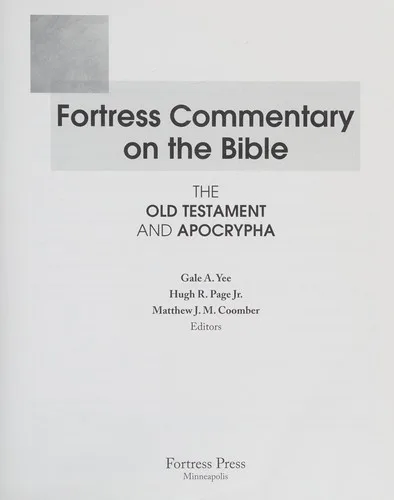
Fortress Commentary on the Bible
 72
72

Fortress Commentary on the Bible
Yee and Coomber's Fortress Commentary on the Bible presents a meticulously researched, albeit dense, engagement with scripture. The authors excel in dissecting the socio-historical milieu of the biblical texts, particularly evident in their treatment of the Pentateuch. For instance, their analysis of the Documentary Hypothesis in relation to Genesis 1-11 offers a clear, if not entirely novel, exposition of complex source-critical debates. However, the work's relentless focus on critical methodology can sometimes overshadow the profound spiritual or existential questions many readers bring to biblical study. The prose, while precise, occasionally lapses into academic jargon that may alienate those outside of specialized theological circles. Ultimately, this commentary serves as a formidable academic resource, but its accessibility for a broader, spiritually-minded audience remains a significant consideration.
📝 Description
72
### What It Is The Fortress Commentary on the Bible, first published in 2014, offers a scholarly examination of biblical texts from a critical perspective. Authored by Gale A. Yee and Matthew J. M. Coomber, this work is not an devotional or inspirational text but rather an analytical tool for understanding the historical, literary, and theological dimensions of scripture. It approaches the Bible as a collection of ancient documents, applying modern critical methodologies to uncover layers of meaning and context.
### Who It's For This commentary is intended for academics, theological students, and serious biblical scholars who require a rigorous and detailed analysis of biblical passages. It is also suitable for readers interested in the historical-critical method of biblical interpretation and those seeking to understand the scholarly debates surrounding the texts. Individuals engaged in comparative religion studies or those researching the development of religious thought will find value here.
### Historical Context Published in 2014, The Fortress Commentary on the Bible emerged during a period of continued engagement with historical-critical approaches to scripture, alongside growing interest in postcolonial and feminist readings. While not a direct response to a single event, it contributes to a broader scholarly discourse that seeks to demythologize and contextualize biblical narratives. This era saw scholars like Adele Berlin advocating for literary approaches, and scholars like Phyllis Trible challenging patriarchal interpretations, both movements influencing the critical landscape into which Yee and Coomber's work was introduced.
### Key Concepts The commentary likely engages with concepts such as source criticism, form criticism, and redaction criticism, methods developed in the late 19th and early 20th centuries. It would also explore the historical-grammatical method, focusing on the original meaning of texts within their ancient Near Eastern contexts. Furthermore, the work may address hermeneutical challenges, the process of interpreting texts across different historical and cultural divides, and the theological implications derived from these critical analyses.
💡 Why Read This Book?
• Gain a nuanced understanding of the historical-critical method as applied to the Pentateuch, learning how scholars analyze biblical texts as layered documents shaped by distinct traditions and editing processes. • Explore specific analyses of key passages, such as the creation accounts in Genesis, which offer a scholarly perspective on their literary construction and theological development beyond devotional readings. • Understand the scholarly context of biblical studies since the early 20th century, appreciating how critical scholarship, as represented in this 2014 publication, engages with foundational religious texts.
⭐ Reader Reviews
Honest opinions from readers who have explored this book.
❓ Frequently Asked Questions
What is the primary methodology used in The Fortress Commentary on the Bible?
The commentary primarily employs the historical-critical method, utilizing approaches like source criticism, form criticism, and redaction criticism to analyze the biblical texts within their original historical and literary contexts.
Who are the authors of The Fortress Commentary on the Bible?
The book was authored by Gale A. Yee and Matthew J. M. Coomber, with its first publication occurring in 2014.
Is The Fortress Commentary on the Bible suitable for devotional reading?
No, this commentary is designed for scholarly and analytical purposes, focusing on critical interpretation rather than devotional or inspirational engagement with the biblical texts.
What historical period does the commentary focus on?
The commentary examines biblical texts originating from the ancient Near East, analyzing their composition and development within their specific historical and cultural milieus.
What does the historical-critical method involve?
It's an approach to biblical study that seeks to understand the text's origins, historical background, and literary development through various critical lenses, distinguishing it from purely theological or devotional readings.
When was The Fortress Commentary on the Bible first published?
The initial publication date for The Fortress Commentary on the Bible was 2014.
🔮 Key Themes & Symbolism
Historical-Critical Method
This commentary champions the historical-critical method, a cornerstone of modern biblical scholarship since the 19th century. It involves dissecting scripture by examining its historical origins, literary forms, and editorial processes. Authors Yee and Coomber likely apply tools such as source criticism, which posits multiple original documents combined into the final text (e.g., the J, E, D, P sources for the Pentateuch), and redaction criticism, which studies how editors shaped these sources. This approach seeks to understand the Bible not as a monolithic divine utterance, but as a complex human document reflecting diverse historical circumstances and theological perspectives from the ancient Near East.
Literary and Source Analysis
Central to the work is a detailed examination of the Bible's literary structures and hypothetical sources. The commentary likely breaks down narrative sections, poetic passages, and legal codes, identifying distinct literary styles and potential underlying traditions. For instance, in analyzing the Pentateuch, the authors would grapple with the Documentary Hypothesis, exploring how scholars have identified different strands of tradition (like the Yahwist or Priestly sources) that were later compiled. This focus on literary artistry and source compilation offers a framework for understanding the Bible's internal development and the evolution of ancient Israelite religious thought.
Contextual Interpretation
The Fortress Commentary stresses the importance of situating biblical texts within their original socio-historical and cultural contexts. This involves understanding the ancient Near Eastern world, including its political structures, religious beliefs, and social customs, to illuminate the meaning of the scriptures. By exploring the 'world behind the text,' the authors aim to move beyond anachronistic readings and grasp the original intent and impact of the biblical writings. This contextual approach is crucial for understanding, for example, the laws or prophetic messages as responses to specific historical crises or social conditions.
Theological Implications of Critical Study
While rigorously analytical, the commentary does not shy away from the theological implications that emerge from critical scholarship. Yee and Coomber likely explore how understanding the historical development and literary composition of the Bible informs, rather than diminishes, its theological significance. By recognizing the human element and historical contingency in scripture, readers can develop a more sophisticated appreciation for how divine messages were conveyed and understood across different eras. The work may suggest that critical study can lead to a deeper, more nuanced understanding of God's relationship with humanity as revealed in scripture.
💬 Memorable Quotes
“The work explores the complex layers of tradition and editorial work that shaped the Pentateuch.”
— This highlights the commentary's focus on the Documentary Hypothesis and similar source-critical theories, viewing the Pentateuch not as a single composition but as a compilation of older texts.
“Understanding the ancient Near Eastern milieu is crucial for grasping the original meaning of biblical laws.”
— This points to the importance of historical context in interpretation, suggesting that biblical legislation must be understood in light of the customs and legal practices of contemporary cultures.
“Literary analysis reveals distinct voices and styles within the prophetic corpus.”
— This indicates a focus on the Bible's literary artistry, suggesting that different prophetic books or sections may have unique stylistic features and authorships that require careful examination.
“The commentary applies critical methodologies developed throughout the 20th century.”
— This frames the book within the history of biblical scholarship, situating its approach within established academic traditions of textual analysis and historical inquiry.
“The historical-critical approach seeks to uncover the text's origins and development.”
— This summarizes the fundamental goal of the methodology employed, emphasizing the scholarly pursuit of understanding how biblical texts came into being and evolved over time.
🌙 Esoteric Significance
Tradition
While primarily a work of academic biblical scholarship, its rigorous textual analysis can inform esoteric traditions that draw upon biblical symbolism. It doesn't belong to a specific esoteric lineage like Kabbalah or Gnosticism but provides a critical foundation that esotericists might use to re-examine scriptural sources often interpreted allegorically or mystically.
Symbolism
The commentary likely dissects symbols such as the serpent in Eden or the Exodus journey not through a mystical lens, but by examining their historical usage and narrative function. For example, the 'fortress' metaphor in the title itself could be interpreted esoterically as a divine protection, but the book's approach would focus on its literal or historical implications within the text's context.
Modern Relevance
Contemporary scholars and practitioners interested in the historical Jesus, the origins of monotheism, or comparative mythology can utilize the critical data presented. The work provides a scholarly baseline against which more mystical or allegorical interpretations, prevalent in some New Age or occult circles, can be measured and contextualized.
👥 Who Should Read This Book
• Theological students and seminarians requiring a solid grounding in critical biblical analysis for their studies. • Academics and researchers in religious studies seeking detailed textual exegesis and historical contextualization of biblical narratives. • Advanced lay readers interested in understanding the scholarly debates surrounding biblical origins and interpretation beyond devotional readings.
📜 Historical Context
The Fortress Commentary on the Bible, published in 2014, arrived at a time when historical-critical methods, though foundational, were increasingly being supplemented and challenged by other interpretive lenses. The late 20th and early 21st centuries saw significant growth in feminist, postcolonial, and liberation theologies, which offered new ways to read scripture, often focusing on marginalized voices within the text and challenging patriarchal interpretations. Scholars like Phyllis Trible had already made significant contributions to feminist biblical criticism. While Yee and Coomber's work likely engages with these developments, its core remains rooted in the established analytical frameworks of source, form, and redaction criticism, which gained prominence in the late 19th and early 20th centuries. The commentary contributes to an ongoing scholarly conversation, providing a robust defense and application of critical scholarship in an era of diverse interpretive approaches.
📔 Journal Prompts
The Documentary Hypothesis as a framework for Genesis.
Literary analysis of prophetic pronouncements.
The role of ancient Near Eastern parallels in understanding biblical law.
Reconciling critical findings with theological meaning.
The evolution of religious thought reflected in scripture.
🗂️ Glossary
Historical-Critical Method
A scholarly approach to biblical interpretation that examines the historical origins, literary forms, and editorial processes of texts to understand their original meaning and development.
Source Criticism
A method that analyzes biblical texts to identify and differentiate hypothetical sources or documents that were combined to form the final text, such as the proposed J, E, D, and P sources in the Pentateuch.
Form Criticism
A critical approach that analyzes biblical texts by identifying their literary genres or forms (e.g., psalms, parables, legal codes) and seeks to understand their original setting and function within the community.
Redaction Criticism
A method that studies how editors (redactors) compiled and shaped existing sources or traditions, examining their theological perspectives and editorial choices to understand the final form of the text.
Pentateuch
The first five books of the Hebrew Bible (Genesis, Exodus, Leviticus, Numbers, Deuteronomy), traditionally attributed to Moses, and a major focus of source-critical analysis.
Ancient Near East
The geographical region comprising modern-day Middle East and parts of North Africa, the historical and cultural milieu in which the biblical texts were composed.
Exegesis
Critical explanation or interpretation of a text, especially of scripture, aiming to draw out its original meaning.