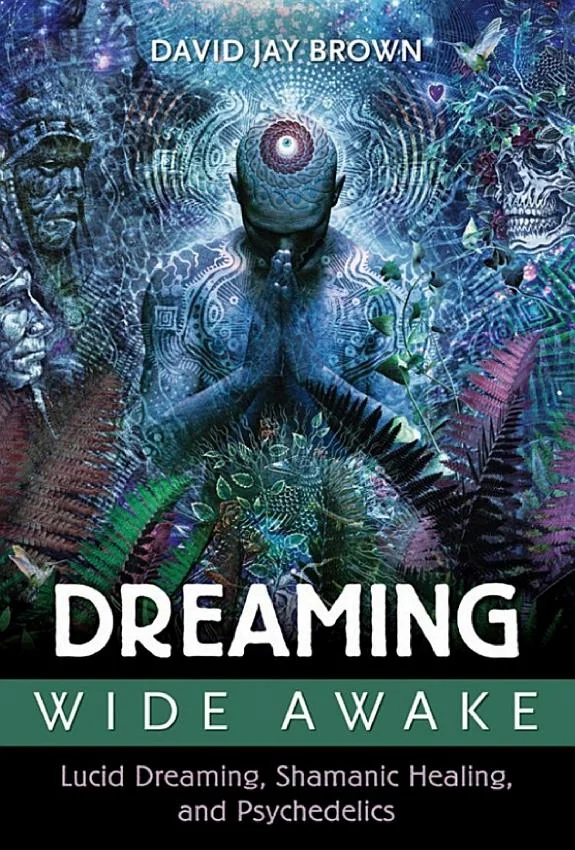
Dreaming Wide Awake
 74
74

Dreaming Wide Awake
David Jay Brown’s Dreaming Wide Awake presents a sprawling, often fascinating, survey of consciousness exploration. The book’s strength lies in its breadth, bringing together disparate ideas and experiences under one cover. Brown’s personal engagement with many of these topics lends an authentic voice, particularly when he discusses his own altered states or interviews fellow explorers. However, the sheer volume of material can sometimes lead to a lack of depth; certain concepts are introduced and then quickly moved past. A particularly compelling thread is the exploration of lucid dreaming as a controllable state for insight, a concept he returns to with consistent clarity. While occasionally feeling like a collection of notes rather than a fully integrated argument, the work offers substantial material for anyone interested in the liminal spaces of the mind. It’s a valuable, if somewhat unwieldy, compendium for the curious.
📝 Description
74
### What It Is Dreaming Wide Awake, first published in 2016 by David Jay Brown, is a compilation of writings and research that interrogates the nature of consciousness, perception, and reality. It gathers diverse perspectives, often drawing from altered states and esoteric traditions, to present a multifaceted view of human experience. The book’s structure is non-linear, presenting a collection of essays, interviews, and reflections that challenge conventional understandings of the mind.
### Who It's For This work is intended for the intellectually curious individual seeking to explore the boundaries of consciousness beyond ordinary waking life. It will appeal to those interested in psychology, parapsychology, comparative religion, and the philosophical implications of altered states of consciousness. Readers open to unconventional ideas and empirical investigation into subjective experience will find fertile ground within its pages.
### Historical Context The book emerges from a late 20th and early 21st-century milieu where interest in consciousness studies, psychedelics, and transpersonal psychology experienced a resurgence. Following the initial wave of psychedelic research in the 1950s and 60s, and the subsequent cultural and political backlash, the 2000s saw renewed academic and popular engagement. Brown’s work stands in dialogue with figures like Stanislav Grof and the broader tradition of exploration into non-ordinary states, often informed by cross-cultural shamanic practices and Eastern contemplative traditions.
### Key Concepts Central to Dreaming Wide Awake is the exploration of non-ordinary states of consciousness as valid avenues for understanding reality. This includes examining the phenomenology of dreams, psychedelic experiences, and mystical states. The book also delves into the potential for these states to unlock creativity, offer healing, and provide insights into the fundamental nature of existence. It questions the primacy of consensus reality, suggesting that subjective experience holds crucial, often overlooked, information.
💡 Why Read This Book?
• Gain an understanding of how altered states, such as lucid dreaming and psychedelic experiences, can be used as tools for self-discovery, drawing on specific case studies and Brown's research. • Explore the historical and cultural context of consciousness studies, referencing figures and movements that shaped the field since the mid-20th century. • Encounter diverse perspectives on the nature of reality and perception, challenging the reader's assumptions about waking consciousness through discussions of non-ordinary states.
⭐ Reader Reviews
Honest opinions from readers who have explored this book.
❓ Frequently Asked Questions
What is the primary focus of David Jay Brown's 'Dreaming Wide Awake'?
The book primarily focuses on exploring non-ordinary states of consciousness, including dreams, psychedelic experiences, and mystical states, as valid avenues for understanding reality and human potential.
When was 'Dreaming Wide Awake' first published?
'Dreaming Wide Awake' was first published in 2016, reflecting a contemporary interest in consciousness studies and alternative states of awareness.
Does the book contain personal anecdotes from the author?
Yes, David Jay Brown often includes personal reflections and experiences within the book, lending an authentic voice to his exploration of consciousness.
Who are some of the individuals or traditions that influence the book's content?
The book draws from various traditions and individuals involved in consciousness research, comparative mysticism, and transpersonal psychology, often engaging with concepts from figures like Stanislav Grof.
Is 'Dreaming Wide Awake' suitable for beginners in esoteric studies?
The book can be accessible to beginners interested in the topic, though its wide-ranging nature and academic leanings might be best appreciated by those with some prior curiosity about consciousness and altered states.
What kind of research does the book present?
It presents a blend of anecdotal evidence, personal experience, philosophical inquiry, and references to scientific and historical research concerning consciousness, dreams, and altered states.
🔮 Key Themes & Symbolism
Consciousness and Perception
The work fundamentally questions the limitations of ordinary, consensus reality by presenting evidence and arguments for the validity of non-ordinary states of consciousness. Brown examines how dreams, psychedelic states, and mystical experiences offer alternative ways of perceiving and understanding the world. The book suggests that these states are not mere illusions but potential gateways to deeper truths about existence, consciousness, and the self, often drawing parallels with shamanic traditions and contemplative practices.
The Nature of Reality
Dreaming Wide Awake posits that reality is far more fluid and multifaceted than typically assumed. Through explorations of altered states, the book challenges materialistic and purely empirical views of existence. It suggests that subjective experience holds significant epistemological weight, offering insights that conventional scientific paradigms might overlook. The text invites readers to consider the role of consciousness in shaping perceived reality and the potential for expanded awareness.
Personal Transformation and Insight
A significant theme is the potential for altered states of consciousness to facilitate profound personal growth, healing, and insight. Brown highlights how experiences beyond the ordinary can lead to breakthroughs in creativity, emotional processing, and spiritual understanding. The book showcases individuals who have utilized these states to overcome limitations, gain new perspectives on life challenges, and achieve a greater sense of purpose and connection.
Cross-Cultural and Historical Perspectives
The book situates the exploration of consciousness within a broader human and historical context. It references diverse cultural practices, from ancient shamanism to modern psychedelic therapy and Eastern meditation techniques. By examining these varied approaches, Brown illustrates a perennial human quest to understand the mind and its potential, suggesting common threads across different traditions and eras.
💬 Memorable Quotes
“Ordinary waking consciousness is but one small island in the vast ocean of awareness.”
— This concept highlights the book's central thesis: that our everyday perception is limited and that numerous other states of being and knowing exist, often unexplored.
“Dreams are not just random neural firings; they are messages from the deeper self.”
— This interpretation emphasizes the value placed on dream states within the book, viewing them as meaningful communications rather than mere biological byproducts.
“Psychedelic substances can act as keys, unlocking doors to inner landscapes.”
— This metaphor suggests that certain mind-altering substances are viewed not as recreational drugs but as tools for accessing hidden or inaccessible dimensions of consciousness.
“The boundary between the self and the universe is far more permeable than we believe.”
— This idea points to a theme of interconnectedness, suggesting that the separation we perceive between ourselves and the external world is an illusion.
“Through conscious exploration, we can learn to navigate altered states with intention and purpose.”
— This emphasizes the book's focus on agency and skill development within non-ordinary states, framing them as areas that can be consciously explored and understood.
🌙 Esoteric Significance
Tradition
The work draws heavily from the broad currents of Western Esotericism and Eastern contemplative traditions, particularly those focused on consciousness, altered states, and the nature of reality. It aligns with traditions that posit a non-material dimension to existence and emphasize subjective experience as a valid source of knowledge. While not strictly adhering to a single lineage like Hermeticism or Gnosticism, it shares their interest in hidden knowledge and the potential for human transformation through inner exploration.
Symbolism
The primary 'symbol' explored is consciousness itself, presented not as a fixed state but as a vast, fluid ocean with many islands. Dreams serve as a potent symbol for the subconscious and the hidden aspects of the psyche, often carrying symbolic messages. The concept of 'doors' or 'gateways' also appears, symbolizing moments or states (like lucid dreaming or psychedelic experiences) that allow passage to different levels of awareness or reality.
Modern Relevance
Dreaming Wide Awake remains relevant for contemporary thinkers and practitioners in fields like transpersonal psychology, consciousness studies, and psychedelic-assisted therapy. It speaks to a modern audience grappling with questions of meaning, subjective experience, and the limitations of purely materialistic worldviews. Its exploration of lucid dreaming also connects with modern mindfulness and self-awareness practices, offering accessible techniques for inner exploration.
👥 Who Should Read This Book
• Individuals curious about the full spectrum of human consciousness, especially those interested in dreams, meditation, and the effects of psychedelics. • Researchers and students of psychology, comparative religion, and philosophy seeking to understand non-ordinary states of awareness and their implications. • Seekers interested in alternative paths to self-discovery and spiritual insight, looking beyond conventional doctrines for experiential knowledge.
📜 Historical Context
Published in 2016, Dreaming Wide Awake emerged during a period of renewed scientific and cultural interest in psychedelics and consciousness research, a trend that had been building since the early 2000s. This era saw figures like Rick Doblin and the Multidisciplinary Association for Psychedelic Studies (MAPS) pushing for clinical trials, challenging the shadows cast by the widespread cultural and legal suppression of such research following the 1960s and 70s. Brown's work engages with this contemporary renaissance while also grounding itself in earlier explorations, such as those pioneered by Stanislav Grof and his work with holotropic breathwork. It stands apart from more purely academic or clinical texts by integrating personal experience and a broader philosophical inquiry, often drawing from non-Western contemplative traditions which offered alternative frameworks for understanding consciousness when Western science was largely dismissive.
📔 Journal Prompts
Reflect on the concept of 'awareness as an ocean' and how your waking perception represents just one part.
Consider the symbolic messages within your own dreams, as discussed in the context of non-ordinary states.
Explore the idea of 'gateways' to consciousness and how practices like lucid dreaming might function as such.
Analyze how the book's exploration of reality challenges your current assumptions about the material world.
Document an experience where your perception of reality shifted significantly, and relate it to the book's themes.
🗂️ Glossary
Non-ordinary states of consciousness
Refers to subjective experiences that differ significantly from the typical waking state, including dreams, meditative states, mystical experiences, and those induced by psychoactive substances.
Consensus reality
The shared agreement or common understanding of reality that most people within a society or culture hold, often contrasted with individual or altered subjective experiences.
Lucid dreaming
A type of dream in which the dreamer becomes aware that they are dreaming and can often exert some degree of control over the dream narrative and environment.
Transpersonal psychology
A branch of psychology that studies transpersonal or spiritual aspects of the human experience, such as altered states of consciousness, mystical experiences, and self-transcendence.
Phenomenology
The philosophical study of the structures of experience and consciousness from the first-person point of view, focusing on how things appear to us.
Epistemology
The branch of philosophy concerned with the theory of knowledge, investigating its nature, scope, and justification.
Holotropic Breathwork
A form of breathwork developed by Stanislav Grof, designed to facilitate non-ordinary states of consciousness for therapeutic and self-exploration purposes.