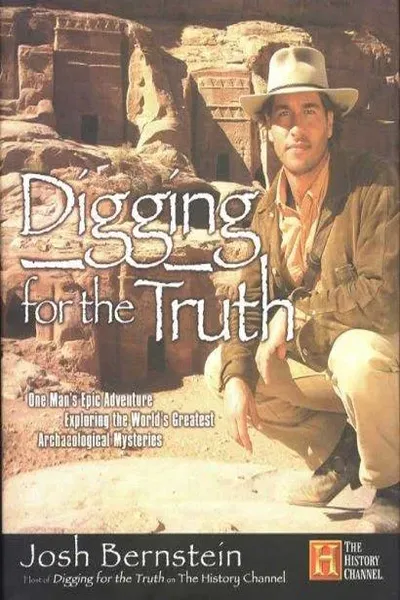
Digging for the Truth

 83
83

Digging for the Truth
Josh Bernstein’s "Digging for the Truth" arrives with the stark, unadorned directness one might expect from a 1975 publication seeking to bypass the usual academic obfuscation. The book operates less as a flowing narrative and more as a series of interconnected propositions, each demanding careful consideration. Its strength lies in its unwavering focus on the investigative process, presenting esoteric concepts not as settled dogma but as avenues for persistent exploration. The primary limitation is its density; readers accustomed to more guided, introductory texts might find the lack of explicit signposting challenging. A particularly striking section discusses the symbolic weight of geometric forms, arguing they are not mere abstractions but fundamental expressions of cosmic order, a point Bernstein elaborates with uncommon rigor.
"Digging for the Truth" offers a rigorous, if demanding, manual for the dedicated seeker.
📝 Description
83
### What It Is Josh Bernstein's "Digging for the Truth," first published in 1975, presents a unique exploration of hidden knowledge and esoteric systems. It is not a narrative in the conventional sense but rather a compendium of ideas, symbols, and historical threads that challenge mainstream understanding of reality. The work approaches its subjects with a directness that eschews academic pretense, aiming instead to uncover fundamental principles believed to be obscured by common perception.
### Who It's For This book is intended for the serious inquirer, the individual who questions established paradigms and seeks to understand the underlying currents of mystical and philosophical thought. It appeals to those who are already familiar with esoteric concepts or who possess a strong intellectual curiosity about subjects often relegated to the fringes of accepted knowledge. Readers should come prepared for dense material that requires contemplation rather than passive consumption.
### Historical Context Emerging in the mid-1970s, "Digging for the Truth" arrived during a period of renewed interest in occultism, mysticism, and alternative philosophies, following the counter-cultural movements of the 1960s. This era saw a proliferation of spiritual seeking and a questioning of materialist worldviews. Bernstein's work contributed to this landscape by offering a particular lens through which to view ancient wisdom and esoteric traditions, placing it alongside other influential texts of the time that sought to bridge the gap between the spiritual and the material.
### Key Concepts The core of Bernstein's work revolves around the idea that truth is not merely discovered but actively unearthed through diligent inquiry and a willingness to engage with unconventional perspectives. It posits that certain symbolic languages and ancient systems hold keys to understanding consciousness and the cosmos. The text suggests that these hidden truths are accessible to those who dedicate themselves to their study, implying a structured approach to esoteric knowledge acquisition that transcends simple belief.
💡 Why Read This Book?
• Gain a framework for understanding esoteric symbols, particularly the significance of geometric patterns as articulated by Bernstein, allowing for a deeper interpretation of ancient texts and art. • Learn a methodology for approaching hidden knowledge, as presented in the book's emphasis on active 'unearthing' rather than passive reception of information, applicable to any field of study. • Understand the context of 1970s esoteric thought, appreciating how "Digging for the Truth" engaged with contemporary spiritual seeking and alternative philosophies.
⭐ Reader Reviews
Honest opinions from readers who have explored this book.
❓ Frequently Asked Questions
What is the primary focus of Josh Bernstein's "Digging for the Truth"?
The book focuses on uncovering hidden knowledge and esoteric systems through diligent inquiry. It suggests that symbolic languages and ancient philosophies hold keys to understanding consciousness and the cosmos, accessible through dedicated study.
When was "Digging for the Truth" first published and what was the intellectual climate?
It was first published in 1975, during a period of heightened interest in occultism and alternative philosophies, influenced by the counter-cultural movements of the preceding decade.
Does the book offer practical exercises for esoteric study?
While not a manual of spells or rituals, the book emphasizes an investigative approach. Its practical application lies in the reader's commitment to contemplation and the active 'unearthing' of principles, rather than prescribed practices.
What kind of reader would benefit most from "Digging for the Truth"?
Serious inquirers who question established paradigms and are curious about mystical thought will benefit. It's suited for those with some familiarity with esoteric concepts or a strong desire to explore them.
Is "Digging for the Truth" considered a foundational text in any particular esoteric tradition?
While not tied exclusively to one lineage, its exploration of symbolic languages and cosmic order aligns with Hermetic and Gnostic currents, offering a unique perspective within the broader spectrum of esoteric thought.
What is the author's approach to presenting complex ideas?
Josh Bernstein adopts a direct, unadorned style, presenting concepts as propositions for exploration rather than definitive truths. This approach demands active engagement and contemplation from the reader.
🔮 Key Themes & Symbolism
The Active Pursuit of Knowledge
Bernstein frames the acquisition of esoteric truth not as passive reception but as an active, investigative process. The title itself, "Digging for the Truth," suggests a deliberate excavation of obscured principles. This theme posits that genuine understanding requires effort, persistence, and a willingness to challenge conventional assumptions. It implies that knowledge is not simply given but must be unearthed, suggesting a methodology for approaching complex philosophical and mystical ideas that values personal engagement and critical examination above all else.
Symbolic Language as Cosmic Blueprint
A central tenet explored in the book is the profound significance of symbolic language, particularly geometric forms, as a blueprint for understanding the cosmos and consciousness. Bernstein suggests that these symbols are not arbitrary but are fundamental expressions of underlying universal laws. The work implies that by decoding these symbols, one can gain access to deeper layers of reality and comprehend the interconnectedness of all things. This perspective elevates symbols from mere representations to active keys that unlock hidden structures of existence.
Challenging Perceptual Frameworks
The book consistently challenges the reader's ordinary perception of reality, urging a re-evaluation of what is considered known or factual. It operates on the premise that mainstream understanding often obscures more profound truths. Bernstein encourages a departure from accepted paradigms, suggesting that esoteric knowledge resides in the spaces between conventional thought. This theme calls for a critical stance towards commonly held beliefs and an openness to alternative interpretations of history, philosophy, and the nature of existence itself.
The Structure of Esoteric Systems
Bernstein's work dissects and presents the inherent structures within various esoteric traditions. It moves beyond simple descriptions to analyze the underlying logic and organizing principles that govern these systems. The book suggests that these structures are not arbitrary but reflect a coherent, albeit hidden, order of the universe. By illuminating these frameworks, the author provides readers with a means to navigate and understand complex metaphysical doctrines, emphasizing the systematic nature of hidden wisdom.
💬 Memorable Quotes
“Truth is not found, but excavated.”
— This aphorism encapsulates Bernstein's core thesis: that knowledge, particularly esoteric knowledge, requires active effort and investigation rather than passive discovery. It emphasizes the labor involved in uncovering deeper realities.
“The geometric is the language of creation.”
— This statement highlights the book's focus on symbolism, suggesting that fundamental geometric shapes are not mere abstractions but represent the underlying principles and order of the universe itself.
“Perception is the first layer of reality.”
— This idea underscores the book's emphasis on challenging ordinary viewpoints. It implies that our default way of seeing the world can obscure deeper truths, and that altering perception is key to understanding.
“Systems of thought are maps, not territories.”
— This quote suggests that all conceptual frameworks, including esoteric ones, are aids to understanding reality rather than reality itself. It encourages critical engagement with any system of knowledge.
“The obscured is often the most vital.”
— Bernstein posits that the most important truths are frequently hidden or overlooked by mainstream thought. This encourages a search for knowledge in unconventional places and perspectives.
🌙 Esoteric Significance
Tradition
The work engages broadly with Hermetic, Gnostic, and Neoplatonic currents, focusing on the idea of hidden correspondences and symbolic languages that underpin reality. It departs from strict adherence to any single tradition, instead seeking to identify universal principles across diverse esoteric systems. Bernstein's approach emphasizes the 'gnosis' or direct knowing sought in Gnosticism but frames it as an investigative pursuit rather than purely revelatory.
Symbolism
Central to the book is the symbolism of geometric forms, particularly the triangle, square, and circle, which are presented as fundamental expressions of cosmic order and consciousness. The concept of 'light' and 'shadow' is also explored, representing known versus hidden knowledge, and the process of 'unearthing' signifies the active engagement required to move from the latter to the former.
Modern Relevance
Contemporary thinkers in fields like comparative mythology, depth psychology, and transpersonal studies often draw on the kind of symbolic analysis found in Bernstein's work. Its emphasis on the structural integrity of esoteric systems and the idea of knowledge as an 'excavated' truth continues to inform practitioners and researchers seeking to understand the enduring patterns of mystical thought and consciousness.
👥 Who Should Read This Book
• Students of comparative religion and philosophy seeking to understand the structural commonalities in esoteric thought, particularly the role of symbolism. • Individuals interested in the intellectual currents of the 1970s spiritual exploration, who wish to engage with texts that offered a more analytical perspective. • Dedicated seekers and critical thinkers who are prepared to engage with dense material and actively 'unearth' underlying principles rather than seeking simple answers.
📜 Historical Context
First published in 1975, "Digging for the Truth" emerged during a period of intense spiritual and philosophical exploration in the West, fueled by the counterculture and a growing disillusionment with purely materialistic worldviews. The 1970s saw a surge in interest in Eastern philosophies, mysticism, the occult, and alternative forms of consciousness exploration. Bernstein's work positioned itself within this milieu, offering a more analytical and investigative approach to esoteric concepts, distinct from the more purely experiential or dogmatic offerings of some contemporary movements. While figures like Idries Shah were exploring Sufism and esoteric traditions from a historical perspective, Bernstein's focus was more on the underlying structure and symbolic language common across various systems, aiming to provide a framework for critical inquiry rather than adherence to a specific doctrine. The book’s directness and its focus on 'unearthing' hidden knowledge resonated with seekers looking for substance beyond superficial spiritual trends.
📔 Journal Prompts
The principle of 'unearthing truth': How does this metaphor shape your approach to learning?
Reflect on the symbolic meaning of geometric forms presented in the text.
Analyze a personal belief system through the lens of 'systems of thought are maps, not territories'.
Consider how 'obscured' knowledge might be vital in your own life or field of study.
Explore the idea that 'perception is the first layer of reality' in your daily observations.
🗂️ Glossary
Esoteric Systems
Frameworks of belief and practice concerning hidden knowledge, often dealing with the nature of reality, consciousness, and the cosmos, typically accessible only to initiates or dedicated students.
Symbolic Language
A system of signs, images, or objects that represent deeper meanings or abstract concepts, often used in mystical and philosophical traditions to convey complex ideas indirectly.
Cosmic Order
The belief in an inherent structure, harmony, and intelligence governing the universe, often understood through mathematical principles, divine laws, or interconnected energetic forces.
Unearthing Truth
A metaphor for the active, investigative process of discovering hidden knowledge or fundamental principles, implying diligent effort and excavation from beneath layers of ignorance or misperception.
Perceptual Frameworks
The mental structures, beliefs, and assumptions through which individuals interpret and understand the world around them.
Gnosis
Direct, intuitive knowledge or spiritual insight, particularly a type of knowing that leads to salvation or liberation, central to Gnostic traditions.
Hermeticism
A philosophical and religious tradition based on writings attributed to Hermes Trismegistus, emphasizing the correspondence between the macrocosm and microcosm and the pursuit of spiritual knowledge.