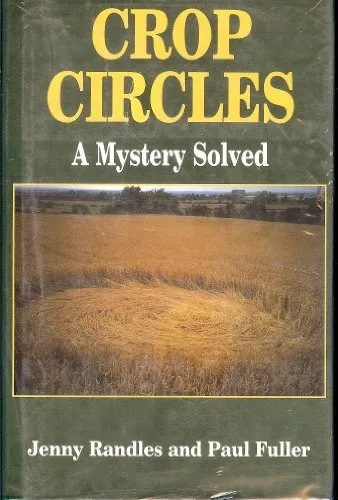
Crop Circles
 74
74

Crop Circles
Randles and Fuller's 'Crop Circles' presents a solid, if dated, foundation for understanding the phenomenon as it was perceived in the early 1990s. Its strength lies in its systematic approach, cataloging formations and early investigative findings with a commendable lack of sensationalism for its time. The authors’ focus on the physical evidence, such as the precise geometric construction and the reported effects on crops, provides a compelling counterpoint to purely skeptical explanations. However, the book’s primary limitation is its publication date; it cannot account for the dramatic evolution in complexity and the subsequent decades of research and documented hoaxes that have reshaped the discourse. The detailed examination of the 1991 formations, for instance, now serves more as a historical marker than current analysis. Nevertheless, for understanding the initial serious inquiry into crop circles, it remains a valuable document.
📝 Description
74
### What It Is
'Crop Circles' by Jenny Randles and Paul Fuller, first published in 1993, is an early comprehensive examination of the enigmatic formations that began appearing in agricultural fields with increasing frequency and complexity. The book meticulously documents a range of cases, analyzing patterns, scale, and the sheer physical impossibility of many formations being created by conventional means. It moves beyond mere cataloging, seeking to understand the phenomenon's origins and implications.
### Who It's For
This work is geared towards individuals intrigued by unexplained aerial phenomena, esoteric mysteries, and the intersection of folklore, science, and belief. It will appeal to researchers of anomalous patterns, those interested in the early days of crop circle investigation, and anyone seeking a structured, investigative approach to a subject often clouded by sensationalism. Readers prepared to engage with detailed observations and consider unconventional explanations will find it particularly rewarding.
### Historical Context
Published in 1993, 'Crop Circles' emerged during a period when the phenomenon was gaining significant global attention, moving from localized occurrences to widespread, complex designs. This era saw a burgeoning interest in ufology and paranormal studies, with figures like Jacques Vallée publishing influential works on unexplained aerial phenomena. The book arrived as the debate intensified between skeptics attributing formations to hoaxes and those exploring more extraordinary causes, positioning itself as a serious inquiry into the evidence.
### Key Concepts
The book explores the evolution of crop circle designs from simple circles to intricate geometric patterns, a progression that challenged initial hoax theories. It examines the physical characteristics of affected crops, such as bent nodes and altered plant structures, which proponents argue point to non-human causation. Furthermore, it considers the psychological and societal impact of these formations, how they capture the public imagination, and the potential for them to represent a form of communication or manifestation.
💡 Why Read This Book?
• Gain an understanding of the early investigative methods applied to crop circles, including specific analysis of formations from the late 1980s and early 1990s, providing historical context not found in later works. • Explore the concept of 'bent nodes' and altered plant physiology as presented by Randles and Fuller, offering specific physical evidence discussed in the book that proponents argue supports non-human origins. • Appreciate the historical development of crop circle complexity, examining the progression from simple circles to elaborate geometric designs documented in the book, demonstrating an evolution that challenged early hoax theories.
⭐ Reader Reviews
Honest opinions from readers who have explored this book.
❓ Frequently Asked Questions
When was Jenny Randles and Paul Fuller's 'Crop Circles' first published?
Jenny Randles and Paul Fuller's 'Crop Circles' was first published in 1993, marking it as an important early work in the serious investigation of these agricultural anomalies.
What kind of evidence does 'Crop Circles' examine regarding crop formation causation?
The book examines physical evidence such as the precise geometric construction of formations, the bending of plant nodes without breaking, and altered plant growth, suggesting non-human origins.
Does the book attribute crop circles to a specific entity or group?
While exploring various hypotheses, 'Crop Circles' does not definitively attribute the formations to a single specific entity. It presents evidence and discusses theories, encouraging reader analysis.
How does 'Crop Circles' differ from more recent books on the subject?
Being published in 1993, it predates many complex formations and documented hoaxes, offering a snapshot of the phenomenon's early investigative phase and evolving public perception.
Is 'Crop Circles' suitable for skeptics?
The book presents detailed observations and investigative approaches that may challenge purely skeptical viewpoints by focusing on empirical data and the limitations of conventional explanations.
What is the significance of the year 1991 mentioned in relation to crop circles?
1991 was a pivotal year for crop circles, with numerous highly complex formations appearing globally, which the book analyzes as evidence of increasing sophistication and a challenge to hoax theories.
🔮 Key Themes & Symbolism
Geometric Precision
The work meticulously documents the increasing geometric sophistication of crop circles, moving beyond simple circles to intricate fractals and algebraic designs. Randles and Fuller highlight the mathematical accuracy and scale of these formations, questioning how they could be created overnight without detection using conventional tools. This precision is presented as a key characteristic demanding explanation, pushing the narrative beyond simple pranks.
Physical Anomalies
A central theme is the examination of physical changes observed in crops within the formations. The authors detail phenomena such as 'bent nodes'—stems bent at precise angles without breaking—and altered cellular structures in the plants. These reported anomalies are presented as evidence that standard mechanical explanations, like rolling or stomping, are insufficient to account for the observed effects.
Evolution of the Phenomenon
Randles and Fuller track the development of crop circles from their initial appearances to the complex designs of the late 1980s and early 1990s. They argue that the accelerating complexity and scale suggest an evolving phenomenon, possibly indicative of learning or increasing capability by the creators, whatever their nature might be.
Investigative Methodology
The book underscores the importance of rigorous, unbiased investigation. It contrasts the approaches of skeptics, hoaxers, and those seeking deeper meanings. The authors advocate for a systematic analysis of evidence, including photographic documentation, ground surveys, and consideration of witness accounts, to approach an understanding of the phenomenon.
💬 Memorable Quotes
“The formations became increasingly complex and widespread throughout the 1980s.”
— This paraphrased concept highlights the accelerating sophistication and geographical reach of crop circles, suggesting a dynamic phenomenon rather than static occurrences.
“Stems were found bent at precise angles, often just above ground level.”
— This refers to the phenomenon of 'bent nodes,' a specific physical characteristic observed in affected crops that proponents argue is difficult to replicate through simple hoaxing methods.
“The sheer scale and detail of some designs defied easy explanation.”
— This interpretation emphasizes the magnitude and intricate nature of many crop circle patterns, presenting a challenge to conventional theories of their creation based on human effort alone.
“Early investigations focused on photographic evidence and ground-level examination.”
— This highlights the foundational investigative techniques employed during the period the book covers, stressing the empirical data gathered from the field.
“The phenomenon captured the public imagination globally.”
— This interpretation speaks to the widespread fascination and media attention crop circles generated, indicating their significant cultural impact beyond agricultural fields.
🌙 Esoteric Significance
Tradition
While not strictly aligned with a single esoteric lineage, 'Crop Circles' engages with themes common in esoteric thought, particularly concerning symbolic communication and manifestation. It touches upon ideas found in some interpretations of Hermeticism regarding patterns in nature reflecting cosmic order, and Gnostic concepts of hidden knowledge or intelligences interacting with the material world. The book's focus on geometric perfection and potential non-human agency aligns with contemporary esoteric interests in extraterrestrial contact and consciousness.
Symbolism
The primary symbols explored are the geometric patterns themselves. Simple circles can be interpreted as representing wholeness, unity, or beginnings. More complex designs, like fractals or mandalas, are often seen in esoteric traditions as representations of cosmic order, sacred geometry, or the unfolding of consciousness. The act of formation in agricultural fields also carries symbolic weight, suggesting a connection between earthly sustenance and celestial or unknown influences.
Modern Relevance
Contemporary esoteric circles continue to analyze crop circles, drawing on foundational works like Randles and Fuller's. Modern interpretations often integrate concepts from consciousness studies, quantum physics, and New Age spirituality, viewing formations as potential messages, energy conduits, or manifestations of collective consciousness. Thinkers exploring sacred geometry, earth energies, and potential forms of non-human communication often reference the early, well-documented cases examined in this book.
👥 Who Should Read This Book
• Researchers of anomalous phenomena: Those interested in unexplained aerial events and physical anomalies will find a detailed catalog and early analysis of crop circle evidence. • Students of folklore and mythology: Individuals studying modern folklore, mass psychology, and the emergence of contemporary myths will gain insight into a significant 20th-century phenomenon. • Skeptics and Believers: Anyone seeking to understand the historical arguments and evidence presented by early investigators, before the full impact of documented hoaxes became widely known.
📜 Historical Context
Emerging in 1993, Jenny Randles and Paul Fuller's 'Crop Circles' arrived at a crucial juncture in the phenomenon's history. The late 1980s and early 1990s saw an explosion in the complexity and number of formations, moving far beyond simple circles. This period coincided with a broader public and academic interest in UFOlogy and unexplained phenomena, influenced by thinkers like Jacques Vallée and John Keel. The book's significance lies in its attempt to provide a structured, evidence-based inquiry amidst a growing dichotomy: on one side, the increasing sophistication of documented hoaxes, notably by Doug Bower and Dave Chorley who confessed in 1991, and on the other, burgeoning theories suggesting more mysterious origins, including atmospheric plasma vortices or even non-human intelligence. Randles and Fuller positioned their work as a critical examination of the physical evidence, seeking to differentiate inexplicable formations from those demonstrably fabricated, a task that proved increasingly challenging as the phenomenon evolved.
📔 Journal Prompts
The precise geometric construction of crop circles, as documented by Randles and Fuller.
Observed physical anomalies in crop stems, such as bent nodes.
The perceived evolution of crop circle designs from 1993 onwards.
The balance between empirical evidence and speculative interpretation in crop circle studies.
The global fascination surrounding the crop circle phenomenon.
🗂️ Glossary
Bent Node
A point on a plant stem where it bends sharply without breaking. This is often cited as evidence suggesting a non-mechanical method of formation.
Sacred Geometry
The study of geometric shapes and proportions that are considered fundamental to the structure of the universe and are often found in nature and ancient architecture.
Hoax
An act intended to deceive or trick. In the context of crop circles, this refers to deliberate human creation of formations to mislead investigators or the public.
Phenomenon
An observable fact or event, especially one whose cause or explanation is in question. Here, it refers specifically to the appearance of crop circles.
Ufology
The study of unidentified flying objects (UFOs) and related phenomena. It often involves investigating sightings, alleged encounters, and physical evidence.
Plasma Vortex Theory
A hypothesis suggesting that some crop circles are formed by swirling masses of ionized gas (plasma) in the atmosphere, capable of flattening crops rapidly.
Formation
Refers to a specific pattern or design created within a crop field. The term encompasses the entire arrangement of flattened or altered plants.