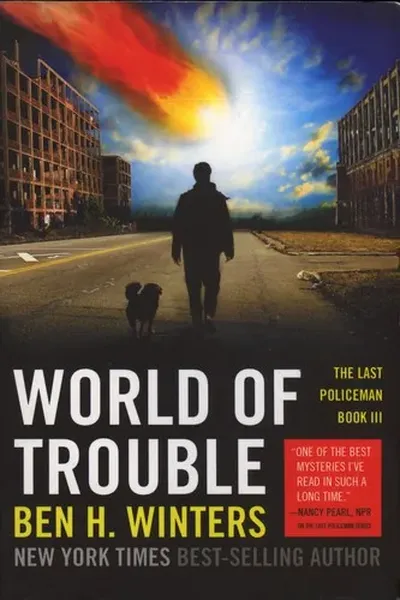
Countdown city

 71
71

Countdown city
Ben H. Winters’ Countdown City presents a chillingly effective premise: a city systematically dismantled, block by block, leaving its inhabitants to reckon with an impossible reality. The novel’s strength lies in its relentless pacing and the stark, almost clinical, depiction of societal disintegration. Winters masterfully uses the physical vanishing of a city as a metaphor for psychological fragmentation. However, the narrative occasionally sacrifices character depth for the sake of its conceptual engine, leaving some motivations feeling as hollow as the spaces where buildings once stood. A particularly striking sequence involves the inexplicable disappearance of the city's central park, a concrete symbol of lost nature and communal space, which forces the protagonist to confront the arbitrary nature of his own memories. The book’s ultimate impact is that of a stark, unsettling parable on the fragility of order and the human need for stable ground, even when that ground is demonstrably vanishing.
📝 Description
71
Ben H. Winters' 2013 novel imagines a city systematically dismantled, mirroring a psychological unravelling.
Countdown City presents a near-future scenario where a metropolis is meticulously erased, piece by piece. This physical disintegration serves as a backdrop for the psychological unravelling of its inhabitants. The narrative questions how individuals confront the erosion of their known world and the arbitrary nature of existence as familiar structures vanish. Winters' work probes the human psyche under duress, examining coping mechanisms when reality itself seems to dissolve. It invites contemplation on the stability of perception and the constructed narratives that anchor identity. The novel focuses on the inhabitants' struggle to maintain their sense of self when the external world loses its coherence, forcing a confrontation with internal states.
While not explicitly occult, Countdown City taps into esoteric traditions concerned with the nature of reality and consciousness. Its depiction of a city's systematic erasure parallels Gnostic ideas of a flawed demiurge or illusory material world. The focus on psychological unravelling when external structures collapse echoes themes found in certain mystical philosophies that emphasize inner experience over material existence. The novel questions the solidity of memory and history, aligning with philosophical inquiries into subjective experience and the constructed nature of perceived reality, common in esoteric thought.
💡 Why Read This Book?
• Gain an understanding of 'controlled decay' as a narrative device, mirroring real-world anxieties about societal fragility, as explored through the systematic dismantling of the city in 2013. • Experience the psychological impact of existential dissolution, as the novel depicts characters confronting the erosion of their environment and, by extension, their identities. • Contemplate the nature of memory and reality when external anchors vanish, prompted by the book's exploration of how familiar landmarks disappearing affects personal history.
⭐ Reader Reviews
Honest opinions from readers who have explored this book.
❓ Frequently Asked Questions
What is the central concept of 'controlled decay' in Countdown City?
Controlled decay in Countdown City refers to the systematic, deliberate dismantling and removal of the city's infrastructure and landmarks. This process is presented as an inexplicable phenomenon that forces inhabitants to confront the breakdown of their known reality.
Does Countdown City have a specific genre classification?
While primarily speculative fiction, Countdown City blends elements of science fiction, existentialism, and psychological thriller. It uses a near-future setting to explore philosophical questions about society and individual consciousness.
When was Countdown City first published and what was the cultural climate?
Countdown City was first published in 2013. This period was marked by growing concerns over digital life, economic instability, and the manipulation of information, themes that resonate with the novel's depiction of societal breakdown.
Who is the author of Countdown City?
The author of Countdown City is Ben H. Winters. He is known for his work in speculative fiction that often delves into societal anxieties and the human condition.
What kind of philosophical themes does Countdown City explore?
The novel explores themes of existentialism, the nature of reality, the fragility of identity when external structures disappear, and the psychological effects of pervasive, inexplicable change.
Is Countdown City a dystopian novel?
While it shares elements with dystopian fiction through its depiction of societal collapse, Countdown City is more accurately described as speculative or philosophical fiction. Its focus is on the psychological and existential implications rather than a prescriptive political warning.
🔮 Key Themes & Symbolism
The Unraveling City
The novel's central premise is the systematic erasure of a functioning city. This 'controlled decay' transforms the urban landscape into a void, forcing inhabitants to confront a reality that defies logic. The physical disappearance of buildings, streets, and familiar landmarks serves as a potent metaphor for the erosion of societal structures and the perceived stability of the world. This theme probes how human beings construct their reality and identity based on external markers and the psychological impact when these anchors are removed.
Manufactured Reality
Countdown City questions the nature of perceived reality. As the city is dismantled, the inhabitants are left to grapple with an impossible situation that challenges their understanding of what is real. The narrative explores the human tendency to create narratives and explanations, even for phenomena that defy rational comprehension. It delves into the psychological coping mechanisms employed when faced with an inexplicable and relentless dissolution of the familiar, suggesting our sense of normalcy is a fragile construct.
Existential Fragmentation
The systematic destruction of the city mirrors a fragmentation of individual identity and consciousness. Stripped of their environments, possessions, and familiar social contexts, characters are forced to confront their sense of self in a void. The work examines how memory, personal history, and social roles contribute to identity, and what remains when these are systematically removed or rendered irrelevant by an incomprehensible external force.
The Psychology of Collapse
This theme focuses on the human response to societal breakdown and the erosion of order. The novel depicts a spectrum of reactions, from denial and confusion to adaptation and existential dread. It explores how individuals navigate a world where the fundamental rules of existence no longer apply, and where the future is not just uncertain but actively disappearing. The narrative probes the resilience and fragility of the human psyche under extreme, inexplicable pressure.
💬 Memorable Quotes
“The buildings just... weren't there anymore.”
— This paraphrased concept captures the surreal and inexplicable nature of the city's disappearance. It highlights the core tension of the novel: the stark contrast between the ordinary experience of waking up and the extraordinary, impossible reality of fundamental elements of one's environment vanishing without explanation.
“We started to forget what the sky looked like from certain streets.”
— This interpretation of a conceptual passage points to the gradual erosion of memory and sensory experience. As the city disappears, so do the familiar vistas and perspectives that anchor memory, suggesting that our perception of the world and our personal history are inextricably linked to physical spaces.
“The maps became useless overnight.”
— This reflects the breakdown of order and the obsolescence of systems designed to navigate a stable world. The uselessness of maps signifies the complete disorientation and the invalidation of all prior knowledge and planning in the face of the city's systematic erasure.
“Every day, a little less of the world we knew.”
— This concept encapsulates the relentless, incremental nature of the city's destruction. It emphasizes the slow, creeping dread and the psychological toll of witnessing one's reality being systematically dismantled piece by piece, rather than through a single catastrophic event.
“We were living in the space where things used to be.”
— This paraphrased idea emphasizes the inhabitants' new mode of existence. They are not just in a changed city, but in the very absence of the former city, forcing a constant confrontation with loss and the void left by what has been removed.
🌙 Esoteric Significance
Tradition
While not explicitly framed within a single esoteric tradition, Countdown City resonates with Gnostic themes of a flawed or illusory material world (the Demiurge's creation) that is systematically dismantled to reveal a more fundamental, albeit terrifying, truth. The inexplicable erasure of the city can be interpreted as a form of cosmic 'unmaking,' forcing inhabitants to confront a reality beyond their comprehension, akin to the Gnostic quest for gnosis (knowledge) to escape the material prison.
Symbolism
The 'disappearing city' itself functions as a potent symbol of impermanence and illusion, mirroring the Buddhist concept of *anatta* (non-self) or the Hermetic principle that 'as above, so below,' where the external breakdown reflects an internal, psychological dissolution. The ubiquitous presence of 'empty space' where structures once stood becomes a symbol of the void and the potential for both terror and liberation that arises from confronting nothingness.
Modern Relevance
Contemporary thinkers exploring the philosophy of simulation theory or the psychological impact of 'digital ghosts' and the ephemeral nature of online existence find resonance in Countdown City. The novel's depiction of reality’s fragility and the human need to impose order on chaos speaks to modern concerns about misinformation, the breakdown of shared narratives, and the psychological toll of living in an increasingly fragmented and uncertain world.
👥 Who Should Read This Book
• Readers interested in existential philosophy and its application in speculative fiction, seeking to explore themes of meaning and reality when external structures collapse. • Fans of literary science fiction who appreciate narratives that prioritize conceptual depth and psychological exploration over traditional plot mechanics. • Individuals drawn to novels that use a concrete, unsettling scenario – the systematic disappearance of a city – to probe deeper questions about identity, memory, and the nature of perception.
📜 Historical Context
Ben H. Winters' Countdown City, published in 2013, emerged in an era increasingly shaped by digital interconnectedness and anxieties surrounding economic precarity and information control. The novel's narrative of a systematically disappearing city can be seen as a speculative response to the growing sense of ephemeral reality in the digital age, where physical presence and tangible structures felt less absolute. It arrived at a time when authors like Dave Eggers were exploring similar themes of societal fragmentation and the impact of technology, for instance, in his 2013 novel 'The Circle,' which critiques social media's influence. While Countdown City doesn't engage directly with specific esoteric movements, its exploration of constructed realities and the psychological impact of inexplicable societal shifts taps into a broader cultural undercurrent of questioning established norms and the perceived stability of the world, a concern amplified by the lingering effects of the 2008 financial crisis.
📔 Journal Prompts
The systematic erasure of the city's landmarks and the resulting psychological impact.
Reflections on the concept of 'controlled decay' and its potential parallels in personal or societal experiences.
The function of maps and familiar routes in constructing a stable sense of reality.
Consider the psychological states of characters as their world physically diminishes.
The meaning derived from inhabiting 'the space where things used to be'.
🗂️ Glossary
Controlled Decay
The central phenomenon in the novel, referring to the systematic, deliberate dismantling and removal of the city's buildings, infrastructure, and public spaces without explanation or resistance.
Empty Space
The literal void left behind where buildings and landmarks once stood. It symbolizes absence, loss, and the unsettling confrontation with nothingness that the inhabitants face.
Manufactured Reality
The idea that the perceived reality of the city's inhabitants is constructed and fragile, capable of being disassembled. It questions the objective existence of their world versus their subjective experience of it.
Psychological Fragmentation
The breakdown of individual identity and mental stability experienced by characters as their external environment is systematically dismantled, mirroring an internal unravelling.
Obsolescence of Knowledge
The state where established knowledge, maps, and societal structures become useless or irrelevant due to the inexplicable and rapid changes occurring in the city.
Existential Void
The profound sense of meaninglessness and dread that arises from confronting the inexplicable disappearance of one's world and the perceived absence of any underlying order or purpose.
Narrative Collapse
The failure of coherent storytelling or explanation to account for the city's disappearance, forcing characters to exist without a framework for understanding their circumstances.