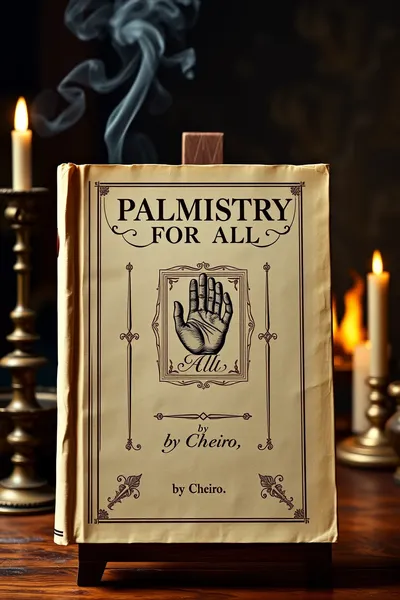
Cheiro's palmistry for all

 72
72

Cheiro's palmistry for all
Cheiro's Palmistry for All remains a remarkably accessible entry point into chiromancy, a testament to the author's skill in demystifying a complex subject. The book's strength lies in its systematic organization, guiding the reader from basic hand classifications to the intricate readings of lines and mounts. Cheiro's approach, while rooted in a specific historical context of occult revival, presents a coherent framework for interpretation that feels less like arbitrary guesswork and more like a learned discipline. A notable limitation, however, is the inherent subjectivity of interpretation. While Cheiro provides extensive mappings, the ultimate reading often relies on the practitioner's intuition, a factor the book acknowledges but doesn't fully resolve. The section on the Mount of Apollo, for instance, links its prominence to artistic talent and success, a correlation that requires a leap of faith for the skeptical reader. Despite this, the enduring appeal of Cheiro's work is its practical, step-by-step methodology, offering a solid foundation for any serious student of the palm. It serves as a valuable, if not definitive, manual for understanding the hands.
📝 Description
72
Cheiro's Palmistry for All, published in 1988, teaches a structured method for reading hands.
This book presents a systematic guide to palmistry by the chiromancer Cheiro. It breaks down the interpretation of hand lines, mounts, and shapes into clear sections. Readers learn to analyze basic hand types and then move to detailed readings of palm features and their meanings. The text aims to give individuals the tools to interpret their own palms and those of others.
It is for anyone interested in palmistry, whether new to the practice or not. The book serves as a practical manual for self-discovery and for understanding people through chiromancy. Those studying esoteric arts, occultism, or divination methods will find it a useful resource. It also appeals to readers interested in historical character assessment and fortune-telling techniques.
Cheiro, the pseudonym of Count Louis Hamon, was a well-known figure in the late 19th and early 20th centuries. This was a time of considerable interest in spiritualism and divination in Europe and America. His systematic approach to palmistry helped make the practice more widely known, reaching audiences fascinated by esoteric subjects during a period of increased inquiry.
Cheiro's work emerged during a period of heightened interest in spiritualism and divination in the late 19th and early 20th centuries. He was a contemporary of figures involved in psychical research and the occult. His systematic presentation of palmistry contributed to its popularization, making esoteric knowledge more accessible to a wider audience curious about such practices. This book is part of that tradition of making occult arts understandable.
💡 Why Read This Book?
• You will learn to identify and interpret the seven major mounts on the palm, understanding their connection to specific character traits as detailed in Cheiro's system, a methodology he refined over decades of practice. • You will gain practical skills in reading the three primary palm lines—Life, Head, and Heart—discovering how their markings and formations, as explained by Cheiro, can illuminate personal tendencies and life paths. • You will explore the significance of hand shapes, such as the Square or Spatillary, and their associated elemental correspondences, a classification system Cheiro employed to categorize fundamental personality types.
⭐ Reader Reviews
Honest opinions from readers who have explored this book.
❓ Frequently Asked Questions
What is the original publication year of Cheiro's Palmistry for All?
The original publication year for Cheiro's Palmistry for All is 1988, making it a foundational text in modern popularizations of palmistry.
Who was Cheiro and why is he important in palmistry?
Cheiro, born Count Louis Hamon, was a prominent Irish astrologer and palmist active in the late 19th and early 20th centuries. He gained international fame for his accurate readings and systematic approach, influencing many subsequent practitioners.
Does Cheiro's Palmistry for All cover hand shapes?
Yes, the book dedicates significant attention to classifying and interpreting different hand shapes, such as the Spatillary, Philosophical, and Elementary hands, linking them to core personality traits.
What are the main palm lines discussed in the book?
Cheiro's Palmistry for All meticulously details the interpretation of the Life Line, Head Line, Heart Line, and Fate Line, explaining how their characteristics reveal aspects of an individual's life and character.
Is this book suitable for absolute beginners in palmistry?
Absolutely. The book is structured to guide beginners through the fundamentals, starting with basic hand analysis and progressively moving to more complex interpretations of lines and mounts.
What are the 'mounts' in palmistry according to Cheiro?
According to Cheiro, the mounts are the fleshy, raised areas on the palm, named after planets and deities (e.g., Mount of Venus, Mount of Jupiter). Their size and prominence are interpreted to signify specific character attributes and potentials.
🔮 Key Themes & Symbolism
Interpreting Palm Lines
The book focuses heavily on the primary lines of the palm: the Life Line, Head Line, and Heart Line, alongside the Fate Line. Cheiro details how variations in their depth, clarity, breaks, and curves are indicative of health, mental faculties, emotional disposition, and life's course. For instance, a clear, unbroken Heart Line is presented as a sign of emotional stability, while a long, curved Life Line suggests vitality. The text provides a systematic lexicon for understanding these markings, moving beyond simple observations to offer detailed interpretations.
The Significance of Hand Shapes
Cheiro categorizes hands into distinct shapes, often associated with elements or classical figures, such as the Spatillary (active, energetic), Philosophical (introspective, studious), or Square (practical, grounded). Each shape is presented as a foundational indicator of a person's core temperament and approach to life. This classification provides an initial framework for understanding an individual, upon which more detailed analysis of lines and mounts is built. The book emphasizes that the hand shape offers a primary lens through which other palm features should be interpreted.
Understanding the Mounts
The fleshy, raised portions of the palm, known as mounts, are assigned significant meaning in Cheiro's system. Named after planets and mythological figures—like the Mount of Venus (love, passion), Mount of Jupiter (ambition, leadership), and Mount of Mercury (communication, business)—their development indicates the strength and influence of the corresponding planetary energies in an individual's life. The book guides readers on how to assess the size and prominence of these mounts to understand dominant personality traits and potential life expressions.
Chiromancy as a Character Science
Cheiro presents palmistry not merely as a method of fortune-telling, but as a science of character analysis. The premise is that the hand, being a complex organ of touch and action, reflects the individual's inner state and predispositions. By studying the consistent correlations between physical hand features and observable personality traits, Cheiro aimed to establish a reliable system for understanding human nature. This perspective positions palmistry as a tool for self-knowledge and improved interpersonal understanding.
💬 Memorable Quotes
“The lines on the palm are the result of the growth of the body and the development of the brain.”
— This statement highlights Cheiro's view of palmistry as a physical manifestation of an individual's biological and mental development. It suggests that the hand's markings are not arbitrary but are organically linked to the person's life and evolution.
“The mounts are the fleshy prominences found at the base of the fingers and palm.”
— This provides a direct, functional definition of the mounts within the context of palmistry. It serves as a clear instruction for the reader to locate these specific areas on the hand before proceeding with their interpretation.
“A long and clear Life Line indicates great vitality.”
— This is a specific interpretive guideline for one of the major palm lines. It links a visible physical characteristic (length and clarity) directly to a core aspect of an individual's being (vitality and life force).
“The hand shapes are classified into four types: Elementary, Spatillary, Philosophical, and Psychical.”
— This establishes the foundational classification system for hand shapes within Cheiro's methodology. It provides the reader with the primary categories to begin their analysis of a person's inherent nature.
“The Head Line shows the character of the brain and the mental capacity.”
— This clearly defines the interpretive domain of the Head Line, associating it directly with cognitive functions and intellectual abilities. It's a key diagnostic marker within the system.
🌙 Esoteric Significance
Tradition
Cheiro's work draws from the long tradition of chiromancy, which has roots in ancient Greece and India, and was further developed through Hermetic and Renaissance occult literature. While not explicitly tied to a single lineage like Kabbalah or Gnosticism, his system integrates astrological principles, assigning planetary rulership to different mounts and lines on the hand. This syncretic approach reflects the broader trend in early 20th-century esotericism to synthesize diverse mystical traditions into accessible, practical systems for personal development and insight.
Symbolism
The primary symbolism in Cheiro's palmistry lies in the mapping of the hand's physical features to cosmic and human attributes. The major lines—Life, Head, Heart—symbolize fundamental aspects of human existence: vitality, intellect, and emotion. The mounts, named after planets (e.g., Venus for love, Jupiter for ambition), symbolize the expression of specific planetary energies and archetypes within an individual. Even the shape of the hand itself carries symbolic weight, often linked to elemental forces or classical types, providing a holistic symbolic language.
Modern Relevance
Cheiro's systematic approach to palmistry continues to influence modern practitioners and authors in the field. His clear categorization of hand shapes, lines, and mounts provides a foundational vocabulary and interpretive framework that many contemporary chiromancers still utilize or adapt. While some aspects of his interpretations might be seen as dated, the underlying principle of correlating physical hand features with psychological traits remains a core tenet for those who view palmistry as a tool for self-understanding and personal growth.
👥 Who Should Read This Book
• Aspiring palmists seeking a structured, step-by-step guide to interpreting the hand, based on a widely recognized system. • Individuals interested in character analysis and the historical development of divination techniques, particularly during the occult revival period. • Those looking for a practical tool for self-reflection and understanding personal potentials and tendencies through the lens of chiromancy.
📜 Historical Context
Cheiro's Palmistry for All emerged during a period of widespread fascination with occultism and esoteric knowledge, particularly in the late 19th and early 20th centuries. This era saw a resurgence of interest in spiritualism, Theosophy, and various forms of divination, partly as a reaction to industrialization and scientific materialism. Cheiro, a contemporary of figures like Madame Blavatsky and Arthur Conan Doyle, capitalized on this public curiosity. His systematic approach to palmistry, presented in works like this, contributed to its popularization, making it accessible beyond esoteric circles. While contemporaries like William Butler Yeats explored mystical traditions, Cheiro focused on a more practical, character-analytic application of chiromancy. His methods were widely disseminated, influencing popular understanding and practice of palm reading throughout the 20th century, although often viewed with skepticism by mainstream academia.
📔 Journal Prompts
The Mount of Venus on your palm: what does its prominence suggest about your capacity for love and passion?
Reflect on the clarity and depth of your Head Line and its potential correlation with your thinking patterns.
Compare the characteristics of your hand shape to Cheiro's descriptions. How do they align with your self-perception?
Consider the meaning of any significant breaks or islands on your Life Line and how they might relate to periods of change.
Analyze the presence and development of your Fate Line. What does its trajectory suggest about external influences on your life path?
🗂️ Glossary
Chiromancy
The practice of reading palms to interpret character and predict future events. It is derived from the Greek words 'cheir' (hand) and 'manteia' (divination).
Mounts
The fleshy, raised areas on the palm, typically located at the base of the fingers and the edge of the palm. They are named after planets and are believed to indicate specific personality traits and potentials.
Life Line
The curved line that encircles the base of the thumb. It is traditionally interpreted as relating to vitality, physical health, and major life events.
Head Line
The line that typically runs horizontally across the middle of the palm. It is associated with mental faculties, intellect, learning, and communication style.
Heart Line
The uppermost horizontal line, running across the palm below the fingers. It is primarily interpreted as representing emotional nature, relationships, and romantic life.
Fate Line
A vertical line, often starting near the wrist and extending upwards towards the middle finger. It is believed to indicate influences and events related to destiny, career, and life purpose.
Spatillary Hand
A hand shape characterized by broad palms and fingers that taper towards the tips. Cheiro associates this shape with an active, energetic, and practical disposition.