Besom, Stang and Sword
 75
75

Besom, Stang and Sword
Christopher Orapello and Tara-Love Maguire's "Besom, Stang and Sword" offers a refreshing counterpoint to the often religiously defined landscape of modern witchcraft. The authors adeptly articulate a vision of Traditional Witchcraft as an animistic practice deeply embedded in the local environment and ancestral lines, moving beyond harvest festivals and fertility rites. Their argument for finding magic in one's own backyard, in the "uncultivated land, the wild unknown," is particularly compelling. However, the work occasionally feels more like a manifesto for a specific approach than a comprehensive guide, leaving some readers wanting more detailed practical applications beyond the conceptual framework. The discussion of the stang as a conduit for working with spirits and the land, while evocative, could benefit from further elaboration on its historical and practical dimensions within this specific tradition. Despite this, the book provides a valuable perspective for those seeking a grounded, non-religious form of witchcraft.
📝 Description
75
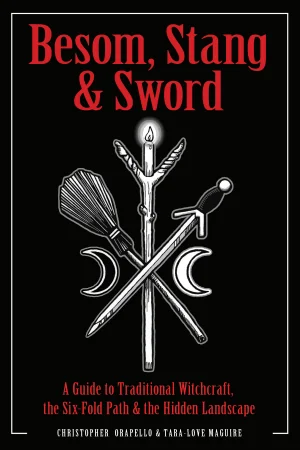
### What It Is "Besom, Stang and Sword" by Christopher Orapello and Tara-Love Maguire, first published in 2018, presents a distinct current within contemporary witchcraft. It defines Regional Traditional Witchcraft not as a religion focused on fertility or harvest cycles, but as an animistic practice rooted in the immediate environment. This approach encourages practitioners to discover their spiritual work within their local landscapes, the untamed wilderness, and ancestral connections, deliberately moving away from deity-centric or neo-pagan religious structures.
### Who It's For This work is geared towards individuals seeking witchcraft practices unburdened by modern religious constructs. It appeals to those interested in animism, folk magic, and the power found in local environments and personal lineage. Readers who feel disconnected from mainstream Wicca or other organized pagan traditions, and who are drawn to a more earth-bound, ancestral, and nature-focused spirituality, will find "Besom, Stang and Sword" particularly relevant.
### Historical Context The book emerges from a growing movement within witchcraft to reclaim older, more localized forms of practice. While Wicca gained prominence in the mid-20th century, Orapello and Maguire's work taps into a lineage of witchcraft that predates modern neopaganism. It engages with the historical trajectory of witchcraft, pushing back against generalizations and emphasizing the diverse, often unwritten, traditions that existed regionally before widespread cataloging and systematization by figures like Gerald Gardner. The 2018 publication date places it within a contemporary resurgence of interest in folk magic and animistic spirituality.
### Key Concepts Central to "Besom, Stang and Sword" is the concept of "regional traditional witchcraft" as distinct from religious witchcraft. This involves a deep engagement with the local ecosystem, understanding its spirits and energies. Ancestral connection is another core theme, advocating for drawing power and wisdom from one's own lineage rather than solely from imported pantheons. The book also explores the practical tools and symbolism of this path, including the besom (broom) and stang (staff), as direct conduits to the natural world and ancestral realms.
💡 Why Read This Book?
• Gain a distinct understanding of Regional Traditional Witchcraft, differentiating it from Wicca and other religious forms by focusing on animism and local ecology, as presented in the book's core definition. • Learn to identify and connect with the spiritual energies inherent in your immediate surroundings and ancestral heritage, moving away from imported deities, as championed by the authors. • Discover the symbolic weight of tools like the besom and stang, understanding their function as direct links to the land and ancestral realms, as explored within the text.
⭐ Reader Reviews
Honest opinions from readers who have explored this book.
❓ Frequently Asked Questions
What is the core difference between Regional Traditional Witchcraft and Wicca, according to "Besom, Stang and Sword"?
The book defines Regional Traditional Witchcraft as an animistic practice focused on local environments and ancestors, distinct from Wicca's common emphasis on religious harvest festivals and fertility-minded rites.
Who are the authors of "Besom, Stang and Sword"?
The authors are Christopher Orapello and Tara-Love Maguire, with the book first published in 2018.
What does the book suggest as the source of magical power for practitioners?
It suggests drawing power from one's own backyard, the uncultivated land, the wild unknown, and one's ancestors, rather than from ancient foreign deities.
Is "Besom, Stang and Sword" a practical how-to guide for witchcraft spells?
While it outlines principles and philosophies, its primary focus is on defining and advocating for a specific approach to traditional witchcraft, rather than providing a spellbook.
What is the significance of the 'besom' and 'stang' in this tradition?
These tools are presented as direct conduits to the natural world and ancestral realms, integral to the animistic practices described in the book.
When was "Besom, Stang and Sword" first published?
The book was first published in 2018.
🔮 Key Themes & Symbolism
Animistic Environmentalism
This theme centers on the book's core assertion that witchcraft should be an animistic practice deeply connected to the immediate environment. It argues against the notion of witchcraft as solely tied to fertility cycles or religious festivals, instead championing the discovery of magic within the "uncultivated land" and the "wild unknown." This perspective encourages a reciprocal relationship with nature, viewing the local ecosystem not just as a resource but as a living entity filled with spirits and energies to be understood and worked with.
Ancestral Connection
"Besom, Stang and Sword" places significant emphasis on ancestral lineage as a vital source of power and wisdom for practitioners. Unlike paths that focus on external deities or pantheons, this tradition encourages looking inward and backward, to one's own family history and the spirits of one's forebears. This connection is presented as a foundational element for grounding magical practice and understanding one's place within a continuum, fostering a personal and deeply rooted spirituality.
Rejection of Religious Structures
A key tenet explored is the deliberate departure from religious or neo-pagan frameworks often associated with witchcraft. The authors differentiate Regional Traditional Witchcraft by framing it as a practice rather than a religion. This approach seeks to strip away dogma and organized belief systems, focusing instead on direct experience, folk traditions, and the inherent magic found in the natural world and personal lineage, offering an alternative for those disillusioned with conventional spiritual paths.
Tools as Conduits
The book highlights specific tools, notably the besom (broom) and stang (staff), not merely as symbolic objects but as active conduits for magical work. These implements are presented as essential for interacting with the spirit world and the land. Their use is tied to the animistic and ancestral focus, serving as tangible connections to the forces practitioners seek to engage with, grounding abstract concepts in physical practice and ritual.
💬 Memorable Quotes
“Find your craft in your own backyards, in the uncultivated land, the wild unknown, and in your ancestors.”
— This concise statement encapsulates the book's central philosophy, advocating for a deeply personal and localized form of witchcraft rooted in immediate surroundings and inherited connections, distinct from external religious or deity-focused practices.
“Regional Traditional Witchcraft is an animistic form of witchcraft that moves away from the religious harvest festivals and fertility-minded practices.”
— This quote precisely defines the book's subject, distinguishing its approach by emphasizing animism and environmental focus over the common Wiccan associations with agricultural cycles and religious dogma.
“Rather than in ancient foreign deities or in a Neo-Pagan-styled religious form of witchcraft.”
— This phrase clearly delineates what the authors position Regional Traditional Witchcraft *against*, highlighting its departure from established neo-pagan structures and imported pantheons in favor of a more indigenous or localized practice.
“The besom, stang and sword are not merely symbolic, but active tools for working with spirit and land.”
— This paraphrased concept emphasizes the practical, functional role of key tools within the described tradition, suggesting they serve as direct interfaces for engaging with the animistic and ancestral elements central to the craft.
“Ancestors rather than in ancient foreign deities.”
— This short, impactful phrase underscores the book's emphasis on lineage and inherited connection as primary sources of spiritual power, contrasting it with the common practice of venerating deities from distant cultures.
🌙 Esoteric Significance
Tradition
This work fits within the broader umbrella of Western Esotericism, specifically branching from folk magic and animistic traditions often considered distinct from Hermetic, Kabbalistic, or Theosophical lineages. It departs from more structured, intellectualized esoteric systems by prioritizing direct experience with the natural world and ancestral spirits over complex symbolic systems or theological frameworks. Its animistic foundation aligns it with primal spiritual practices, offering a less mediated, more immanent approach to the sacred.
Symbolism
Key symbols include the **besom (broom)**, representing purification, sweeping away negativity, and bridging the mundane and spirit worlds. The **stang (staff)** functions as a direct conduit to the earth and ancestral energies, a tool for focus, journeying, and connection to the wild. The **sword**, while less elaborated in the provided blurb, often symbolizes cutting ties, protection, and directed will within esoteric traditions, likely employed here in a similar protective or assertive capacity within the context of environmental and ancestral work.
Modern Relevance
Contemporary thinkers and practitioners interested in land-based spirituality, animism, and the decolonization of spiritual practices find resonance in "Besom, Stang and Sword." It informs current discussions around ecological witchcraft and the rejection of colonial religious imports. Modern animistic practitioners, eco-pagans, and those seeking non-religious, nature-focused spiritual paths often draw upon the principles articulated by Orapello and Maguire to ground their work in their local environments and personal histories.
👥 Who Should Read This Book
• Individuals disillusioned with the religious or deity-centric aspects of modern witchcraft, seeking a more animistic and environmentally grounded practice. • Practitioners interested in exploring the power of their local landscapes and ancestral connections as primary sources for magical work. • Students of comparative witchcraft and folk magic seeking to understand divergent paths within contemporary esoteric movements.
📜 Historical Context
Published in 2018, "Besom, Stang and Sword" emerged during a period of significant diversification within contemporary witchcraft and paganism. While the mid-20th century saw the rise of Gerald Gardner's Wicca, which heavily influenced modern neopaganism with its structured rituals and emphasis on deity, Orapello and Maguire's work taps into a counter-current. This current seeks to reclaim older, less formalized folk magic traditions and animistic worldviews that predate systematic religious structures. The book implicitly engages with the legacy of figures like Margaret Murray, whose controversial theories about a widespread European witch-cult influenced early 20th-century occultists, and contemporary authors exploring land-based spirituality. Its focus on regionalism and animism offers a direct challenge to the more universalist or religion-focused models prevalent in some pagan circles, positioning itself within a growing movement advocating for localized, earth-centered practices.
📔 Journal Prompts
Reflection on the spirits residing in your local uncultivated land.
Mapping your ancestral connections and their potential influence on your craft.
The role of the besom in clearing energetic space for practice.
How the concept of the 'wild unknown' manifests in your personal life.
Identifying potential stang-like objects in your environment.
🗂️ Glossary
Regional Traditional Witchcraft
A form of witchcraft emphasizing animism, local environment, and ancestral connections, distinct from religious or deity-focused practices.
Animistic
A worldview characterized by the belief that spirits inhabit inanimate objects, plants, and natural phenomena, and that these spirits possess consciousness and agency.
Besom
A broom, often used in witchcraft for ritualistic purposes such as purification, cleansing spaces, and acting as a conduit between worlds.
Stang
A pole or staff, traditionally associated with certain forms of folk magic and witchcraft, used as a tool for grounding, journeying, and connecting with earth and ancestral energies.
Uncultivated Land
Areas of nature that remain wild and undeveloped by human intervention, seen as potent sources of natural energy and spiritual connection.
Ancestors
Refers not only to direct biological lineage but also to spiritual forebears and the collective ancestral spirits whose wisdom and power can be invoked.
Neo-Pagan
A broad term for modern spiritual paths inspired by or seeking to revive pre-Christian European religions, often incorporating elements of Wicca, mythology, and nature worship.