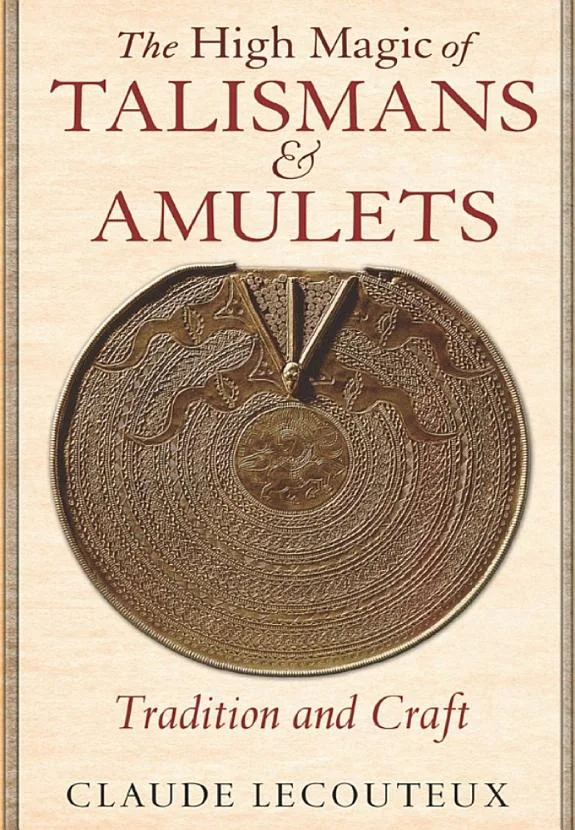
The High Magic of Talismans and Amulets
 80
80

The High Magic of Talismans and Amulets
Claude Lecouteux’s "The High Magic of Talismans and Amulets" functions as a vital scholarly bridge between historical magical practice and contemporary esoteric study. Rather than merely cataloging ancient charms, Lecouteux meticulously details the foundational principles and operative techniques required for the actual construction and activation of these magical instruments. A notable strength lies in his thorough examination of figures like Albertus Magnus, presenting a nuanced view of medieval magical science. However, the sheer density of information, while valuable, might present a steep learning curve for newcomers to the field. The section detailing the specific invocations needed to imbue an amulet with power, for instance, requires careful study and prior knowledge of related magical frameworks. Ultimately, this book serves as an indispensable, if demanding, resource for serious practitioners and historians of Western esotericism.
📝 Description
80
### What It Is Claude Lecouteux's "The High Magic of Talismans and Amulets" offers a scholarly exploration into the creation and utilization of enchanted objects within the Western Mystery Tradition. It moves beyond mere collection of lore, presenting a structured examination of the theoretical underpinnings and practical applications of talismans and amulets. The work synthesizes historical accounts, magical theory, and practical instructions, providing readers with a comprehensive understanding of these potent artifacts. Lecouteux grounds the discussion in textual evidence and historical practice, making it a substantial reference for serious students of esoteric sciences.
### Who It's For This text is intended for dedicated practitioners and serious researchers of Western esotericism, particularly those interested in the historical development and practical application of magical objects. Individuals focused on the works of figures like Agrippa, Albertus Magnus, and Athanasius Kircher will find substantial material. Those seeking to understand the construction and activation of talismans, requiring knowledge of specific invocations and magical principles, will benefit immensely. It is not a beginner's guide to simple charms but a deep dive for those committed to the intricacies of magical artifact creation.
### Historical Context The book situates talismans and amulets within a rich historical lineage, tracing their use from antiquity through the medieval and Renaissance periods. Lecouteux examines the intellectual climate that fostered such practices, referencing influential figures like Heinrich Cornelius Agrippa, whose "Three Books of Occult Philosophy" (1531) significantly shaped Renaissance magical thought. The work also touches upon the integration of these practices within broader philosophical and religious frameworks of the time. This provides essential context for understanding how magical objects were perceived and employed by scholars and practitioners before the scientific revolution.
### Key Concepts Central to the book is the concept of sympathetic magic, the principle that like affects like and that objects can be imbued with specific virtues through correspondences and ritual. Lecouteux details the necessary knowledge for crafting an amulet or talisman, including astrological timings, planetary virtues, the use of specific materials, and the precise invocations required to awaken their inherent powers. The work also distinguishes between different types of enchanted objects, from ancient jewelry imbued with protective qualities to complex ritualistic artifacts designed for specific magical outcomes, underscoring the sophisticated understanding of their function in historical magical systems.
💡 Why Read This Book?
• Understand the specific magical principles and correspondences, such as planetary virtues and astrological timings, required to construct effective talismans, as detailed in the historical context of Agrippa's work. • Learn the precise invocations and ritualistic steps necessary to activate the latent powers within talismans and amulets, moving beyond theoretical knowledge to practical application. • Gain insight into the medieval and Renaissance understanding of enchanted objects, differentiating between various types of amulets and their intended functions based on historical accounts.
⭐ Reader Reviews
Honest opinions from readers who have explored this book.
❓ Frequently Asked Questions
What is the primary difference between a talisman and an amulet according to Lecouteux?
Lecouteux clarifies that while often used interchangeably, talismans are typically created with specific magical intentions and are charged with symbolic imagery and planetary influences to manifest a particular effect. Amulets, conversely, are often more general in their protective function, drawing power from their material, inscription, or inherent symbolic resonance.
Does the book provide instructions for making talismans for modern practitioners?
Yes, the book provides a comprehensive summary of the magical knowledge required to make talismans and amulets, including invocations. While rooted in historical practice, the principles discussed are presented in a way that can be adapted by dedicated modern practitioners studying figures like Agrippa.
Which historical figures are prominently discussed in relation to talismans and amulets?
Claude Lecouteux prominently features the works and theories of key historical figures such as Heinrich Cornelius Agrippa, Albertus Magnus, and Athanasius Kircher. Their contributions to the understanding and practice of creating magical objects are central to the book's exposition.
What kind of knowledge is necessary before reading 'The High Magic of Talismans and Amulets'?
While the book aims to be comprehensive, prior familiarity with Western esotericism, basic astrological concepts, and the history of magic, particularly from the Renaissance period, would enhance comprehension. Understanding the context of figures like Agrippa is beneficial.
Are the invocations mentioned in the book readily usable or do they require complex ritual setup?
The invocations discussed are presented within a specific magical framework, implying a need for understanding the associated ritualistic contexts, materials, and timings. While the book details them, their effective use requires dedicated study and practice, as outlined by Lecouteux.
Does the book cover talismans and amulets from non-Western traditions?
The primary focus of "The High Magic of Talismans and Amulets" is on the Western Mystery Tradition. While acknowledging the universality of such practices, Lecouteux concentrates his detailed analysis on European magical history, particularly medieval and Renaissance European practices.
🔮 Key Themes & Symbolism
Operative Magic of Objects
This theme centers on the practical, 'operative' aspect of magic as applied to physical objects. Lecouteux details how talismans and amulets were not merely decorative but functional tools imbued with specific virtues and powers. He explains the intricate process of their creation, emphasizing the necessity of precise correspondences – astrological, elemental, and symbolic – to imbue an object with desired magical qualities. This approach moves beyond theoretical mysticism to the hands-on construction and activation of enchanted items, a core tenet of historical Western magical practice.
Historical Magical Systems
The book provides a deep dive into the historical evolution of talismanic magic within the Western tradition, particularly from the medieval period through the Renaissance. Lecouteux examines the contributions of key figures like Albertus Magnus and Agrippa, situating their work within the intellectual and spiritual currents of their eras. By referencing specific historical texts and practices, the work reconstructs how these magical systems functioned and were understood by practitioners, offering a valuable perspective on the continuity and transformation of magical knowledge over centuries.
Invocations and Activation
A crucial element discussed is the activation of talismans and amulets through specific invocations. Lecouteux outlines the importance of linguistic and spiritual power in awakening the potential within these objects. This involves understanding the correct formulas, prayers, or divine names to call upon, aligning the artifact with celestial or spiritual forces. The process described underscores that the object itself is a conduit, and its efficacy is directly tied to the ritualistic and spiritual work performed during its creation and charging.
Sympathetic Magic and Correspondences
The underlying principle of sympathetic magic, the idea that 'like affects like,' is fundamental to understanding talismanic construction. Lecouteux elaborates on the complex web of correspondences – planetary, stellar, herbal, mineral, and symbolic – that practitioners utilized. These connections allowed for the channeling of specific energies and virtues into an object. For example, using a particular metal during a specific planetary hour was not arbitrary but a deliberate act of aligning the object with cosmic forces for a desired magical outcome.
💬 Memorable Quotes
“The knowledge required to make an amulet or talisman includes invocations to activate their powers.”
— This statement highlights the active, rather than passive, nature of magical objects. It asserts that true efficacy comes not just from the object's form or materials, but from the ritualistic charging and spiritual work that awakens its inherent potential.
“The work explores the medieval and Renaissance use of amulets and talismans, including the work of Agrippa.”
— This points to the book's focus on a specific historical period and its key intellectual figures. It signals that the content will be grounded in documented historical practices and theories, particularly those articulated by prominent occult philosophers of the era.
“Reviews different kinds of amulets and talismans, from ancient jewelry to magical objects.”
— This indicates the broad scope of the book's survey, covering a wide spectrum of enchanted items. It suggests that readers will encounter diverse examples, from simple protective jewelry to more complex, purpose-built magical artifacts.
“Provides an in-depth look at the medieval and Renaissance use of amulets and talismans.”
— This emphasizes the book's scholarly depth and historical specificity. It promises a detailed examination of how these objects were employed during a crucial period for Western esotericism, moving beyond superficial descriptions.
“A comprehensive study of the use of talismans and amulets in the Western Mystery Tradition.”
— This serves as a foundational statement about the book's purpose: to offer a complete and authoritative account of enchanted objects within a defined esoteric lineage. It suggests that the work aims to be a definitive resource on the subject.
🌙 Esoteric Significance
Tradition
This work is deeply embedded within the Western Esoteric Tradition, specifically drawing from Hermetic, Neoplatonic, and Renaissance magical lineages. It represents a continuation of the 'operative' magical arts, where the focus is on the practical manipulation of subtle energies through material objects and ritual. Lecouteux's scholarship connects the ancient practices of creating enchanted objects to the sophisticated systems developed by figures like Agrippa, positioning the book as a guide to a specific, historically grounded branch of Western magic that emphasizes direct interaction with cosmic forces.
Symbolism
Key symbols explored include planetary signs and sigils, which are crucial for imbuing talismans with specific celestial influences. The book also delves into the symbolism of materials – metals, stones, herbs – each carrying inherent virtues and correspondences tied to different planets or energies. Furthermore, the inscriptions on talismans, whether divine names, astrological symbols, or sacred geometry, are treated as potent carriers of magical intent, acting as focal points for the energies being channeled and directed by the practitioner.
Modern Relevance
Contemporary practitioners of Western esotericism, particularly those interested in traditional magical arts and historical reconstruction, frequently draw upon Lecouteux's meticulous research. His work informs modern approaches to talismanic creation within Hermetic and ceremonial magic orders. Thinkers and practitioners focused on the history of occultism and comparative magical practices also utilize his insights to understand the continuity of these arts. The book's detailed exposition makes it a valuable reference for anyone seeking to revive or understand historical methods of object-based magic in a contemporary context.
👥 Who Should Read This Book
• Serious students of Western Esotericism seeking to understand the historical construction and activation of magical objects, moving beyond purely theoretical works. • Practitioners of ceremonial magic or Hermeticism interested in the practical application of planetary correspondences and specific invocations for creating talismans. • Researchers in the history of magic and occultism who require detailed information on medieval and Renaissance magical practices and the theories of figures like Agrippa.
📜 Historical Context
The creation and use of talismans and amulets, as explored by Lecouteux, flourished in an era where the boundaries between magic, science, and religion were far more fluid than today. The medieval and Renaissance periods were characterized by a deep engagement with Neoplatonism, Hermeticism, and Kabbalah, intellectual currents that provided a framework for understanding the hidden virtues of the cosmos and their manipulation. Figures like Heinrich Cornelius Agrippa, whose "Three Books of Occult Philosophy" was published in 1531, codified many of these ideas, providing detailed systems of correspondences that informed talismanic construction. This work emerged during a time when scholars and clergy alike engaged with magical theories, though by the later Renaissance, increasing persecution and philosophical shifts began to marginalize such practices. Lecouteux’s study situates these objects within this complex intellectual landscape, contrasting with the later rise of purely materialistic scientific paradigms.
📔 Journal Prompts
The specific invocations required to activate an amulet's powers.
Albertus Magnus's approach to imbuing objects with virtue.
The connection between planetary hours and talismanic material selection.
How the symbolism of ancient jewelry differs from Renaissance magical objects.
Agrippa's framework for sympathetic magic in object creation.
🗂️ Glossary
Talisman
An object, typically inscribed with symbols or figures, that is believed to possess magical properties and is consecrated or charged to attract certain influences or provide protection.
Amulet
An object worn to ward off evil, illness, or danger; often possessing protective qualities derived from its material, inscription, or spiritual charging.
Western Mystery Tradition
A broad term encompassing various esoteric and occult traditions originating in Europe, including Hermeticism, Kabbalah, Rosicrucianism, and ceremonial magic.
Invocations
Formal prayers or magical formulas used to call upon divine beings, spirits, or energies for assistance, protection, or to activate the power of an object.
Correspondences
The system of relationships between different elements of the cosmos (e.g., planets, stars, colors, metals, herbs) used in magical practices to channel specific energies.
Sympathetic Magic
A type of magic based on the principle that like produces like, or that a cause affects its effect through a mystical connection, often involving the use of effigies or related objects.
Planetary Virtues
The specific qualities, influences, and energies attributed to the seven classical planets (Sun, Moon, Mercury, Venus, Mars, Jupiter, Saturn) in astrological and magical systems.