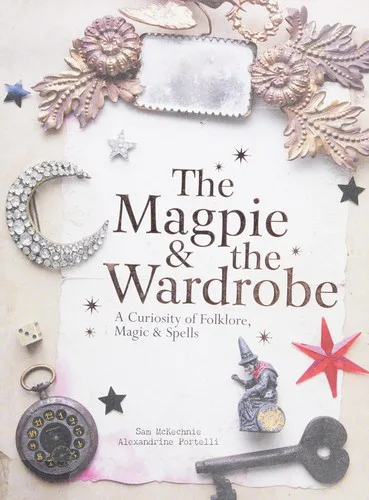
Magpie and the Wardrobe
 77
77

Magpie and the Wardrobe
Sam McKechnie’s “Magpie and the Wardrobe” offers a rigorous, if sometimes dense, exploration of how narratives function as conduits for esoteric understanding. The book’s strength lies in its systematic deconstruction of fictional elements, treating them as components of a larger metaphysical architecture. McKechnie’s analysis of the “animating principle” within stories, for instance, provides a compelling framework for understanding narrative vitality. However, the text’s academic rigor occasionally overshadows its accessibility; readers unfamiliar with Jungian archetypes or comparative mythology might find certain passages challenging. A notable section details how the magpie, a recurring motif, acts as a psychopomp within narrative structures, guiding characters and readers through symbolic transitions. This specific example exemplifies the book’s potential for illuminating insights, though its broader application could benefit from more varied illustrative examples. Ultimately, “Magpie and the Wardrobe” is a valuable scholarly work for those dedicated to the deeper study of narrative symbolism.
📝 Description
77
Sam McKechnie's 2015 book, Magpie and the Wardrobe, analyzes how esoteric thought shapes narrative.
Published in 2015, Sam McKechnie's "Magpie and the Wardrobe" is an analytical text that examines the relationship between esoteric philosophy and narrative structure. The book does not tell a story itself; instead, it dissects fictional works to expose the symbolic language and archetypal patterns that inform them. McKechnie treats stories as dynamic expressions of consciousness and tradition, revealing underlying metaphysical principles. The author's method is academic but accessible, aiming to give readers the tools to recognize hidden dimensions within any story, from ancient myths to modern fiction.
This work is for individuals who approach literature with a metaphysical perspective. It will interest students of comparative mythology, scholars of esoteric traditions, and anyone curious about the psychological and spiritual foundations of storytelling. Readers seeking to grasp how narratives function on a symbolic plane, beyond their surface plots, will find it valuable. It is especially suited for those who appreciate analytical frameworks applied to cultural artifacts and wish to develop a more critical approach to the stories they encounter.
McKechnie's work follows a line of inquiry into symbolism, echoing scholarship on figures like Carl Jung and Mircea Eliade. While not directly affiliated with organizations such as the Golden Dawn or the Theosophical Society, the book engages with an academic literary theory infused with an appreciation for the esoteric significance of myth and symbol. It emerged during a time of growing interest in Jungian psychology and archetypal criticism, alongside popular engagement with esoteric philosophies.
💡 Why Read This Book?
• Gain insight into the "narrative matrix": Understand how stories are structured by metaphysical laws, not just plot, allowing you to analyze fictional works on a deeper symbolic level. • Discover the "animating principle" in literature: Learn to identify the spiritual or psychological essence that gives narratives their power, enhancing your appreciation for storytelling's impact. • Explore the "wardrobe" as a portal: Grasp how narrative elements function as gateways to altered states of consciousness or understanding, enriching your personal interpretation of texts.
⭐ Reader Reviews
Honest opinions from readers who have explored this book.
❓ Frequently Asked Questions
What is the 'narrative matrix' as described in Sam McKechnie's book?
The 'narrative matrix' is a core concept in "Magpie and the Wardrobe," referring to the underlying metaphysical and symbolic structures that govern a story. It suggests that narratives are not random but are built according to inherent symbolic laws.
What does the 'animating principle' signify in the context of 'Magpie and the Wardrobe'?
The 'animating principle' represents the vital essence or spirit within a narrative. McKechnie uses this term to explain what gives a story its unique power, coherence, and ability to affect the reader on a profound level.
How does the book discuss the symbolism of the magpie?
The book often uses the magpie as a symbol, particularly as a psychopomp or messenger. It signifies transitions, the gathering of hidden knowledge, and the bridging of different realms within a narrative structure.
Is 'Magpie and the Wardrobe' a fictional story or an analysis of stories?
It is an analytical work. Published in 2015, the book by Sam McKechnie analyzes fictional and mythical narratives to reveal their underlying esoteric and symbolic frameworks, rather than telling its own story.
Who would benefit most from reading 'Magpie and the Wardrobe'?
Readers interested in literary analysis, comparative mythology, Jungian psychology, and esoteric studies would find this book beneficial. It's for those who want to understand the deeper symbolic meanings in stories.
What does the 'wardrobe' symbolize in McKechnie's analysis?
The 'wardrobe' in McKechnie's work metaphorically represents a portal or threshold. It signifies entry points into different dimensions of understanding, states of consciousness, or layers of meaning within a narrative.
🔮 Key Themes & Symbolism
Narrative Matrix Structure
The book posits that stories are not random but adhere to a 'narrative matrix,' a framework of underlying metaphysical and symbolic laws. McKechnie argues that understanding this structure allows for a deeper perception of a story's intent and impact. This matrix influences character development, plot progression, and thematic resonance, suggesting that effective storytelling taps into universal patterns of consciousness.
The Animating Principle
Central to McKechnie's thesis is the 'animating principle,' which he identifies as the vital force that imbues a narrative with life and meaning. This principle can be seen as the story's soul, connecting its elements and resonating with the reader's psyche. It’s the intangible quality that distinguishes a compelling narrative from a mere sequence of events, often rooted in archetypal energies.
Symbolic Resonance and Portals
The work explores how specific symbols and motifs, like the magpie or the wardrobe, function as 'portals' within narratives. These elements evoke 'symbolic resonance,' triggering deeper psychological or spiritual understandings in the reader. The wardrobe, in particular, is examined as a threshold, inviting immersion into altered states of perception or different dimensions of meaning within the story's universe.
Archetypal Narrative Functions
McKechnie analyzes how characters and plot devices serve archetypal functions within the narrative matrix. The magpie, for instance, can act as a psychopomp, guiding the protagonist or reader through transitions. This focus on archetypes connects literary analysis to broader traditions of mythology and comparative religion, revealing how stories echo fundamental human experiences and spiritual quests.
💬 Memorable Quotes
Direct passages from the work, attributed to the author.
“Stories are not mere tales; they are architectures of consciousness.”
— This statement expresses McKechnie's core argument that narratives possess an inherent structure mirroring metaphysical principles. It suggests that engaging with a story is akin to exploring a constructed reality designed to affect the reader's inner world.
“The wardrobe functions as a threshold, a place of passage between known and unknown realities within the narrative.”
— This highlights the symbolic role of the 'wardrobe' motif. It represents a transition point, inviting characters and readers to cross into different states of being, explore hidden potentials, or confront transformative experiences.
“A magpie’s presence often signals a shift, a gathering of disparate elements into a meaningful whole.”
— This interpretation focuses on the magpie's symbolic function as a connector and catalyst. It suggests the bird's appearance in a narrative heralds moments of integration, revelation, or the discovery of hidden truths.
“Every compelling narrative contains an animating principle, a vital spark that connects it to the reader's soul.”
— This emphasizes the energetic and spiritual dimension of storytelling. It proposes that the power of a story lies in its ability to establish a deep, almost living, connection with the audience's inner being.
“We read not just for plot, but for the resonance of archetypes speaking to our own inner landscape.”
— This points to the psychological depth of narrative engagement. It suggests that readers are drawn to stories because they reflect and speak to universal patterns and truths residing within the human psyche.
🌙 Esoteric Significance
Tradition
This work engages with the hermeneutic traditions of Western esotericism, particularly drawing on symbolic analysis influenced by Jungian psychology and comparative mythology. It doesn't belong to a single, tightly defined lineage but rather synthesizes approaches that seek hidden meanings within cultural artifacts. It departs from purely dogmatic or ritualistic esoteric systems by focusing on the symbolic potential inherent in narrative structures accessible to any thoughtful reader.
Symbolism
Key symbols include the 'magpie,' often associated with trickster figures, messengers, or collectors of knowledge, representing the gathering of disparate symbolic elements into a coherent narrative. The 'wardrobe' functions as a classic threshold symbol, a portal to other realms, dimensions, or states of consciousness, inviting transformation and discovery within the story's symbolic landscape.
Modern Relevance
Contemporary thinkers in fields like narrative therapy, transpersonal psychology, and even certain branches of literary criticism that explore archetypal patterns find value in McKechnie’s framework. His analysis offers a method for understanding how stories can serve as vehicles for personal growth and spiritual exploration in a secularized world, resonating with modern practices that emphasize self-discovery through symbolic engagement.
👥 Who Should Read This Book
• Students of Jungian psychology and archetypal studies: You will find a detailed application of archetypal theory to narrative construction, enhancing your understanding of mythic patterns. • Comparative mythology enthusiasts: This book offers a unique analytical lens for dissecting universal themes and symbols across diverse cultural narratives. • Aspiring writers and literary critics: Gain tools to imbue your own work with deeper symbolic meaning or to critically analyze the subconscious layers of existing literature.
📜 Historical Context
Sam McKechnie’s "Magpie and the Wardrobe," first published in 2015, emerged in an era marked by a resurgence of interest in Jungian analytical psychology and comparative mythology. While not directly affiliated with earlier esoteric orders like the Hermetic Order of the Golden Dawn (founded 1888), its focus on symbolic interpretation aligns with the broader tradition of Western esotericism that sought to uncover hidden meanings in texts and symbols. The book's analytical approach can be seen as a contemporary iteration of the work of scholars like Mircea Eliade, who explored the sacred in myth and ritual, or Joseph Campbell, who popularized the study of archetypes in world mythology. The academic reception of such works in the 2010s often positioned them within cultural studies and literary theory, sometimes engaging with, or diverging from, more traditional religious or occult scholarship. Unlike the more direct occult practices of the early 20th century, McKechnie's work engages with these themes through the lens of narrative analysis.
📔 Journal Prompts
Reflect on the 'narrative matrix' of a favorite childhood story.
Identify the 'animating principle' in a film you recently watched.
Consider the 'wardrobe' as a symbolic portal in your own life experiences.
Analyze the role of a 'magpie' figure in any myth or legend you know.
How does 'symbolic resonance' manifest when you encounter specific imagery?
🗂️ Glossary
Narrative Matrix
The underlying framework of metaphysical and symbolic laws that structure a story, influencing its coherence, progression, and thematic depth.
Animating Principle
The vital, often intangible, essence or spirit that gives a narrative its power, liveliness, and capacity to connect with the reader's psyche.
Symbolic Resonance
The phenomenon where specific symbols, motifs, or narrative elements evoke deeper, often unconscious, psychological or spiritual meanings in the audience.
Wardrobe
A symbolic motif representing a threshold or portal, facilitating passage into different domains of understanding, consciousness, or narrative dimensions.
Magpie
A symbolic figure often representing a messenger, a collector of knowledge, or a psychopomp, signaling transitions and the integration of disparate elements.
Archetypal Functions
The roles that characters or plot elements play in a story, reflecting universal patterns of human experience and consciousness, as studied in mythology and psychology.
Psychopomp
A guide of souls from one life or realm to another; in narrative, a figure that facilitates transition or reveals hidden truths.
🔮 Readers Also Liked
Browse all →







More Free Magic & Ritual Books
View all →