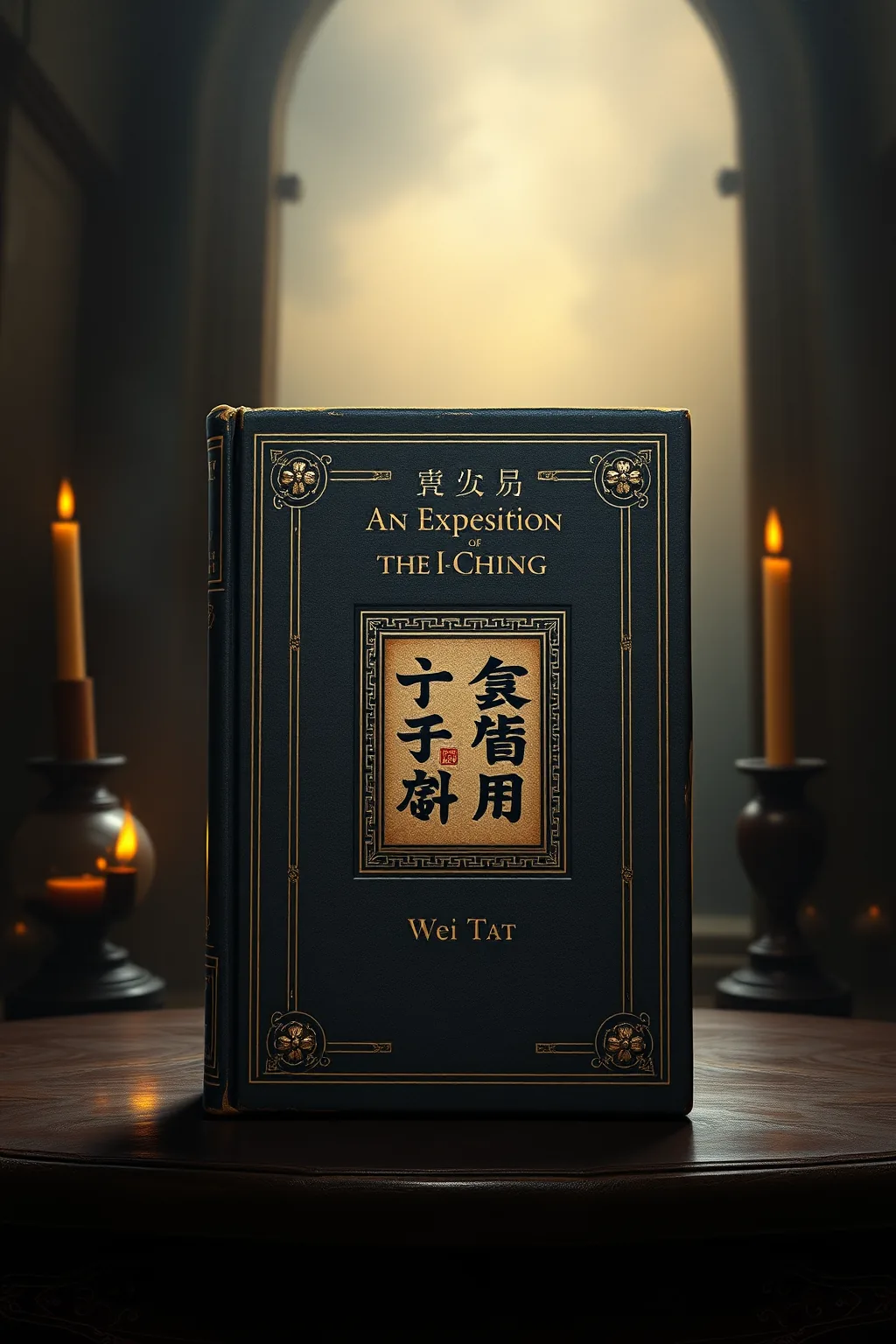
An exposition of the I-Ching or book of changes
 62
62

An exposition of the I-Ching or book of changes



Review by Isolde Whitaker (Sacred Texts Editor) — Wei Tat's 'An Exposition of the I-Ching' stands as a luminous beacon for those venturing into the profound currents of Chinese metaphysics. This work offers an exceptionally clear and insightful exploration of the 'Book of Changes,' demystifying its complex symbolism and philosophical underpinnings. Tat's authoritative yet accessible prose guides readers through the sixty-four hexagrams, revealing their layered meanings and practical applications for divination and self-understanding. It is an indispensable resource for anyone seeking to grasp the esoteric wisdom of the I Ching, providing a solid foundation for both study and practice.
📝 Description
62
Embark on a profound journey into the ancient wisdom of the *I Ching*, the 'Book of Changes,' through Wei Tat's meticulous exposition. This seminal work unveils the intricate tapestry of one of humanity's oldest oracular systems, offering a gateway to cosmic patterns and the ebb and flow of destiny. Delve into the philosophical depths of its hexagrams, their symbolic language, and the profound insights they offer into the human condition and the universe's unfolding mysteries. Wei Tat masterfully illuminates the esoteric principles that underpin this divinatory art, making it accessible to the earnest seeker and the seasoned scholar alike. Explore the interconnectedness of all things, the cyclical nature of existence, and the power of understanding these universal forces to navigate life's myriad transformations. This is not merely a guide to fortune-telling; it is an invitation to unlock hidden knowledge, cultivate inner harmony, and align oneself with the Tao.
✍️ Author
Wei Tat
Ng (pronounced [ŋ̍]) is the simplified (tone-less) romanization of the Cantonese surnames 吳/吴 (Jyutping: Ng4, read in Mandarin as pinyin: Wú) and 伍 (Ng5, Mandarin Wǔ); and also of the Hokkien surnames 黃/黄 (Pe̍h-ōe-jī: N̂ɡ, Mandarin Huáng) and 阮 (Ńg, Mandarin Ruǎn). The surname is often pronounced in English as əng or ing or eng.
💡 Why Read This Book?
Unravel the ancient secrets of destiny and transformation. This book offers a clear, profound gateway to the I Ching's wisdom, perfect for spiritual seekers, students of esoteric traditions, and practitioners aiming to deepen their understanding of life's cyclical nature. Gain invaluable insights for personal growth and wise decision-making.
⭐ Reader Reviews
Honest opinions from readers who have explored this book.
❓ Frequently Asked Questions
What is the I Ching?
The I Ching, or 'Book of Changes,' is an ancient Chinese divination text and philosophical classic. It is comprised of 64 hexagrams, each representing a fundamental situation or process, and is used to understand the dynamics of change and offer guidance.
Who was Wei Tat?
Wei Tat was a dedicated scholar and practitioner of the I Ching. His work is renowned for its clarity and depth, making the complex philosophies and divinatory practices of the 'Book of Changes' accessible to a wider audience.
How is the I Ching used for divination?
Divination with the I Ching typically involves casting yarrow stalks or coins to generate a hexagram. This hexagram, along with its changing lines, is then interpreted using the text's commentary to provide insight into a current situation and potential future developments.
What are the philosophical underpinnings of the I Ching?
The I Ching is deeply rooted in Taoist philosophy, emphasizing the principles of Yin and Yang, the constant flux of change, and the interconnectedness of all phenomena. It teaches about balance, harmony, and adapting to the natural flow of the universe.
Is this book suitable for beginners?
Yes, Wei Tat's exposition is highly recommended for beginners due to its clear explanations and structured approach. It provides a solid foundation for understanding the I Ching's principles and practical application.
🔮 Key Themes & Symbolism
The Dynamics of Change
At its core, the I Ching is a philosophy of constant transformation. This exposition delves into the fundamental principle that nothing is static, and all things are in a perpetual state of flux. It explores how understanding these inherent shifts allows one to navigate life's challenges with wisdom and adaptability. The book illuminates the cyclical nature of existence, from growth and flourishing to decline and renewal, providing a framework for comprehending and responding effectively to the ever-changing landscape of reality.
Symbolic Language of the Hexagrams
The sixty-four hexagrams of the I Ching are not mere symbols; they are archetypal representations of universal situations and energies. Wei Tat's work meticulously deciphers this rich symbolic language, revealing the profound meanings embedded within the combination of Yin and Yang lines. Each hexagram is presented as a cosmic blueprint, offering nuanced insights into the forces at play in any given circumstance, and guiding the reader to interpret these potent symbols for divination and self-reflection.
Harmony and the Tao
The ultimate aim of engaging with the I Ching, as illuminated by Wei Tat, is to achieve harmony with the Tao—the fundamental principle of the universe. This exposition emphasizes how aligning one's actions and intentions with the natural order, as revealed by the I Ching's wisdom, leads to a more balanced and fulfilling existence. It explores the practical application of these principles in daily life, fostering a deeper connection to oneself, others, and the cosmic flow.
💬 Memorable Quotes
“The I Ching is a mirror reflecting the universe's intricate dance.”
— This highlights the divinatory power of the I Ching, suggesting it reveals hidden patterns and connections within the cosmos that influence our lives.
“Change is the only constant; wisdom lies in adapting.”
— This core tenet emphasizes the book's philosophical message of embracing flux and developing flexibility to navigate life's inevitable transformations.
“Within the hexagrams lie the seeds of destiny.”
— This suggests that the symbolic representations of the I Ching offer profound insights into potential future outcomes and the underlying forces shaping them.
“To know the hexagram is to understand the moment.”
— This points to the practical utility of the I Ching, asserting that its guidance provides clarity and understanding for present circumstances.
“Seek balance in the interplay of Yin and Yang.”
— This emphasizes the foundational principle of Taoist philosophy and the I Ching, advocating for equilibrium between opposing forces for inner and outer harmony.
🌙 Esoteric Significance
Tradition
This work is deeply rooted in the Taoist tradition, drawing heavily on its principles of Yin and Yang, the cyclical nature of the universe, and the concept of the Tao as the fundamental guiding force. It also intersects with Confucian thought, particularly in its ethical and philosophical applications for governance and personal cultivation. The esoteric significance lies in its function as a practical tool for understanding cosmic patterns and aligning oneself with universal energies.
Symbolism
The primary symbolism revolves around the 64 hexagrams, each composed of six lines that are either solid (Yang) or broken (Yin). These lines and their combinations represent archetypal situations, natural phenomena, and human experiences. The trigrams (three-line combinations) are foundational, symbolizing elements like Heaven, Earth, Water, Fire, and so on. Their interplay and transformations within the hexagrams create a complex symbolic language for interpreting destiny and guiding action.
Modern Relevance
In contemporary times, the I Ching, as expounded by Wei Tat, offers a powerful antidote to the fragmentation and uncertainty of modern life. Its emphasis on balance, adaptability, and understanding cyclical patterns provides invaluable guidance for personal growth, decision-making, and navigating complex social and environmental changes. It serves as a profound tool for introspection, fostering mindfulness and a deeper connection to the natural world and the subtle energies that govern existence.
👥 Who Should Read This Book
This exposition is a treasure for a diverse range of readers. For the absolute beginner, it provides a clear and structured entry point into the profound world of the I Ching, demystifying its core concepts. Seasoned scholars of Eastern philosophy and esoteric traditions will find Wei Tat's insights nuanced and valuable, offering new perspectives on familiar texts. Spiritual seekers and practitioners of divination will discover a potent tool for self-discovery, ethical guidance, and deepening their intuitive abilities. Anyone seeking to understand the fundamental forces of change and cultivate a more harmonious relationship with the universe will benefit immensely.
📜 Historical Context
Wei Tat's 'An Exposition of the I-Ching' emerges from a rich tradition of Chinese scholarship that has revered the 'Book of Changes' for millennia. Originating from the Shang Dynasty (c. 1600–1046 BCE) and further developed by Confucian scholars, the I Ching served as a cornerstone of Chinese philosophy, governance, and divination. This exposition stands as a testament to the enduring appeal of this ancient text, bridging the gap between its classical origins and the modern seeker. It reflects a period where Eastern wisdom traditions were increasingly being explored and appreciated in the West, offering a sophisticated yet accessible interpretation for a global audience interested in ancient metaphysics and esoteric practices.
📔 Journal Prompts
Reflect on a recent significant change in your life. Which hexagram might represent this transition, and what guidance does it offer?
Consider the interplay of Yin and Yang in a current challenge you face. How can embracing both energies lead to a more balanced resolution?
What universal archetypes or situations do you see reflected in the I Ching's hexagrams that resonate with your personal journey?
How can the principle of 'adapting to change' be more consciously integrated into your daily decisions and actions?
Imagine you are consulting the I Ching for wisdom on a future endeavor. What core principles from the book would you prioritize in your planning?
🗂️ Glossary
Hexagram
A figure composed of six stacked horizontal lines, either solid (Yang) or broken (Yin). Each of the 64 hexagrams in the I Ching represents a specific archetype or situation.
Trigram
A figure composed of three stacked horizontal lines, either solid (Yang) or broken (Yin). There are eight trigrams, often associated with natural elements and fundamental concepts.
Yin
In Taoist philosophy and the I Ching, Yin represents the passive, dark, feminine, receptive, and yielding aspects of existence. It is often depicted by a broken line (--) in a hexagram.
Yang
In Taoist philosophy and the I Ching, Yang represents the active, light, masculine, assertive, and creative aspects of existence. It is often depicted by a solid line (—) in a hexagram.
Tao
The fundamental principle of the universe in Taoism, often translated as 'the Way.' It represents the natural order, the source of all things, and the ultimate reality that is both immanent and transcendent.








![SQL [asterisk] forms operator's reference card](/img/thumb/sql-asterisk-forms-operator-s-reference-card-oracle-corporation.webp)