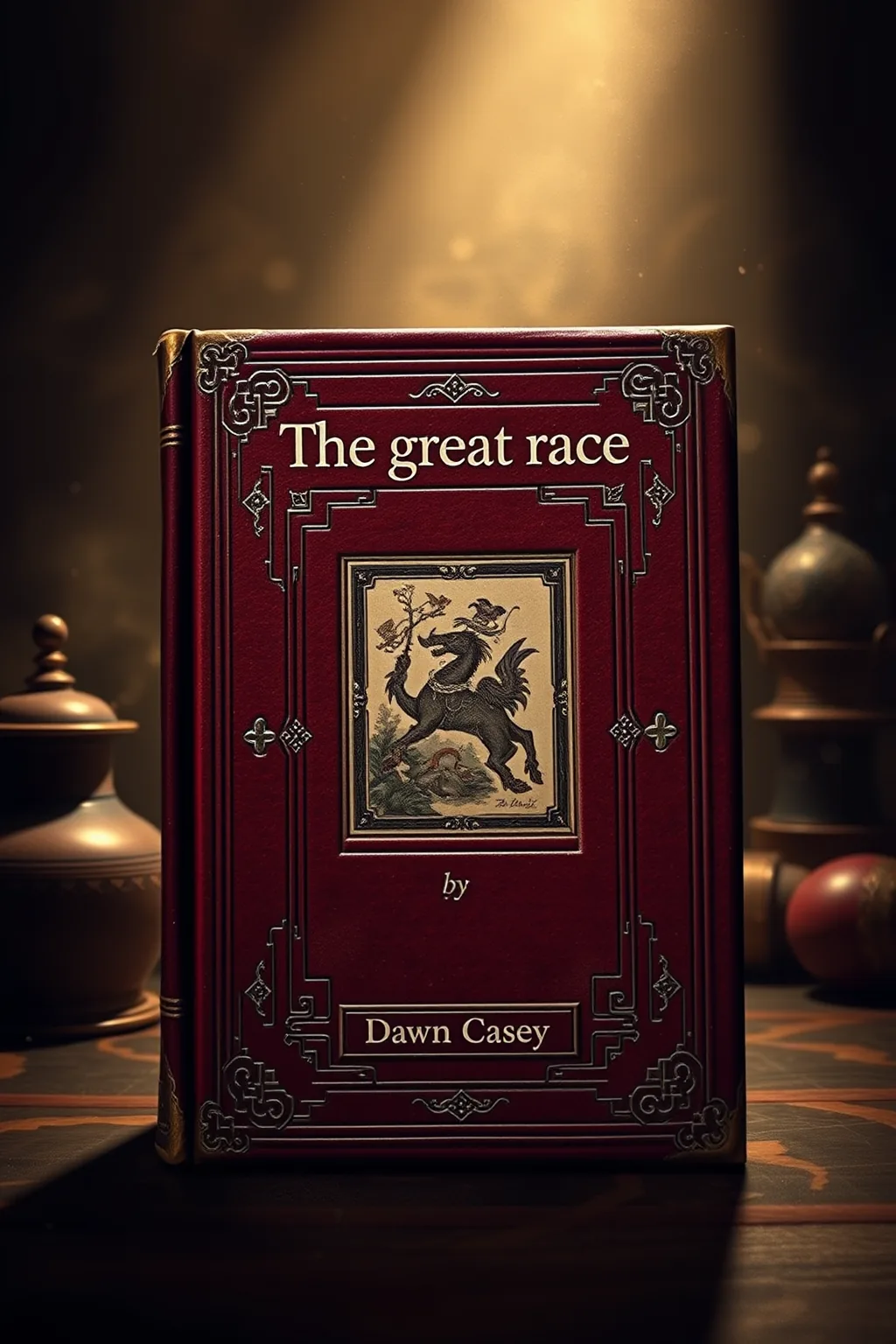
The great race
 72
72

The great race
Dawn Casey’s ‘The Great Race’ offers a disquieting, yet ultimately liberating, perspective on existence. Its strength lies in its relentless questioning of perceived reality, particularly its examination of how societal constructs and personal narratives bind our understanding of time and self. The section discussing the ‘echoes of the past’ and their influence on present actions is particularly potent, suggesting a cyclical rather than linear progression that challenges conventional notions of progress. However, the book’s abstract nature, while intended to foster open interpretation, occasionally verges on the elusive. Without a firm grounding in specific practices or more concrete examples from the 2008 publication date, some arguments feel less developed than others. Despite this, ‘The Great Race’ serves as a valuable prompt for introspection, urging readers to reconsider the very foundations of their perceived world.
📝 Description
72
Dawn Casey's 2008 book, 'The Great Race,' questions the physical world's perceived limits.
'The Great Race' by Dawn Casey, published in 2008, examines consciousness and the human experience. It suggests that our understanding of existence is shaped by physical limitations, proposing alternative ways to view reality. The book does not offer a single answer but a range of ideas designed to encourage deeper thought about what is real. Casey invites readers to consider that the 'race' of life might be an internal process, not an external struggle.
This work is suitable for those interested in comparative spirituality, philosophy, and fundamental questions about life and death. It will appeal to readers who look beyond conventional views, seeking broader meanings in human existence. Those who appreciate speculative thinking and unconventional paths to knowledge will find ample material for contemplation.
Published in 2008, 'The Great Race' entered a period where interest in consciousness studies and alternative spiritualities was rising. This coincided with the growing influence of New Age ideas, popular interpretations of quantum physics, and the wider acceptance of ancient traditions. Casey's work relates to contemporary discussions on presence and ego, but focuses more specifically on metaphysical structures.
💡 Why Read This Book?
• Gain a new perspective on the nature of time, moving beyond linear progression to understand its subjective and potentially cyclical dimensions, as explored in the book's concept of 'echoes of the past'. • Understand how societal conditioning and personal narratives shape our perception of reality, encouraging a critical examination of the 'great race' as an imposed construct. • Explore the interconnectedness of consciousness and the universe, challenging the illusion of separation and fostering a sense of unity with all existence.
⭐ Reader Reviews
Honest opinions from readers who have explored this book.
❓ Frequently Asked Questions
When was 'The Great Race' by Dawn Casey first published?
'The Great Race' by Dawn Casey was first published in 2008, reflecting a period of increased public interest in consciousness and alternative philosophical frameworks.
What are the main themes explored in 'The Great Race'?
The book primarily explores themes of consciousness, perception, the nature of time, the illusion of separation, and the idea that human existence is not a linear race but a more complex, interconnected process.
Is 'The Great Race' a practical guide or a philosophical text?
'The Great Race' leans more towards a philosophical and speculative text. It aims to provoke thought and offer new frameworks for understanding existence rather than providing step-by-step instructions.
Who is Dawn Casey?
Dawn Casey is the author of 'The Great Race'. Information on her broader background or other works is less prominent, suggesting this book is a significant, singular contribution to esoteric thought.
Does 'The Great Race' reference specific esoteric traditions?
While not strictly adhering to one tradition, the work draws upon concepts found in various esoteric and philosophical streams, including Gnosticism and non-dualistic philosophies, reinterpreting them through a modern lens.
What is the central metaphor of 'The Great Race'?
The central metaphor of 'The Great Race' is the critique of the human tendency to view life as a competitive, linear pursuit or 'race,' suggesting instead a more profound, interconnected, and less goal-oriented experience of being.
🔮 Key Themes & Symbolism
Perception and Reality
Casey posits that human perception is a highly filtered and constructed experience, often creating an illusion of separation and individuality. The work challenges the reader to question the fundamental nature of what is perceived as 'real,' suggesting that the external world is a projection of consciousness. This theme is central to understanding why the author critiques the notion of a linear 'race,' implying that our perceived reality dictates our understanding of progress and competition.
The Nature of Time
A significant aspect of 'The Great Race' is its deconstruction of linear time. Casey suggests that our adherence to chronological progression is a product of our limited perception, obscuring a more holistic experience where past, present, and future may coexist or be fluid. This challenges the very foundation of the 'race' metaphor, as it implies a beginning and an end, rather than an eternal now or a cyclical existence.
Interconnectedness of Being
The book emphasizes the profound interconnectedness of all phenomena, arguing against the illusion of discrete entities. It suggests that individual consciousness is not isolated but part of a larger universal awareness. This perspective reframes the human experience from one of individual struggle in a 'race' to one of participation in a unified field of existence, where actions and states of being ripple through the whole.
Transcending the 'Race' Metaphor
The core of Casey's critique lies in the 'great race' itself. The work argues that this metaphor, deeply embedded in modern culture, is a misinterpretation of the human journey. Instead of a competition for scarce resources or status, life is presented as an exploration, a process of unfolding, or a spiritual evolution. This reinterpretation invites readers to release the anxieties associated with external achievement.
💬 Memorable Quotes
Direct passages from the work, attributed to the author.
“The race we perceive is often a reflection of internal limitations, not external realities.”
— This statement expresses the book's central thesis: that our perceived struggles and competitive drives are not inherent to existence but are generated by our own psychological and perceptual frameworks.
“Time is not a river flowing in one direction, but a landscape to be explored.”
— This highlights Casey's view of temporality, suggesting that our linear understanding of time is restrictive. The metaphor of a landscape implies a multidimensional or accessible quality to time, beyond simple progression.
“Separation is the first illusion we must shed.”
— This points to the theme of interconnectedness. The perceived division between self and other, or between the individual and the universe, is presented as a fundamental misunderstanding of our true nature.
“The finish line is an invention of the race, not a destination of being.”
— This interpretation reinforces the critique of goal-oriented living. It suggests that the pursuit of an end-point is a construct of the 'race' metaphor and distracts from the inherent value of the present moment or the process of unfolding.
“Consciousness is not a passenger in the body, but the driver of the entire perceived vehicle.”
— This emphasizes the primacy of consciousness in shaping our experience of reality. It positions consciousness not as a passive observer but as the active architect of our perceived world and journey.
🌙 Esoteric Significance
Tradition
Casey’s work aligns with perennial philosophy and non-dualistic traditions, drawing parallels with Gnostic ideas concerning illusion and liberation, as well as certain interpretations of Vedanta and Buddhist thought that emphasize the illusory nature of the separate self. It departs from strict adherence to any single lineage, instead synthesizing concepts to offer a contemporary perspective on consciousness and existence.
Symbolism
The primary symbol is the 'Great Race' itself, representing the illusion of linear, competitive human striving. Other implicit symbols include the 'finish line,' signifying a false goal, and the 'landscape' of time, contrasting with the restrictive 'river' metaphor. These symbols serve to deconstruct conventional notions of progress and purpose.
Modern Relevance
Contemporary thinkers exploring consciousness studies, transpersonal psychology, and mindfulness practices often engage with ideas similar to those presented in 'The Great Race.' Its critique of societal pressures and its emphasis on internal reality resonate with movements promoting self-awareness, de-conditioning, and a holistic approach to well-being, finding echoes in modern therapeutic and spiritual guidance.
👥 Who Should Read This Book
• Individuals questioning societal narratives about success and achievement, seeking to understand if life is truly a competitive race. • Students of comparative philosophy and esoteric thought interested in non-dualistic perspectives on consciousness and reality. • Seekers interested in deconstructing their own perception of time and the self, looking for frameworks that challenge conventional understanding.
📜 Historical Context
Published in 2008, Dawn Casey’s 'The Great Race' emerged within a landscape increasingly influenced by New Age spirituality and explorations into consciousness. This period saw a surge in interest in quantum physics as a metaphor for spiritual interconnectedness and the limitations of materialist paradigms. Thinkers like Eckhart Tolle were gaining immense popularity with works such as 'The Power of Now' (1997), advocating for presence and the transcendence of ego-driven narratives, a theme resonant with Casey's critique of the 'race' metaphor. While Tolle focused on immediate presence, Casey’s work is more abstract, questioning the very structure of perceived reality and temporal progression. The book can be seen as part of a broader intellectual current that sought to integrate ancient wisdom with contemporary philosophical and scientific inquiries, challenging the dominant Western rationalist viewpoint and offering alternative frameworks for understanding human existence and purpose.
📔 Journal Prompts
The perceived 'finish line' in your life's endeavors.
Moments where the 'illusion of separation' dissolved.
Your personal interpretation of the 'landscape' of time.
How societal conditioning shapes your understanding of the 'great race'.
The elements of past perceptions influencing your present actions.
🗂️ Glossary
The Great Race
A metaphor used in the book to critique the human tendency to view life as a linear, competitive pursuit of external goals and achievements.
Illusion of Separation
The concept that the perceived division between the individual self and the rest of existence, or between individuals, is a perceptual construct rather than fundamental reality.
Linear Time
The conventional understanding of time as a unidirectional flow from past to present to future, which the book suggests is a limited perspective.
Perception
The process by which sensory input is organized and interpreted to represent and understand the environment, which Casey argues is often a highly subjective and limited filter.
Consciousness
The state or quality of awareness, or of being aware of an external object or something within oneself. The book posits consciousness as the fundamental reality shaping experience.
Elements of the Past
Refers to how past experiences, beliefs, and conditioning continue to influence present thoughts and actions, often unconsciously, within the framework of perceived time.
Field of Time
An alternative metaphor for time, suggesting it is not a linear progression but a multidimensional space that can be explored or experienced holistically, rather than sequentially.
🔮 Readers Also Liked
Browse all →
![Animadversio astrologica: or, a discourse touching astrology. To which are added, these considerations, I. of the mutability of sublunary beings. ... IV. The causes of several phaenomena's [sic] ... By D. Irish, ... 1701](/img/thumb/animadversio-astrologica-or-a-discourse-touching-astrology-to-which-are-added-these-considerations-i-of-the-mutability-of-sublunary-beings-iv-the-causes-of-several-phaenomena-s-sic-by-d-irish-1701-iri.webp)








More Free Astrology & Cosmology Books
View all →