Horary Astrology
 78
78

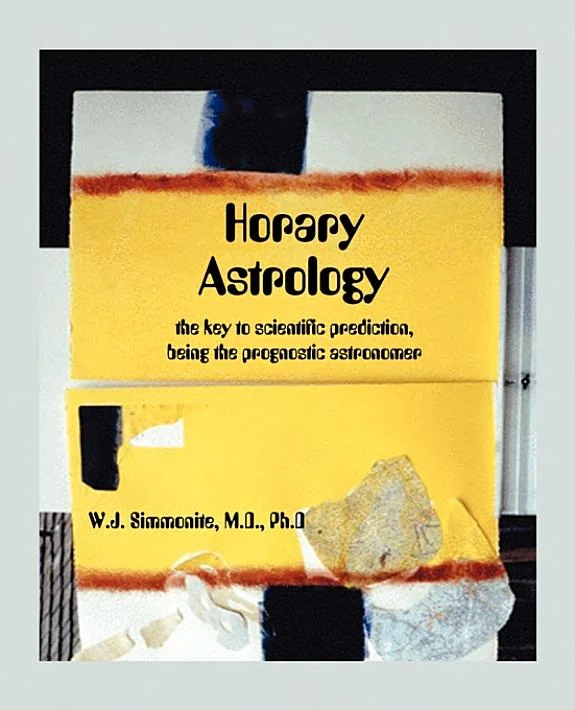
Horary Astrology
Simmonite’s *Horary Astrology* offers a robust, if at times dense, exploration of a potent divinatory system. The manual’s strength lies in its systematic approach, presenting a coherent framework for tackling specific questions through chart interpretation. Its meticulous detail, particularly in the sections detailing planetary significations and house rulerships, provides a solid foundation for aspiring horary practitioners. A notable aspect is the inclusion of Neptune and Pluto in later revisions, bridging classical practice with modern discoveries, although the integration can feel somewhat appended rather than organic. The primary limitation is the sheer technicality; the text assumes a degree of familiarity with astrological jargon that might challenge absolute beginners. However, the inclusion of an index of horary questions serves as a practical anchor, guiding users to relevant sections for common inquiries. Simmonite's work remains a valuable, if demanding, reference for those committed to mastering this ancient art.
📝 Description
78
William J. Simmonite's 1857 work defines horary astrology as an art for answering specific questions.
Horary astrology, as detailed by William J. Simmonite, is a method for divining answers to specific questions. This practice relies on casting an astrological chart for the exact moment a question is understood. The resulting chart acts as a snapshot of celestial energies, holding clues to the question's resolution. Unlike natal astrology, which focuses on a person's birth, horary astrology addresses immediate concerns.
Simmonite's text is aimed at serious students of astrology interested in practical, historical techniques. It is particularly useful for those who wish to find direct answers to life's challenges through astrological interpretation. Readers with a basic grasp of astrological concepts will find Simmonite's detailed approach beneficial. Newcomers to the subject may need additional resources to fully understand the methods presented.
The core of this work involves interpreting the horary chart. This includes identifying the significators for the querent and the question, analyzing house placements, planetary aspects, and the Moon's state. Simmonite outlines specific rules for predicting outcomes, considering factors like planetary reception, combustion, and applications or separations. A key principle discussed is radicality, ensuring the chart accurately reflects the question asked.
This book belongs to the tradition of Western esoteric astrology, specifically the branch known as horary astrology. Originating in ancient Mesopotamia and developing through Hellenistic, Arabic, and European traditions, horary astrology was a prominent divinatory art for centuries. Simmonite's work represents a classical approach, predating significant modern astrological developments. Its focus on practical application and direct answers through chart interpretation connects it to a long history of seeking celestial guidance for everyday matters and specific inquiries, distinguishing it from more philosophical or psychological astrological systems.
💡 Why Read This Book?
• Learn to cast and interpret a horary chart for the exact moment a question is posed, a skill distinct from natal astrology, as detailed in the core methodology sections. • Understand the specific roles of planetary significators and the Moon's condition in judging outcomes, a crucial technique for resolving querent inquiries presented in the interpretation chapters. • Explore a classical approach to astrological divination, updated to acknowledge planets like Pluto, offering a bridge between mid-19th-century practices and modern astrological considerations outlined in the editorial history.
⭐ Reader Reviews
Honest opinions from readers who have explored this book.
❓ Frequently Asked Questions
What is the primary difference between horary astrology and natal astrology?
Horary astrology answers specific questions posed at a particular moment, using a chart cast for that instant. Natal astrology, conversely, analyzes the birth chart of an individual to understand their personality, potential, and life path.
When was William J. Simmonite's 'Horary Astrology' originally written?
The original work is believed to have been written in the mid-1800s, with subsequent revisions occurring in 1896 and editorial updates in 1950.
Does this book include modern planets like Uranus and Neptune?
Yes, the revised edition includes Neptune and Pluto, adapting the classical horary framework to incorporate these later-discovered planets.
What is an 'index of horary questions' in this context?
It is a reference tool within the book that lists common types of questions asked in horary astrology, allowing readers to quickly find relevant interpretive guidelines and examples.
Is 'Horary Astrology' suitable for complete beginners to astrology?
While it offers a comprehensive guide, the book assumes some foundational knowledge of astrological terms and concepts. Beginners may find it beneficial to study introductory astrology texts first.
What does 'radicality' mean in horary astrology?
Radicality refers to the assessment of whether an astrological chart is genuinely suitable for answering the question asked. A chart must be 'radical' for the horary judgment to be considered valid.
🔮 Key Themes & Symbolism
The Art of the Question
This work anchors itself in the premise that a question, when clearly articulated and astrologically mapped, becomes a key to unlocking its own answer. The emphasis is on the 'moment of understanding' the question, establishing the horary chart as a direct, almost judicial, representation of the query. It moves beyond general life readings to provide specific, actionable insights, treating each question as a unique cosmic event demanding precise interpretation.
Planetary and House Significators
Central to Simmonite's method is the precise assignment of planetary rulers (significators) to the querent, the quesited (the subject of the question), and the relevant houses of the chart. The condition of these significators—their dignity, placement, and aspects—forms the basis for judgment. This detailed system allows for nuanced interpretations concerning relationships, finances, legal matters, and more, grounded in the fundamental structure of the astrological chart.
The Moon as a Universal Significator
The Moon plays a critical role in horary astrology, acting as a general significator for the querent and reflecting the immediate unfolding of events. Its state, its aspects to other planets, and its void-of-course condition are meticulously analyzed. The text details how the Moon's journey through the zodiac and its relationships with other celestial bodies offer vital clues about the progression and resolution of the horary question.
Historical Astrological Practice
This book serves as a window into mid-19th-century astrological thought, preserved through revisions by figures like John Story and Ernest Grant. It showcases a tradition that valued direct divination through chart interpretation, predating extensive psychological interpretations. The inclusion of planets discovered later, like Neptune and Pluto, highlights the evolution of astrological practice while retaining its classical roots.
💬 Memorable Quotes
Direct passages from the work, attributed to the author.
“The astrologer must be certain that the querent fully understands the question before casting the figure.”
— This highlights the critical importance of clarity and precision in horary work. The validity of the entire reading hinges on the accurate astrological representation of the question at the moment it is truly grasped.
“The condition of the significators will reveal the success or failure of the matter.”
— This captures the core principle of horary judgment: the state of the planets representing the question's components directly correlates to the outcome. It underscores a deterministic, yet decipherable, cosmic logic.
“The Moon, being swift in motion, signifies the present state and immediate future.”
— This emphasizes the dynamic role of the Moon in horary charts. Its rapid movement makes it a key indicator of how events are unfolding and what the near-term consequences might be.
“Reception between planets shows how the parties concerned affect each other.”
— This points to the intricate language of planetary aspects. 'Reception,' a measure of planetary dignity, is used here to understand the mutual influence and relationship dynamics between individuals or entities involved in the question.
“A void-of-course Moon indicates that the matter will not come to fruition as expected.”
— This specific condition of the Moon suggests a significant obstacle or a deviation from the anticipated course of events, often implying a lack of further progress or a resolution that differs from initial hopes.
🌙 Esoteric Significance
Tradition
This work fits within the broader Hermetic tradition, specifically its divinatory branch. Horary astrology, like other forms of divination such as Tarot or geomancy, relies on the principle of correspondence – that the microcosm (the astrological chart) reflects the macrocosm (the question and its potential outcome). It departs from purely Kabbalistic or Gnostic systems by focusing on practical, worldly answers rather than solely spiritual enlightenment or cosmic mysteries.
Symbolism
Key symbols include the twelve houses, representing different spheres of life (e.g., the 1st house for the querent, the 7th for relationships), and the planets, each embodying distinct archetypal energies and motivations. The Moon, often symbolizing the subconscious or immediate circumstances, is particularly potent. Aspects between planets are symbolic representations of interaction, harmony, or conflict between these forces, dictating the flow of events.
Modern Relevance
Contemporary practitioners of traditional astrology, particularly those focused on Hellenistic and medieval techniques, draw heavily on works like Simmonite's. Modern horary astrologers often integrate insights from this text into their practice, sometimes blending classical interpretations with the understanding of newly discovered planets, as seen in the revised editions. The book's methodical approach informs modern courses and studies in practical astrology.
👥 Who Should Read This Book
• Aspiring horary astrologers seeking a systematic, classical guide to answering specific life questions through chart interpretation. • Students of Western esotericism interested in the practical application of astrological principles within the Hermetic tradition. • Researchers of divination methods interested in historical practices and the evolution of astrological techniques from the mid-19th century onwards.
📜 Historical Context
William J. Simmonite's *Horary Astrology*, originating in the mid-19th century, emerged during a period of intense interest and resurgence in occult and esoteric studies, often termed the 'Occult Revival'. This era saw figures like Eliphas Lévi publishing influential works on magic and the Kabbalah, and the founding of societies such as the Theosophical Society later in the century. Horary astrology, with its practical, question-and-answer format, offered a tangible method of divination distinct from more philosophical or theoretical systems like ceremonial magic or complex Kabbalistic interpretations. The text's survival and subsequent revisions by John Story (1896) and Ernest Grant (1950) demonstrate its enduring appeal. While figures like William Wynn Westcott were exploring Hermetic traditions and the Rosicrucians, Simmonite's work provided a direct engagement with a classical form of astrological practice, accessible to those seeking concrete answers rather than purely esoteric exploration.
📔 Journal Prompts
The querent's significator and its house placement, reflecting the self.
The condition of the Moon at the time the question was understood.
Planetary reception as a measure of mutual influence between question components.
The 7th house significator and its relationship to the querent's ruler.
Interpreting a void-of-course Moon in the context of a specific horary question.
🗂️ Glossary
Horary Chart
An astrological chart cast for the precise date, time, and location when an astrologer understands a specific question posed by a querent. It is used to find the answer to that question.
Significator
A planet or house cusp that represents a person, thing, or matter relevant to the question being asked in a horary chart. Each key element of the question has a designated significator.
House
One of the twelve divisions of the astrological chart, each representing a different area of life or experience, such as self, possessions, siblings, home, or career.
Aspect
The angular relationship between two planets in an astrological chart, indicating how their energies interact. Common aspects include conjunction, opposition, trine, square, and sextile.
Reception
A measure of how much dignity or debility one planet has in the sign ruled by another planet. It indicates a form of mutual relationship or influence between the two planets.
Void of Course Moon
Describes the Moon when it has made its last major aspect to another planet in a sign, and before it enters the next sign. Often interpreted as indicating that the matter will not proceed as expected.
Radicality
The principle used in horary astrology to determine if a chart is appropriate for answering the question asked. Certain conditions must be met for a chart to be considered 'radical'.
This book appears in 1 collection
🔮 Readers Also Liked
Browse all →







From the “Horary Astrology” Collection
View all →








More Free Astrology & Cosmology Books
View all →