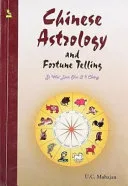
Chinese Astrology and Fortune Telling
 82
82

Chinese Astrology and Fortune Telling
U.C. Mahajan's Chinese Astrology and Fortune Telling offers a broad survey of ancient Chinese divinatory arts, with a particular focus on the Yi Jing and Zi Wei Dou Shu. The author effectively presents the Yi Jing not merely as a fortune-telling tool, but as a philosophical text deeply embedded in Chinese intellectual history, referencing its use by emperors for statecraft. A notable strength is the book's attempt to connect these practices to broader philosophical traditions, though at times this feels more like an overview than a deep analysis. The primary limitation is the sheer breadth of the subject matter; covering both the Yi Jing and Zi Wei Dou Shu within a single volume necessarily leads to a somewhat superficial treatment of each. The section discussing the sixty-four hexagrams of the Yi Jing, while informative, could benefit from more detailed examples of their application in specific historical or personal contexts. Mahajan's work provides a useful entry point for those unfamiliar with these systems, but seasoned practitioners may find it lacks the depth they seek. It functions best as a gateway to further study.
📝 Description
82
Published in 2009, U.C. Mahajan's book introduces ancient Chinese divination systems.
This work by U.C. Mahajan, published in 2009, serves as an introduction to Chinese divination. It begins with the Yi Jing, or Book of Changes, a text historically used by leaders and thinkers for guidance. The book also covers Zi Wei Dou Shu, a detailed astrological system, showing how it fits into Chinese thought.
The book is for anyone wanting to understand Chinese esoteric traditions. It suits newcomers, students of comparative religion, historians of philosophy, and people interested in different divination methods. Readers will appreciate its clear overview of complex topics.
Mahajan traces the history of Chinese divination back to ancient times. The Yi Jing influenced philosophical ideas in Confucianism and Taoism, as well as practical matters of governance. The book notes that Chinese astrology was a part of China's culture long before 2009.
This book engages with a long tradition of Chinese cosmology and divination. The Yi Jing, dating back millennia, is a core text in Taoism and a system for understanding change and cosmic patterns. Zi Wei Dou Shu, a complex astrological chart system, offers a different method for understanding destiny and personal characteristics based on birth time. These practices reflect a worldview where celestial events and earthly occurrences are interconnected, offering insight into personal fate and the broader flow of the universe.
💡 Why Read This Book?
• Gain a foundational understanding of the Yi Jing, exploring its structure of sixty-four hexagrams and their philosophical underpinnings, as presented in Mahajan's 2009 work, which positions it as a historical guide for rulers. • Discover the basic principles of Zi Wei Dou Shu, a complex Chinese astrological system, and how it differs from Western astrology, offering a unique lens for personal analysis. • Appreciate the historical significance of these divinatory practices within Chinese culture, recognizing their influence on philosophy and statecraft over millennia, as detailed in the book's contextual sections.
⭐ Reader Reviews
Honest opinions from readers who have explored this book.
❓ Frequently Asked Questions
What is the Yi Jing and how is it used in Chinese Astrology and Fortune Telling?
The Yi Jing, or Book of Changes, is an ancient Chinese oracle and philosophical text composed of 64 hexagrams. Mahajan's book explains its use not only for divination but also as a source of wisdom, historically consulted by emperors and sages for guidance on difficult decisions.
What is Zi Wei Dou Shu?
Zi Wei Dou Shu, as introduced in the book, is a complex form of Chinese astrology that uses the positions of stars and celestial bodies at the time of birth to map out a person's destiny and life path, distinct from Western astrological interpretations.
When was Chinese Astrology and Fortune Telling first published?
The book 'Chinese Astrology and Fortune Telling' by U.C. Mahajan was first published on September 3, 2009. This edition provides an accessible overview of these ancient Chinese esoteric systems.
Who historically consulted the Yi Jing?
According to the book, the Yi Jing (Book of Changes) was historically consulted by Chinese emperors for guidance on statecraft and difficult issues. It was also later used by Sages and Philosophers as a source of wisdom and philosophical insight.
Does the book compare Chinese and Western astrology?
Yes, the book touches upon this by presenting Zi Wei Dou Shu as a distinct Chinese astrological system. It highlights how this method focuses on celestial bodies and destiny analysis in a manner that differs from the zodiacal and planetary interpretations common in Western astrology.
What is the primary focus of U.C. Mahajan's book?
The primary focus is on introducing the foundational principles of ancient Chinese divination, particularly the Yi Jing (Book of Changes) and Zi Wei Dou Shu (Chinese astrology). It aims to explain their historical context and key concepts.
🔮 Key Themes & Symbolism
The Yi Jing's Dual Nature
The work explores the Yi Jing (Book of Changes) not solely as a tool for fortune-telling, but as a profound philosophical text integral to Chinese intellectual history. Its sixty-four hexagrams are presented as symbolic representations of universal principles, offering guidance and wisdom that historically informed statecraft and personal ethics. The book illustrates how this ancient oracle served as a repository of insight for leaders and thinkers, bridging the gap between practical decision-making and metaphysical understanding.
Zi Wei Dou Shu Astrological Framework
This theme centers on Zi Wei Dou Shu, a complex Chinese astrological system distinct from Western zodiacal astrology. The book outlines its reliance on the positions of specific stars and celestial palaces at the moment of birth to chart an individual's destiny. It emphasizes the system's analytical depth, offering a method for understanding life's challenges and opportunities through a unique cosmological lens, thus providing a personalized map of fortune.
Interconnection of Divination and Philosophy
Mahajan's text posits a deep connection between Chinese divination practices and philosophical traditions. The Yi Jing, for instance, is shown to be intertwined with concepts found in Taoism and Confucianism, reflecting a worldview where cosmic order influences human affairs. This theme highlights how ancient Chinese societies used these divinatory methods not just to predict the future, but to understand the underlying patterns of existence and to align oneself with the Tao.
Historical Application of Oracles
The book details the practical application of Chinese oracular systems throughout history. It recounts how figures of authority, such as emperors, relied on texts like the Yi Jing for critical decisions in governance and warfare. This historical perspective underscores the role of divination in shaping political and social landscapes, presenting these practices as integral to the functioning of ancient Chinese states and the development of their ethical frameworks.
💬 Memorable Quotes
Direct passages from the work, attributed to the author.
“The Yi Jing... was both a source and repository of philosophical insight for the Chinese, even as a part of Chinese Astrology or Zi Wei Dou Shu.”
— This statement highlights the book's core argument: that Chinese divinatory systems are not merely tools for prediction but are deeply integrated with philosophical thought, offering clear insights into the nature of reality and human existence.
“The Yi Jing... has been consulted in times of trouble for thousands of years.”
— This emphasizes the enduring relevance and historical depth of the Book of Changes, positioning it as a long-standing source of guidance and wisdom that has been sought out across centuries during periods of uncertainty and crisis.
“It was used as a guide and source of wisdom by the emperors, helping them decide the difficult issues of statecraft.”
— This interpretation underscores the practical and authoritative role the Yi Jing played in ancient Chinese governance, illustrating its function as a tool for strategic decision-making at the highest levels of power.
“Both of the major Chinese philosophical traditions, T...”
— This fragmented quote (as presented in the original blurb) suggests the book's intention to connect divination practices with the foundational philosophical schools of China, implying a broad influence on Chinese thought that extends beyond mere ritual.
“Later on by Sages and Philosophers.”
— This indicates a progression in the use of the Yi Jing, moving from imperial application to intellectual and spiritual exploration by scholars and thinkers, thereby expanding its significance from statecraft to personal enlightenment.
🌙 Esoteric Significance
Tradition
This work fits within the broad tradition of comparative esoteric studies, drawing from ancient Chinese cosmological and divinatory systems. While not strictly adhering to Western Hermeticism or Kabbalah, it shares the universal esoteric pursuit of understanding hidden patterns and cosmic correspondences. Mahajan's text contributes to this lineage by presenting indigenous Chinese systems, offering insights into a worldview that emphasizes balance, cyclical change, and the interconnectedness of the human and celestial realms, distinct from but complementary to other global esoteric frameworks.
Symbolism
Key symbols include the binary principles represented by Yin and Yang, fundamental to understanding the hexagrams of the Yi Jing. These opposing yet complementary forces are seen as the generative source of all phenomena. Another significant motif is the sixty-four hexagrams themselves, each a unique combination of six lines (broken for Yin, solid for Yang), symbolizing a specific situation or phase of change and offering guidance. The book also touches upon the symbolism within Zi Wei Dou Shu, where specific star configurations represent different aspects of fate and character.
Modern Relevance
Contemporary thinkers and practitioners interested in archetypal psychology, systems thinking, and cross-cultural spirituality find relevance in Mahajan's exploration. The principles of the Yi Jing, particularly its emphasis on change and adaptability, resonate with modern concepts of resilience and personal development. Furthermore, the book's introduction to Zi Wei Dou Shu offers an alternative to Western-centric astrological frameworks, appealing to those seeking diverse methods for self-understanding and forecasting life's cycles.
👥 Who Should Read This Book
• Students of comparative religion and philosophy interested in ancient Chinese thought, seeking to understand the historical and philosophical context of the Yi Jing and its relation to major Chinese schools. • Aspiring practitioners of Eastern divination methods who are new to the subject and desire a clear, introductory overview of both the Yi Jing and Zi Wei Dou Shu systems. • Individuals curious about alternative astrological systems, looking to explore the unique principles and applications of Chinese astrology beyond the familiar Western zodiac.
📜 Historical Context
Published in 2009, U.C. Mahajan's work emerged in an era where interest in Eastern philosophies and esoteric practices was growing globally. The book engages with traditions that have roots stretching back millennia, particularly the philosophical underpinnings of the Yi Jing, which influenced schools like Confucianism and Taoism. While not directly engaging with specific contemporary authors or reception events from its publication year, it implicitly situates itself within a lineage of scholarship on Chinese metaphysics that includes figures like James Legge, whose translations of the classics brought these texts to Western attention in the late 19th century. The work addresses the historical use of these systems, contrasting them with other forms of divination and astrological interpretation that were also gaining traction in the early 21st century, such as Western astrology and numerology.
📔 Journal Prompts
The sixty-four hexagrams of the Yi Jing: How might understanding these symbolic configurations offer a new perspective on personal challenges faced today?
Zi Wei Dou Shu's focus on celestial palaces: Reflect on how charting one's birth-time stars could illuminate innate strengths or potential obstacles.
The historical use of the Yi Jing by emperors: Consider a modern-day leadership challenge and how an ancient oracle might offer guidance.
The concept of Yin and Yang: Explore a situation in your life that embodies the interplay of these dualistic forces.
Ancient oracles as repositories of wisdom: How can consulting historical texts, like the Yi Jing, contribute to present-day decision-making?
🗂️ Glossary
Yi Jing (I Ching)
An ancient Chinese text, also known as the Book of Changes, comprising 64 hexagrams used for divination, wisdom, and philosophical exploration. It is a foundational text in Chinese culture.
Book of Changes
The English translation for Yi Jing (I Ching). It signifies the text's core function of revealing patterns of change and offering insights into the dynamics of the cosmos and human affairs.
Zi Wei Dou Shu
A complex Chinese astrological system that maps a person's destiny based on the positions of stars and celestial bodies at their exact time of birth. It is also known as Purple Star Astrology.
Hexagram
In the Yi Jing, a hexagram is a symbol composed of six stacked lines, each either solid (Yang) or broken (Yin). There are 64 unique hexagrams, each representing a specific situation or principle.
Yin and Yang
The fundamental Taoist concept of dualism, representing complementary opposites such as female/male, dark/light, passive/active. These forces are seen as interdependent and constantly interacting.
Statecraft
The skillful management of state affairs; the art of government. Historically, the Yi Jing was consulted for guidance in matters of statecraft by Chinese rulers.
Oracle
A person or agency considered to be a source of wise counsel or prophetic predictions inspired by a deity or supernatural force. The Yi Jing functions as an oracle.