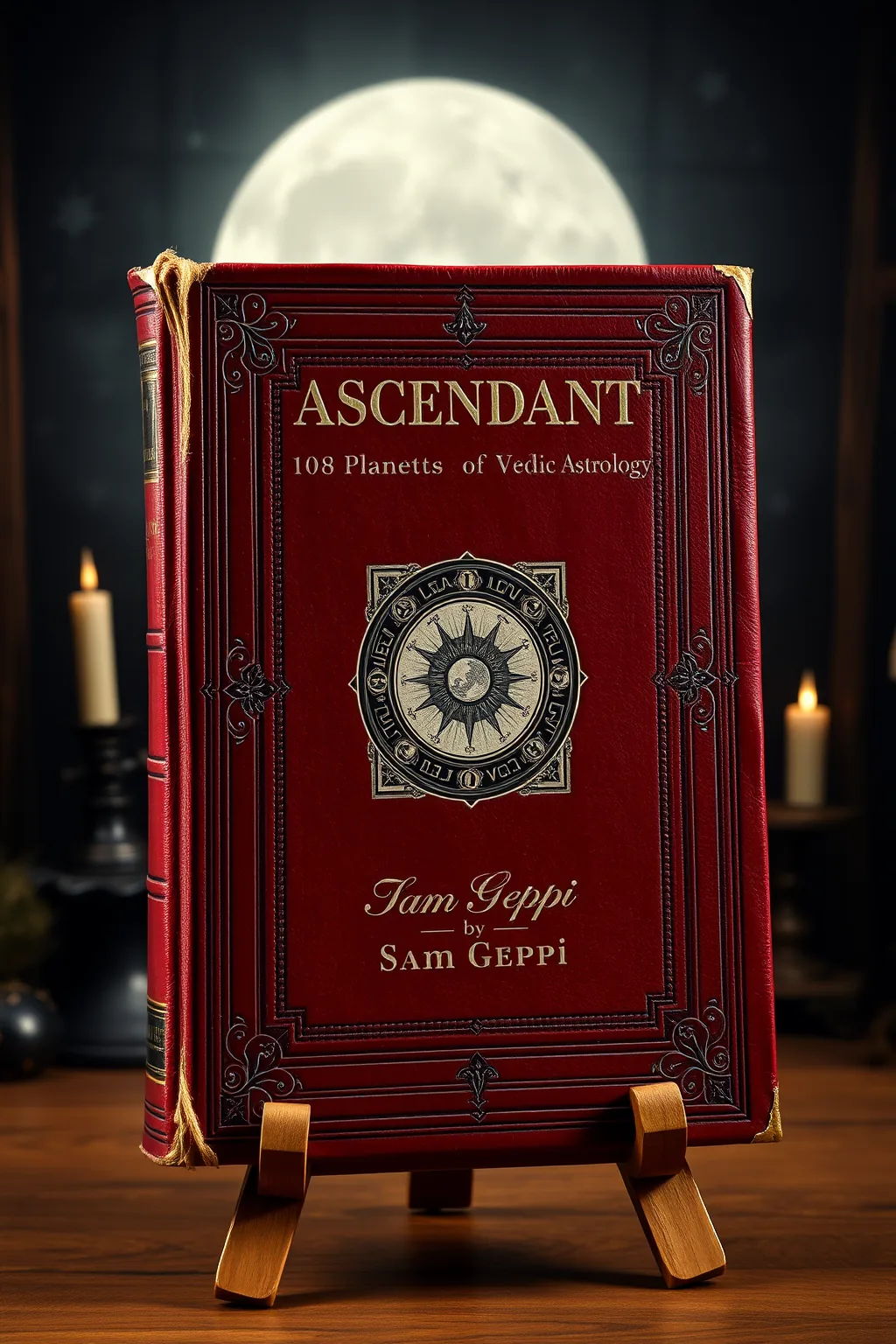
Ascendant-108 Planets of Vedic Astrology
 61
61

Ascendant-108 Planets of Vedic Astrology


Sam Geppi's 'Ascendant-108 Planets of Vedic Astrology' is a groundbreaking work, a luminous beacon in the often-murky waters of astrological literature. Geppi's deep understanding of Vedic principles allows him to reveal the profound esoteric dimensions of the 108 planets, moving beyond superficial interpretations to touch upon the soul's journey. His prose is both scholarly and imbued with a palpable sense of wonder, making complex concepts accessible without sacrificing their mystical essence. This book is an essential acquisition for anyone seeking a more profound, soul-level understanding of Jyotish, offering fresh perspectives that resonate with ancient truths. It is destined to become a cornerstone text for serious practitioners and spiritual seekers alike.
📝 Description
61
Sam Geppi's 2022 book introduces the concept of 108 planets in Vedic astrology.
Sam Geppi's 'Ascendant-108 Planets of Vedic Astrology' examines a less common aspect of Jyotish. The book focuses on the 108 planetary energies considered in some Vedic traditions, moving beyond the commonly known nine planets (navagrahas) and twelve zodiac signs.
Geppi details how these 108 celestial influences, which include the nakshatras and shadow planets, contribute to an individual's karmic patterns and destiny. The text aims to provide a framework for understanding the subtle connections between the cosmos and human experience. It is intended for those interested in a deeper dive into astrological symbolism and its potential impact on personal growth and spiritual awareness.
This work engages with a specific, less mainstream branch of Vedic astrology, Jyotish. While standard Jyotish often centers on the navagrahas (nine primary celestial bodies), this book delves into traditions that recognize a more extensive pantheon of 108 planetary influences. These often incorporate the lunar mansions (nakshatras) and other subtle energies, linking them to a complex understanding of karma and spiritual evolution within the Indian philosophical framework. It positions itself within the esoteric traditions that seek deeper symbolic meanings in celestial movements.
💡 Why Read This Book?
This book is your key to unlocking the deeper, more mystical layers of Vedic astrology. If you're a seeker yearning for a cosmic map of your soul's purpose, a practitioner aiming to refine your craft with ancient, hidden knowledge, or a scholar fascinated by the philosophical depths of Jyotish, 'Ascendant-108' offers unparalleled insights. It reveals celestial influences far beyond the conventional, promising a richer, more profound astrological understanding.
⭐ Reader Reviews
Honest opinions from readers who have explored this book.
❓ Frequently Asked Questions
What are the '108 Planets' in Vedic Astrology?
Beyond the seven classical planets and the shadow planets Rahu and Ketu, Vedic astrology recognizes 108 planetary energies, including the nakshatras and their governing deities, revealing a far more nuanced cosmic influence on human destiny and spiritual growth.
Is this book suitable for beginners?
Yes, while it delves into advanced concepts, Sam Geppi’s clear and evocative writing style makes the foundational principles of the 108 planets accessible to dedicated beginners eager to explore deeper astrological truths.
What is the philosophical significance of the number 108 in this context?
The number 108 holds immense spiritual and mathematical significance across many Eastern traditions, representing wholeness, spiritual completion, and the interconnectedness of all existence. In astrology, it signifies a comprehensive spectrum of celestial influences.
How does this differ from Western astrology?
'Ascendant-108' focuses on the sidereal zodiac and the unique philosophical framework of Vedic astrology, emphasizing karma, dharma, and the subtle body. It introduces planetary energies and concepts largely absent in Western systems.
Can this book help with spiritual growth?
Absolutely. By understanding the deeper karmic and spiritual implications of the 108 planets, readers can gain profound self-awareness, align with their soul's purpose, and navigate their life path with greater wisdom and intention.
🔮 Key Themes & Symbolism
The Mystical 108 Planetary Energies
This book unveils the profound esoteric significance of the 108 planets, a concept far richer than the commonly known celestial bodies. It examines the subtle energies of the nakshatras, their ruling deities, and the lesser-known grahas, revealing a comprehensive cosmic architecture. Geppi illustrates how these energies interweave to shape our karmic blueprint, offering a panoramic view of the soul's journey through the cycles of existence. This exploration invites readers to perceive the heavens not as static points of light, but as dynamic forces intricately connected to our inner landscape and destiny.
Vedic Astrology as a Spiritual Science
Sam Geppi presents Vedic astrology (Jyotish) not merely as a predictive tool, but as a sacred science, a profound spiritual discipline designed for self-realization. The book emphasizes the philosophical underpinnings of Jyotish, highlighting its role in understanding dharma, karma, and the interconnectedness of the microcosm and macrocosm. It encourages a contemplative approach, urging readers to use astrological insights as a catalyst for inner transformation, ethical living, and alignment with cosmic order. This perspective positions the celestial bodies as guides on the path to enlightenment.
Symbolism and the Cosmic Dance
The text is rich with symbolic interpretations, drawing from ancient Sanskrit texts and philosophical traditions. Geppi elucidates the archetypal meanings associated with each of the 108 planets, connecting them to universal mythologies and psychological patterns. The book portrays the celestial movements as a divine dance, a cosmic play that mirrors our own life experiences. Understanding this strong symbolism allows readers to decipher the deeper messages encoded in their birth charts, fostering a profound sense of connection to the universe and its inherent wisdom.
💬 Memorable Quotes
Direct passages from the work, attributed to the author.
“Karma is the echo of the soul's past journeys.”
— This profound statement frames karma not as punishment, but as a natural consequence and learning opportunity arising from the soul's accumulated experiences across multiple lifetimes, emphasizing the cyclical nature of existence.
“The birth chart is a sacred map of destiny.”
— This evocative phrase positions an astrological chart as more than just a diagram of planetary positions; it is a divinely ordained guide, offering insight into one's life path, challenges, and ultimate potential for growth and fulfillment.
“True astrology illuminates the path to inner freedom.”
— This suggests that the ultimate purpose of studying astrology is not merely to predict events, but to gain self-awareness, understand one's conditioning, and ultimately achieve liberation from limiting patterns and external influences.
💡 Key Ideas
Editorial paraphrase of the work's core concepts — not direct quotes.
The stars whisper secrets to those who learn to listen.
This quote suggests that the celestial bodies are not silent observers but actively communicate profound truths to individuals who possess the spiritual attunement and wisdom to perceive their messages, hinting at a deeper, intuitive form of astrological understanding.
Each planet is a facet of the divine consciousness.
This quote elevates the understanding of planetary influences beyond mere physical bodies, presenting them as manifestations of a singular, universal divine intelligence that interacts with and shapes our individual reality.
🌙 Esoteric Significance
Tradition
This book is deeply rooted in the esoteric tradition of Vedic Astrology (Jyotish), a Vedic science that views the cosmos as a reflection of divine consciousness. It draws from the philosophical underpinnings of Vedanta and Yoga, emphasizing karma, dharma, and the journey of the soul. The concept of 108 planets extends beyond the physical to encompass subtle energies and archetypal forces, aligning with Tantric and yogic understandings of the universe as a manifestation of pure consciousness.
Symbolism
The number 108 is profoundly symbolic, representing spiritual completion and the totality of existence. Each of the 108 planets, including the nakshatras and their associated deities, carries rich archetypal symbolism derived from Vedic mythology, cosmology, and philosophy. These symbols are not merely illustrative but are understood as potent forces that shape human consciousness and destiny, offering keys to understanding the subtle interplay between the individual and the cosmos.
Modern Relevance
In an era often characterized by disconnection and existential searching, 'Ascendant-108' offers a profound framework for understanding oneself and one's place in the universe. Its modern relevance lies in its ability to provide a holistic, spiritual perspective on life's challenges and opportunities. By deciphering the intricate dance of the 108 planets, individuals can gain deeper self-awareness, cultivate intentional living, and foster a sense of cosmic interconnectedness, leading to greater personal meaning and spiritual fulfillment.
👥 Who Should Read This Book
This informative text is a treasure for a diverse audience. **Beginners** with a sincere interest in astrology will find Geppi's clear explanations a gentle yet profound introduction to the deeper layers of Jyotish. **Aspiring and practicing astrologers** will discover a wealth of new perspectives and techniques to enrich their readings and understanding of planetary influences. **Spiritual seekers** drawn to ancient wisdom traditions will find a cosmic map that speaks to their journey of self-discovery and enlightenment. **Scholars of comparative religion and esotericism** will appreciate the rigorous scholarship and the exploration of a rich, often overlooked, facet of astrological lore.
📜 Historical Context
Vedic astrology, or Jyotish, boasts an lineage stretching back thousands of years, deeply interwoven with the ancient Vedic civilization of India. Its foundational texts, such as the Brihat Parashara Hora Shastra, were compiled during periods of intense philosophical and spiritual inquiry, likely between the 5th and 8th centuries CE, though its roots are undoubtedly older. The concept of 108 planetary energies, while not always explicitly enumerated in the same way as in this modern interpretation, reflects a holistic cosmology that embraced a vast pantheon of deities and celestial observations. The transmission of this knowledge occurred through oral traditions and meticulously copied manuscripts, surviving invasions, cultural shifts, and the passage of millennia. Sam Geppi's work, 'Ascendant-108,' stands as a contemporary reinterpretation and expansion of this ancient wisdom, bridging the gap between historical esoteric practices and modern seekers, demonstrating the enduring relevance and profound depth of this celestial science.
📔 Journal Prompts
Reflect on the primary themes of your birth chart as illuminated by the 108 planets. How do these energies manifest in your daily life?
Consider the concept of karma as presented in this book. What past actions might be influencing your present circumstances, and how can you consciously shape future karma?
Which of the 108 planetary energies resonates most strongly with your current life challenges or aspirations? Explore its symbolic meaning and potential guidance.
How does understanding the 108 planets shift your perception of your own destiny and the interconnectedness of the universe?
If you were to create a personal mantra or affirmation based on a key insight from this book, what would it be and why?
🗂️ Glossary
Jyotish
The traditional Sanskrit name for Vedic Astrology, a system of celestial divination and spiritual science originating from ancient India, focused on understanding cosmic influences on earthly life and the soul's journey.
Graha
In Vedic Astrology, 'graha' refers to a planet or celestial body that exerts an influence, encompassing the Sun, Moon, Mercury, Venus, Mars, Jupiter, Saturn, and the shadow planets Rahu and Ketu.
Nakshatra
Lunar mansions or constellations in Vedic Astrology, representing 27 divisions of the ecliptic, each with unique deities, symbols, and characteristics that offer a finer layer of interpretation beyond the zodiacal signs.
Dharma
A fundamental concept in Indian philosophy, referring to one's duty, righteousness, cosmic order, and the intrinsic nature of things. In astrology, it relates to one's life purpose and ethical path.
Rahu and Ketu
The shadow planets or lunar nodes in Vedic Astrology, representing the points of intersection between the Sun and Moon's orbits. They are considered karmic influencers, signifying past life patterns and future destiny.
This book appears in 2 collections
🔮 Readers Also Liked
Browse all →








From the “Astrology” Collection
View all →








More Free Astrology & Cosmology Books
View all →