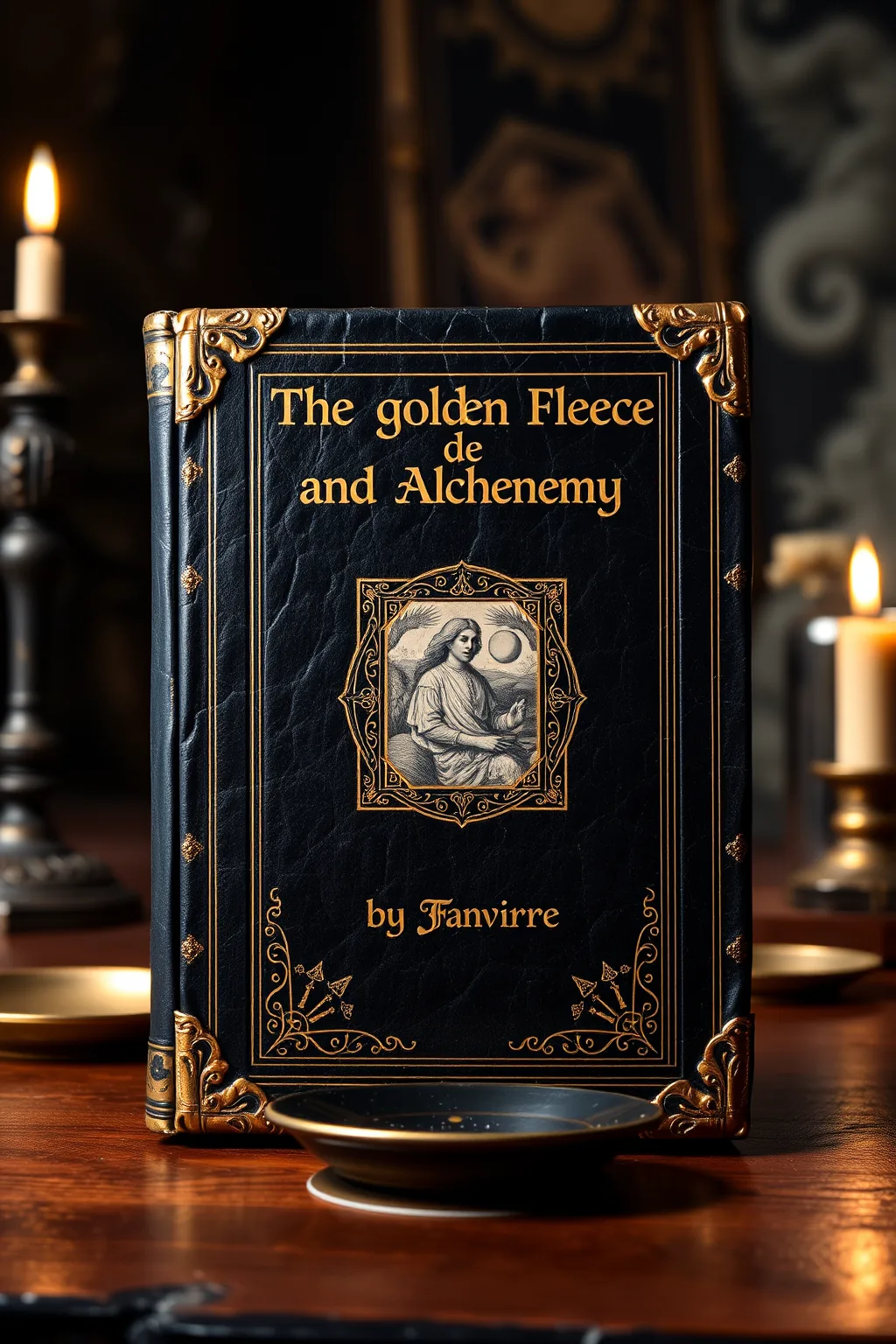
The golden fleece and alchemy
 81
81

The golden fleece and alchemy
Antoine Faivre’s "The Golden Fleece and Alchemy" offers a compelling argument for viewing alchemical pursuits as deeply embedded within a rich philosophical and mythological tradition. Rather than merely cataloging symbols, Faivre masterfully connects the quest for the Golden Fleece to the alchemist’s search for spiritual gold. The book excels in its detailed tracing of these connections through historical periods, demonstrating a nuanced understanding of how myth informs esoteric practice. A particular strength lies in its scholarly approach, refusing to sensationalize the subject, instead presenting a rigorous intellectual history. However, the academic density, while a virtue for scholars, might present a barrier for the casual reader seeking a more accessible introduction to alchemy. The chapter discussing the integration of Christian mystical concepts with alchemical symbolism, particularly the notion of the *lapis philosophorum* as a Christological figure, is exceptionally insightful. Faivre’s work is an indispensable resource for understanding the philosophical depth of the alchemical tradition.
📝 Description
81
Antoine Faivre published "The Golden Fleece and Alchemy" in 1993, examining alchemical symbolism through myth.
Antoine Faivre's "The Golden Fleece and Alchemy" scrutinizes the historical and philosophical roots of alchemy, focusing on its connection to the Golden Fleece myth. The book argues that alchemical practices were not simply early chemistry but a symbolic system for achieving spiritual or psychological integration. Faivre traces the development of these concepts across different eras and cultures, showing how various philosophical ideas merged within the alchemical tradition.
This study is aimed at those with a serious interest in esoteric history, comparative religion, and the philosophy of science. It is for readers who want a thorough, academic grasp of alchemy's intellectual and spiritual dimensions, rather than a surface-level account. Individuals researching Hermeticism, Gnosticism, or Renaissance esotericism will find valuable material here, particularly in how mythic narratives inform philosophical thought.
Published in 1993, Faivre's work arrived as Western esotericism began to gain academic traction, building on earlier scholarship by figures like Frances Yates. Faivre specifically illuminated the Golden Fleece archetype as a framework for alchemical symbolism. This contributed to a scholarly understanding of alchemy as more than proto-chemistry, but as a complex symbolic system tied to inner transformation and gnosis, reflecting a broader academic shift towards recognizing the intellectual depth of esoteric traditions.
💡 Why Read This Book?
• Understand the deep symbolic connection between the classical myth of Jason and the Argonauts' quest for the Golden Fleece and the alchemical Great Work, moving beyond simplistic materialist interpretations. • Grasp the concept of *soteriology* within alchemy, as explored by Faivre, revealing how alchemists viewed their practice as a path to spiritual salvation and inner perfection. • Appreciate the historical integration of alchemical ideas with Renaissance philosophy, particularly the influence of Hermetic texts and thinkers like Giordano Bruno, as detailed in the book's historical context.
⭐ Reader Reviews
Honest opinions from readers who have explored this book.
❓ Frequently Asked Questions
What is the primary thesis of Antoine Faivre's "The Golden Fleece and Alchemy"?
Faivre argues that the alchemical quest, often misunderstood as mere proto-chemistry, is deeply intertwined with the myth of the Golden Fleece, representing a profound spiritual and philosophical pursuit for inner transformation and gnosis.
How does Faivre connect the Golden Fleece myth to alchemy?
He demonstrates how the narrative of Jason and the Argonauts provided a symbolic framework and archetypal quest that alchemists adopted and adapted to represent their own spiritual journey towards perfection and the Great Work.
What historical periods does the book cover in relation to alchemy?
The book explores the historical development of alchemical thought from antiquity through the Renaissance and beyond, highlighting key periods of philosophical and symbolic evolution, particularly as they relate to Hermeticism.
Is this book about practical alchemical recipes?
No, Faivre's work is primarily a scholarly examination of the philosophical, spiritual, and mythological dimensions of alchemy, not a practical guide to laboratory procedures or recipes.
Who is considered a key contemporary figure whose work relates to Faivre's exploration?
Scholars like Frances Yates, who illuminated the Hermetic tradition and its influence on Renaissance thought, represent a significant intellectual lineage to which Faivre's work contributes, though he focuses specifically on the Fleece motif.
What does 'opus magnum' refer to in the context of this book?
The 'opus magnum,' or Great Work, refers to the alchemical process, which Faivre interprets as encompassing not only material transformation but also profound spiritual regeneration and the attainment of esoteric knowledge.
🔮 Key Themes & Symbolism
Myth as Alchemical Blueprint
Faivre meticulously details how ancient myths, particularly the quest for the Golden Fleece, served as foundational narratives for alchemical symbolism. The journey of Jason and the Argonauts is presented not as a mere adventure, but as an allegorical representation of the alchemist's arduous path towards spiritual realization and the Great Work. This theme highlights the power of archetypal stories to provide a conceptual and symbolic structure for esoteric practices, suggesting that the desire for transformation and hidden treasure is a universal human impulse channeled through specific mythic narratives.
The Spiritual Dimension of the Great Work
Central to Faivre's analysis is the concept of the *opus magnum*, or the Great Work, which transcends purely material goals. The book emphasizes that for many alchemists, the ultimate aim was spiritual purification, inner illumination, and a form of gnosis or salvation. This perspective reframes alchemy from a primitive science to a complex spiritual discipline, integrating psychological and theological dimensions. Faivre argues that the alchemical process mirrored a journey of the soul, seeking to restore a lost divine harmony within the practitioner.
Alchemy and Esoteric Traditions
Faivre situates alchemy within a broader spectrum of esoteric traditions, tracing its connections to Hermeticism, Gnosticism, and Neoplatonism. He explores how alchemical symbolism often drew upon and contributed to these diverse lineages, creating a complex web of philosophical ideas. The work illuminates the concept of *correspondences* – the belief in the interconnectedness of the microcosm and macrocosm – as a key principle underlying many esoteric systems, including alchemy, and how this principle was applied to understand both the material world and spiritual realities.
Symbolic Language of Transformation
The book explores the rich and often enigmatic symbolic language employed by alchemists. Faivre interprets alchemical texts not as literal scientific treatises but as sophisticated philosophical and spiritual allegories. Symbols such as the fleece, the dragon, and various metals are analyzed for their multi-layered meanings, representing stages of purification, challenges to overcome, and the ultimate goal of spiritual perfection. This theme underscores the importance of deciphering symbolic codes to understand the deeper intent of alchemical writings.
💬 Memorable Quotes
Direct passages from the work, attributed to the author.
“The quest for the Golden Fleece mirrors the alchemist’s search for the Philosopher's Stone.”
— This statement expresses the core argument: the mythic journey of Jason is not merely a parallel but a symbolic precursor and conceptual foundation for the alchemical Great Work, representing the arduous path to spiritual perfection.
“Alchemy aimed at a form of spiritual regeneration, not just material change.”
— This highlights the book's emphasis on the soteriological aspect of alchemy, positioning it as a discipline focused on the transformation of the soul and the attainment of divine knowledge, rather than solely on chemical processes.
“The principle of correspondences linked the microcosm and the macrocosm.”
— This refers to a fundamental esoteric concept that Faivre applies to alchemy, suggesting that understanding the patterns and relationships between the human being (microcosm) and the universe (macrocosm) was key to the alchemical endeavor.
“Mythological narratives provided the symbolic framework for alchemical operations.”
— This points to how ancient stories and archetypes, like the Golden Fleece legend, offered alchemists a rich vocabulary of symbols and narrative structures to articulate their complex spiritual and philosophical ideas.
💡 Key Ideas
Editorial paraphrase of the work's core concepts — not direct quotes.
The alchemist sought an inner transformation, a spiritual gold.
This paraphrase emphasizes the internal, psychological, and spiritual dimension of the alchemical pursuit, contrasting it with a purely external or material interpretation and aligning it with the concept of inner perfection.
🌙 Esoteric Significance
Tradition
This work is deeply rooted in the Hermetic and Gnostic traditions, exploring how alchemical practices and theories functioned as a form of spiritual discipline aimed at achieving gnosis or salvific knowledge. Faivre situates alchemy within a lineage that seeks hidden truths and cosmic correspondences, departing from purely materialist interpretations. It fits within the broader Hermetic concept of *prisca theologia*, the idea of an ancient, unified wisdom tradition, by showing how alchemical symbolism draws from and contributes to this overarching spiritual philosophy.
Symbolism
The titular Golden Fleece serves as a primary symbol, representing not just material wealth but the ultimate prize of spiritual enlightenment and the successful completion of the Great Work. The journey of Jason and the Argonauts is interpreted as an allegory for the alchemist's path, fraught with trials and requiring specific virtues. Other key symbols explored include the dragon (representing primordial chaos or the challenges of transformation) and the concept of the *lapis philosophorum* (Philosopher's Stone) as a representation of perfected matter and spiritual unity.
Modern Relevance
Faivre's scholarship continues to influence contemporary scholars and practitioners interested in Western esotericism, comparative mythology, and the philosophy of religion. Thinkers exploring Jungian archetypes, transpersonal psychology, and the symbolic dimensions of religious experience often draw upon his work. The book remains a foundational text for understanding the historical and philosophical underpinnings of practices that seek inner transformation through symbolic engagement, relevant to modern movements interested in depth psychology and esoteric spirituality.
👥 Who Should Read This Book
• Students of comparative mythology and classical studies seeking to understand the deeper symbolic meanings embedded within ancient Greek myths. • Advanced scholars of Western Esotericism and Hermeticism requiring a rigorous, academic analysis of alchemy's philosophical and spiritual dimensions. • Psychologists and philosophers interested in the archetypal nature of quests and the symbolic language of transformation, particularly as it relates to individuation and spiritual development.
📜 Historical Context
Antoine Faivre's "The Golden Fleece and Alchemy" emerged in 1993, a period when the academic study of Western esotericism was gaining significant traction, moving beyond earlier, more speculative approaches. This era saw scholars like Frances Yates already having established the importance of Hermeticism in Renaissance intellectual history. Faivre's work distinguished itself by forging a specific link between a foundational myth and the alchemical tradition, contributing to a more nuanced understanding of esoteric symbolism. It appeared at a time when competing schools of thought, such as purely historical materialism or psychological reductionism, were being challenged by approaches that acknowledged the internal coherence and philosophical depth of esoteric systems. The book’s rigorous methodology and focus on philosophical interpretation aligned it with a burgeoning academic discipline seeking to treat its subjects with intellectual seriousness, contrasting with earlier, more occultist-focused literature.
📔 Journal Prompts
The symbolic journey of the Golden Fleece and its relation to the alchemist's Great Work.
Reflections on the concept of *soteriology* as applied to alchemical pursuits.
Analyzing the principle of *correspondences* in personal spiritual practices.
The role of symbolic language in understanding esoteric traditions.
How does the myth of the Golden Fleece resonate with modern quests for meaning?
🗂️ Glossary
Opus Magnum
Latin for 'Great Work,' referring to the entire process of alchemical transformation, encompassing both material and spiritual purification and perfection.
Soteriology
The doctrine of salvation; in the context of alchemy, it refers to the belief that the alchemical process leads to spiritual liberation, enlightenment, or a form of redemption.
Gnosis
Greek for 'knowledge,' referring to a special, intuitive, or revealed knowledge, often associated with spiritual enlightenment and salvation in Gnostic and esoteric traditions.
Hermeticism
A religious, philosophical, and esoteric tradition based on writings attributed to Hermes Trismegistus, emphasizing divine knowledge, the interconnectedness of the cosmos, and spiritual transformation.
Correspondences
The esoteric principle that there is a relationship or similarity between different areas of existence, particularly between the macrocosm (universe) and the microcosm (human being).
Lapis Philosophorum
The Philosopher's Stone, a legendary alchemical substance said to be capable of transmuting base metals into gold or silver and to be an elixir of life.
Prisca Theologia
Latin for 'ancient theology,' the concept that a single, true theology existed in antiquity and was passed down through various philosophers and traditions, including Hermeticism.
🔮 Readers Also Liked
Browse all →![Ancient fragments of the Phœnician, Chaldæan, Egyptian, Tyrian, Carthaginian, Indian, Persian, and other writers; with an introductory dissertation: and an inquiry into the philosophy and trinity of the ancients. By Isaac Preston Cory […]](/img/thumb/ancient-fragments-of-the-ph-nician-chald-an-egyptian-tyrian-carthaginian-indian-persian-and-other-writers-with-an-introductory-dissertation-and-an-inquiry-into-the-philosophy-and-trinity-of-the-ancien.webp)







More by Faivre, Antoine
All books →



More Free Alchemy & Hermeticism Books
View all →