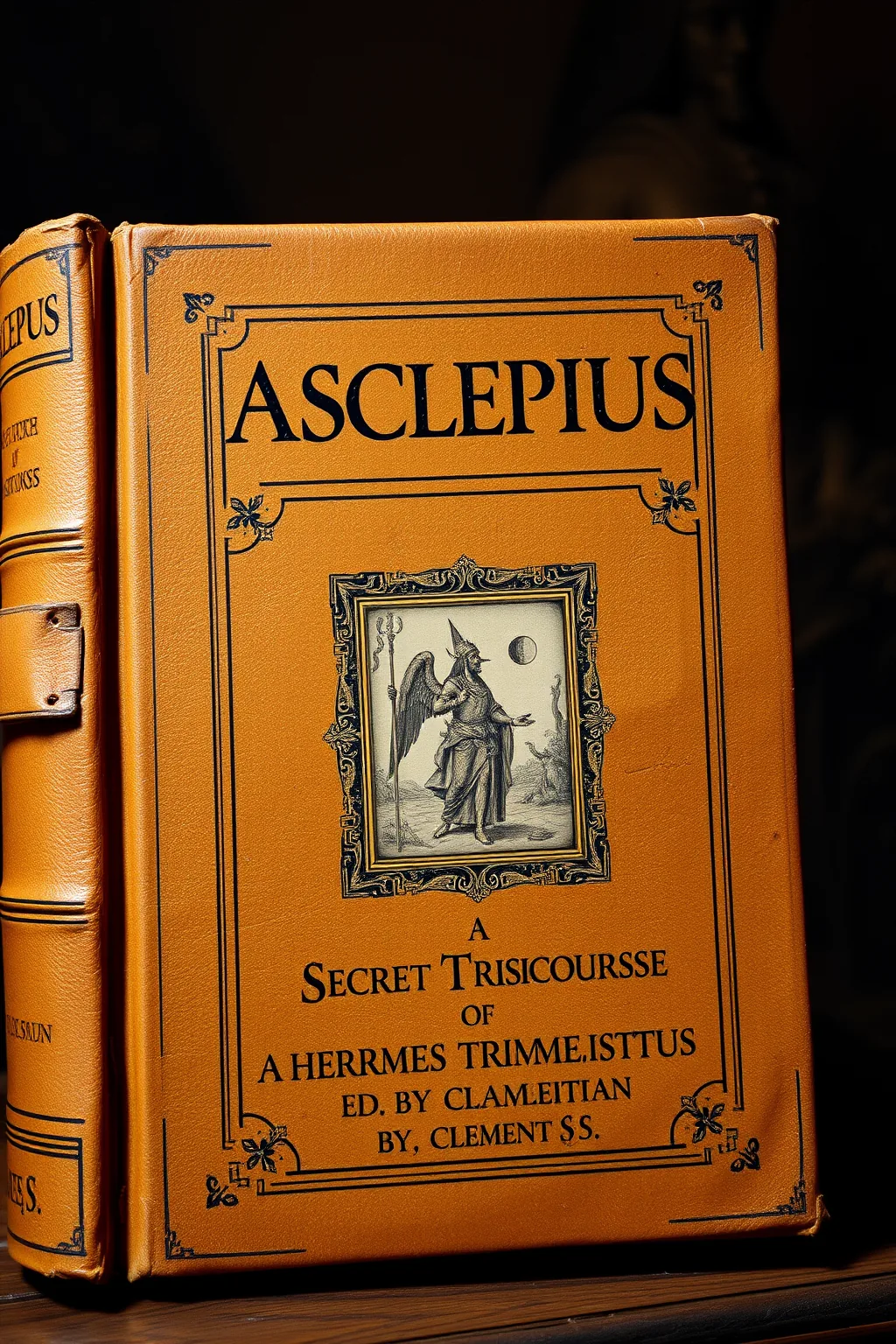
ASCLEPIUS: A SECRET DISCOURSE OF HERMES TRISMEGISTUS; ED. BY CLEMENT SALAMAN
 80
80

ASCLEPIUS: A SECRET DISCOURSE OF HERMES TRISMEGISTUS; ED. BY CLEMENT SALAMAN
Clement Salaman's 2007 edition of the Asclepius offers a clear presentation of a foundational Hermetic text. The clarity of the translation, while necessarily interpretive, allows the dense theological and cosmological arguments to remain accessible to a modern audience. A particular strength lies in its examination of the dialogue between Asclepius and Hermes, which frames complex philosophical ideas in a relatable question-and-answer format. However, the absence of extensive scholarly annotation beyond the editor's introductory remarks might leave those unfamiliar with the broader Hermetic corpus seeking more contextual depth. The section discussing the creation of man and his subsequent fall from divine awareness, a recurring motif in ancient philosophical discourse, is particularly striking in its depiction of humanity's potential for both degradation and redemption.
This edition serves as a solid gateway into the Asclepius for dedicated seekers.
📝 Description
80
Clement Salaman's 2007 edition makes the Asclepius accessible for modern study.
The Asclepius is a dialogue attributed to Hermes Trismegistus, a figure blending Greek and Egyptian deities. This text discusses cosmology, the divine, and humanity's place in creation, holding a significant position within the Hermetic tradition. It offers a perspective on Gnostic and Neoplatonic ideas that influenced later Western thought.
This particular edition, curated by Clement Salaman, aims to introduce the Asclepius to contemporary esoteric students. It is suited for those interested in Hermetic philosophy, ancient mysticism, and comparative religion. Readers will find value in its exploration of the divine mind, the cosmos as a sentient entity, and human spiritual potential.
The work examines the concept of the 'All' as existence's totality and its connection to the 'One' or God. It addresses the creation of the cosmos and humanity's dual physical and spiritual nature. A central idea is the divine spark within humans and how gnosis, or knowledge, can bring spiritual freedom. The text also touches on the nature of divinity, intermediary beings, and cosmic order.
The Asclepius is a key text within the Hermetic tradition, linked to Hermes Trismegistus, a syncretic deity. Its ideas circulated in antiquity, influencing thinkers from early Christianity through the Renaissance. Marsilio Ficino, for example, incorporated its concepts into his 15th-century Neoplatonic studies. The text's exploration of Gnostic and Neoplatonic thought makes it a bridge between ancient philosophical traditions and later Western esotericism, touching on themes of creation, divinity, and human spiritual ascent.
💡 Why Read This Book?
• Gain an understanding of the Hermetic concept of the 'All' and its relationship to the singular divine source, as presented in this ancient dialogue. • Explore the Neoplatonic idea of humanity as a divine image, with the potential for spiritual ascent through knowledge, a core tenet explored in the text. • Familiarize yourself with the historical context of the Asclepius, understanding its influence on Renaissance thinkers like Marsilio Ficino and its place in the broader Hermetic tradition.
⭐ Reader Reviews
Honest opinions from readers who have explored this book.
❓ Frequently Asked Questions
What is the historical significance of the Asclepius text?
The Asclepius is a key text within the Hermetic tradition, known since antiquity. It significantly influenced Renaissance Neoplatonism, particularly thinkers like Marsilio Ficino, and contributed to esoteric thought regarding cosmology and divinity.
Who is Hermes Trismegistus?
Hermes Trismegistus is a legendary, syncretic figure representing a fusion of the Greek god Hermes and the Egyptian god Thoth. He is considered the author of the Hermetic texts, which form a cornerstone of Western esoteric philosophy.
What are the main philosophical themes in the Asclepius?
The text explores themes of cosmology, the nature of God (the 'All'), humanity's divine origin and potential, and the path to spiritual knowledge (gnosis) for redemption.
What makes Clement Salaman's 2007 edition notable?
Salaman's edition aims to present the Asclepius for contemporary esoteric study, focusing on clarity for modern readers interested in Hermeticism and related philosophical traditions.
How does the Asclepius relate to Gnosticism?
While distinct, the Asclepius shares thematic parallels with Gnosticism, particularly in its emphasis on divine knowledge as a means of salvation and its exploration of the spiritual nature of humanity.
Where does the concept of the 'Nous' appear in Hermetic thought?
The 'Nous,' or divine Mind, is a central concept in Hermetic philosophy, often discussed in relation to the creation of the cosmos and the divine spark within humanity, as explored in texts like the Asclepius.
🔮 Key Themes & Symbolism
The Divine Cosmos
The Asclepius presents a vision of the cosmos as a divinely ordered and animated entity, an emanation from the singular God, referred to as 'the All.' This perspective views the universe not as inert matter but as infused with divine intelligence and purpose. The text details the creation of the world and its various strata, from the celestial spheres to the earthly realm, emphasizing the interconnectedness of all things under divine providence. This holistic view is fundamental to understanding humanity's place within the grand cosmic design, as conceived by Hermetic philosophy.
Humanity as Divine Image
A core teaching within the Asclepius is the concept of humanity as a reflection or 'image' of the divine. This is not merely a metaphorical statement but suggests an inherent spiritual essence within each person, a spark of the divine Nous. The text explores the dual nature of humanity, composed of both physical form and an immortal soul. It posits that through understanding and gnosis, individuals can reconnect with their divine origin, transcending the limitations of the material world and realizing their inherent spiritual potential.
The Path of Gnosis
Gnosis, or divine knowledge, is presented as the primary means for humanity's spiritual redemption and ascent. The Asclepius outlines that true understanding of the divine nature, the cosmos, and oneself is essential to break free from the cycle of material existence. This knowledge is not merely intellectual but experiential, involving a profound realization of one's true spiritual identity. The text implies that this illuminated state allows individuals to align themselves with the divine will and participate in the cosmic order.
The Nature of God
Hermes Trismegistus, through the Asclepius, grapples with the ineffable nature of the ultimate reality, often termed 'the All' or God. This divine principle is depicted as singular, eternal, and the source of all creation, yet also immanent within the cosmos. The text explores the paradox of a transcendent yet omnipresent deity, the ultimate mind (Nous) from which all existence flows. Understanding this divine nature is presented as the ultimate goal of spiritual inquiry, leading to harmony with the universal order.
💬 Memorable Quotes
Direct passages from the work, attributed to the author.
“The universe is a living being, endowed with soul and intelligence.”
— This statement captures the Hermetic view of a divinely animated cosmos, contrasting with purely materialistic interpretations. It suggests that all creation possesses a form of consciousness or divine spark, emphasizing interconnectedness and inherent sacredness.
“Man is a great miracle, a being worthy of reverence.”
— This highlights the elevated status of humanity within the Hermetic worldview. It points to the divine image or spark within humans, suggesting their potential for spiritual greatness and their unique position in the created order.
“The gods are mingled with men.”
— This suggests a close, interactive relationship between the divine and human realms. It points to the presence of divine intelligences or influences that are accessible to or involved with humanity, a common theme in ancient mysticism.
“The greatest evil is ignorance.”
— This interpretation reflects the Hermetic emphasis on knowledge (gnosis) as the path to liberation. Ignorance of the divine and one's true nature is seen as the root cause of spiritual bondage and suffering.
💡 Key Ideas
Editorial paraphrase of the work's core concepts — not direct quotes.
To know God is to be like God.
This paraphrased concept emphasizes the transformative power of gnosis. The acquisition of divine knowledge is not passive but actively aligns the individual with the divine essence, leading to a state of spiritual likeness or union.
🌙 Esoteric Significance
Tradition
The Asclepius is a cornerstone text of the Hermetic tradition, a philosophical and religious system attributed to the mythical figure Hermes Trismegistus. It bridges Neoplatonic and Gnostic ideas, offering a unique synthesis that profoundly influenced Western esotericism. It fits within this lineage by exploring cosmology, the nature of the divine mind (Nous), and the potential for human spiritual ascent through knowledge, positioning it as a key text for understanding the development of Western mystical thought.
Symbolism
Key symbols include the 'All,' representing the singular, all-encompassing divine source from which creation emanates. Humanity is often depicted as a 'divine image,' symbolizing its inherent spiritual potential and connection to the Nous. The cosmos itself is frequently described as a living entity, a 'great being,' underscoring the interconnectedness and animated nature of existence within the Hermetic worldview.
Modern Relevance
Contemporary practitioners of Western Esotericism, particularly those within Hermetic, occult, and ceremonial magic traditions, continue to draw upon the Asclepius. Its concepts of cosmic order, divine immanence, and human potential for spiritual realization resonate with modern seekers exploring consciousness, spirituality, and the nature of reality. Thinkers in comparative religion and philosophy of religion also engage with it for its historical insights into ancient cosmological and theological frameworks.
👥 Who Should Read This Book
• Students of ancient philosophy and religion: To understand the foundational texts that shaped Western esoteric thought and influenced Renaissance humanism. • Seekers of Hermetic wisdom: To engage directly with a key discourse attributed to Hermes Trismegistus, exploring themes of divinity, creation, and human purpose. • Comparative theology scholars: To analyze the parallels and divergences between Hermetic cosmology and other ancient mystical and philosophical systems, such as Gnosticism and Neoplatonism.
📜 Historical Context
The Asclepius emerged from the Hellenistic period, a time when Greek philosophical and religious ideas mingled with those of other cultures, particularly Egyptian. Attributed to Hermes Trismegistus, a figure blending Greek Hermes with Egyptian Thoth, these texts became foundational to Hermeticism. The Asclepius, known primarily through a Latin translation, gained significant traction in late antiquity and the Middle Ages. Its influence surged during the Renaissance, notably through the work of Marsilio Ficino, who translated and commented on Hermetic texts in the 1460s, integrating them into the revival of Neoplatonism. Ficino saw Hermeticism as an ancient theology predating Christianity, a perspective that shaped its reception among humanist scholars. While Gnosticism offered competing cosmological narratives, Hermeticism presented a more optimistic view of creation and humanity's place within it.
📔 Journal Prompts
The concept of humanity as a divine image requires contemplation.
Reflect on the text's description of the 'All' as a singular, yet all-encompassing, divine source.
Consider the role of ignorance versus gnosis as presented in the discourse.
Explore the idea of the cosmos as a living, intelligent entity.
Meditate on the Asclepius's portrayal of the relationship between the human and divine realms.
🗂️ Glossary
Hermes Trismegistus
A legendary, syncretic figure revered as the author of the Hermetic texts. He represents a fusion of the Greek messenger god Hermes and the Egyptian god of wisdom, Thoth, embodying divine knowledge and revelation.
The All
A central concept in Hermetic philosophy, referring to the singular, supreme, and all-encompassing divine principle or God, from which all of creation emanates.
Nous
The Greek term for 'Mind' or 'Intellect,' often referring to the Divine Mind or cosmic intelligence that permeates and orders the universe in Hermetic and Neoplatonic thought.
Gnosis
Spiritual or divine knowledge; a central concept in Gnosticism and Hermeticism, understood as a direct, intuitive apprehension of divine truths leading to spiritual liberation or enlightenment.
Cosmos
In the context of the Asclepius, the universe is viewed as an ordered, living, and divinely created entity, imbued with intelligence and soul, reflecting its divine source.
Divine Image
The idea that humanity is created in the likeness of God, possessing an inherent spiritual spark or essence that connects them to the divine realm and allows for spiritual potential.
Hellenistic Period
The historical era following Alexander the Great's conquests (roughly 323 BCE to 31 BCE), characterized by the spread of Greek culture and ideas across the ancient Mediterranean and Near East, fostering syncretic philosophical and religious movements.
🔮 Readers Also Liked
Browse all →








More Free Alchemy & Hermeticism Books
View all →