Gregory Zorzos
Italian maritime republics were medieval city-states that dominated Mediterranean trade, politics, and culture through naval power.
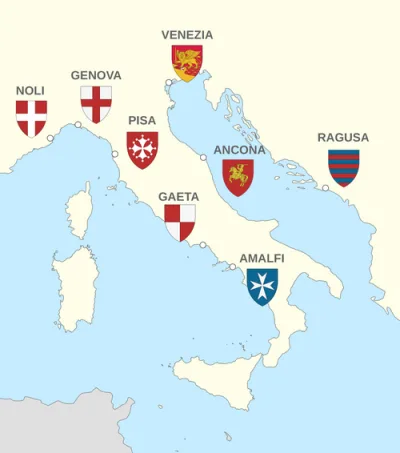
Starting in the Middle Ages, several Italian city-states known as maritime republics achieved significant political autonomy and economic prosperity through their seafaring activities. While the term, coined in the 19th century, most commonly refers to Amalfi, Genoa, Pisa, and Venice, other cities like Ancona, Gaeta, Noli, and Ragusa also held this status. These republics were crucial not only for trade and navigation, reestablishing connections between Europe, Asia, and Africa, but also as conduits for artistic ideas and news from distant lands. They played a role in the Crusades and produced notable explorers. Their fortunes varied over the centuries, with some rising and falling while others, like Venice and Genoa, maintained dominance for extended periods.
Historiographical Development
The concept of 'maritime republics' as a distinct historical category was formalized in the 19th century, long after the existence of these states. Initially, in works like Jean Charles Léonard de Sismondi's "History of the Italian Republics of the Middle Centuries" (1807), these cities were often viewed negatively due to their internal conflicts, contrasting with the unified spirit of the Risorgimento. However, following Italian unification, there was a romantic nationalist reinterpretation of the Middle Ages, leading to a more positive portrayal of the maritime republics. They were celebrated for their seafaring prowess and their contribution to Italian industriousness and civilization, helping to forge a common historical identity for the newly unified nation. This reevaluation led to their inclusion in school curricula and popular historical accounts.
Characteristics and Influence
Key characteristics defined a maritime republic, including de jure or de facto independence, autonomy centered on maritime trade, and possession of a fleet. These city-states established themselves as significant powers, often expanding their influence, and maintained networks of warehouses and consuls across Mediterranean ports. They developed their own currencies, accepted throughout the region, and distinct maritime laws. Their republican form of government and participation in endeavors like the Crusades or anti-piracy efforts further shaped their identity. The economic resurgence in Europe from the 9th century onwards, coupled with the risks of overland trade, provided fertile ground for their development and influence.
Evolution and Recognition
The number of cities recognized as maritime republics evolved over time. While initially a broader list existed, a focus on four key cities—Amalfi, Genoa, Pisa, and Venice—became prominent, particularly after symbols of these four were incorporated into the Italian Navy's flag in 1947. This specific grouping was solidified through various historical and cultural initiatives, including publications and the establishment of events like the Regatta of the Historical Marine Republics. Despite this consolidation, later scholarship has continued to acknowledge a wider array of maritime republics, including cities like Ancona, Gaeta, Noli, and Ragusa, recognizing their significant historical roles.
Key Ideas
- Medieval Italian city-states that achieved political and economic power through maritime trade and naval strength.
- The historiographical evolution of the concept of maritime republics from negative to positive interpretations.
- The characteristics defining a maritime republic, including independence, fleet ownership, and trade networks.
Notable Quotes
“... The Italy of the maritime republics ... reopened the ways of the world to Europe.”
Books by Gregory Zorzos
11 free public domain books · Read online or download