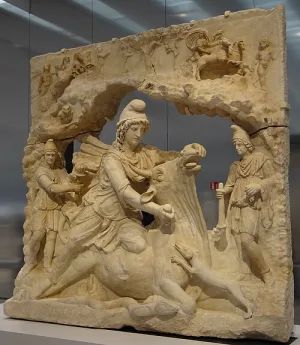
Mithraism was a Roman mystery religion centered on the god Mithras, popular in the army, with rituals and symbolism distinct from its Iranian roots.
Mithraism, also known as the Mithraic mysteries, was a Roman mystery religion focused on the deity Mithras. While inspired by the Zoroastrian divinity Mithra, the Roman version developed unique imagery and practices, making the extent of continuity with Persian worship a subject of debate among scholars. The mysteries were particularly widespread within the Roman army from the 1st to the 4th century AD. Adherents engaged in a structured system of seven initiation grades and communal meals, identifying themselves as 'syndexioi' or 'united by the handshake'. They convened in underground temples called mithraea, often designed to resemble caves, many of which have been discovered across the Roman Empire.
Mithraism is often considered a contemporary rival to early Christianity. By the 4th century, Mithraists faced persecution from Christians, leading to the religion's eventual suppression and disappearance by the end of that century. Our understanding of Mithraism relies heavily on archaeological evidence, including numerous sites, inscriptions, and artifacts, as no written theological texts or narratives from the religion itself have survived. Key surviving iconography depicts Mithras being born from a rock, slaying a bull (tauroctony), and sharing a banquet with the sun god Sol. The interpretation of this symbolic material remains a challenging and contested area of study.
Origins and Spread
The Roman mystery religion known as Mithraism drew inspiration from the ancient Iranian divinity Mithra. However, the Roman interpretation of Mithras evolved with distinct imagery and practices, leading to ongoing scholarly discussion about the degree of direct continuity with its Persian antecedents. The cult gained significant traction within the ranks of the Imperial Roman army between the 1st and 4th centuries AD. Its influence extended widely across the western Roman Empire, reaching as far south as Roman Africa and Numidia, east to Roman Dacia, north to Roman Britain, and to a lesser extent, Roman Syria. The religion's center is believed to have been in Rome itself.
Rituals and Iconography
Followers of Mithras participated in a complex system of seven grades of initiation and communal ritual meals. These initiates referred to themselves as 'syndexioi,' meaning 'united by the handshake.' Their places of worship, known as mithraea, were typically underground temples, often referred to as caves, with a substantial number surviving archaeologically. The central and most iconic imagery associated with Mithraism features the god in several key scenes: his birth from a rock, the act of slaughtering a bull (tauroctony), and a shared banquet with the sun god Sol. While no written theological texts exist, these visual representations, alongside inscriptions and passing references in classical literature, form the basis of modern understanding, though their interpretation is often debated.
Relationship with Christianity and Legacy
Mithraism is frequently viewed as a significant rival to early Christianity. During the 4th century, adherents of Mithraism experienced persecution at the hands of Christians, a period that ultimately led to the religion's suppression and elimination within the Roman Empire by the century's end. Despite the lack of written doctrine, the archaeological record provides extensive evidence of the cult's presence, with approximately 420 sites yielding materials related to Mithraic worship. These finds include around 1,000 inscriptions and hundreds of depictions of the tauroctony scene, offering tangible links to this ancient mystery religion. Scholars like Franz Cumont were instrumental in early studies of the religion, linking the Roman name 'Mithras' to the older Iranian deity.
Key Ideas
- Roman mystery religion centered on the god Mithras.
- Popular among the Roman army.
- Complex system of seven initiation grades.
- Met in underground temples (mithraea).
- Iconography includes birth from a rock, bull-slaying (tauroctony), and banquet with Sol.
- Considered a rival to early Christianity and suppressed by the 4th century.
Books by
3 free public domain books · Read online or download