Donald Tyson
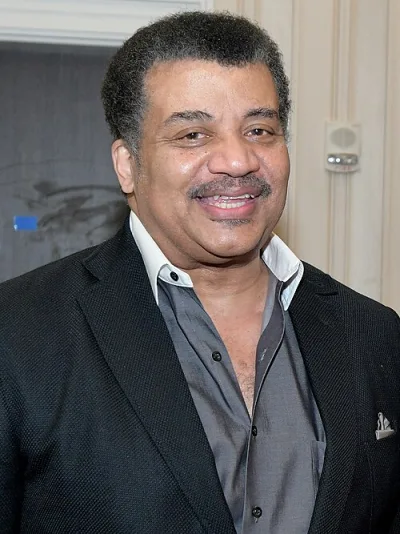
Neil deGrasse Tyson is an American astrophysicist, author, and science communicator known for his work at the Hayden Planetarium and popularizing science.
Neil deGrasse Tyson is an American astrophysicist, author, and science communicator, born in 1958. He pursued his education at several prominent universities, including Harvard, the University of Texas at Austin, and Columbia University, where he earned his PhD in astrophysics. Tyson's early fascination with astronomy began at age nine after a visit to the Hayden Planetarium, an experience that profoundly shaped his career path.
He has held significant positions, including a postdoctoral research associate role at Princeton University and later becoming the director of the Hayden Planetarium in 1996. Under his leadership, the planetarium underwent a major reconstruction. Tyson has also been a prolific writer, contributing monthly essays for Natural History magazine and authoring popular science books. He has hosted television programs and podcasts, notably "StarTalk" and "Cosmos: A Spacetime Odyssey," aiming to share the wonders of the universe with the public. His efforts to communicate science have been recognized with several awards.
Early Life and Astronomical Awakening
Born in Manhattan and raised in the Bronx, Neil deGrasse Tyson's initial spark of interest in astronomy ignited at the age of nine during a visit to the Hayden Planetarium. This formative experience, he later described, felt like a cosmic calling. During his high school years, he furthered his astronomical studies through courses at the same planetarium. He credited Mark Chartrand III, the planetarium's director at the time, as a crucial early mentor whose engaging teaching style inspired Tyson to communicate scientific concepts with enthusiasm and clarity. His passion was further recognized when, at 15, he was already giving lectures on astronomy and received an invitation from Carl Sagan to visit Cornell University, an encounter that solidified his ambition to become a scientist and shaped his vision of the kind of scientist he aspired to be.
Academic and Professional Journey
Tyson's academic path led him through several esteemed institutions. He earned a Bachelor of Arts in physics from Harvard College and a Master of Arts in astronomy from the University of Texas at Austin. After his doctoral studies at Columbia University, where he obtained a PhD in astrophysics in 1991, he embarked on a postdoctoral research position at Princeton University. His professional career saw him join the Hayden Planetarium in 1994, eventually rising to the position of director in 1996. He played a key role in overseeing the planetarium's extensive $210 million renovation. Throughout his career, Tyson has dedicated himself to making complex scientific ideas accessible, a mission reflected in his extensive writing, broadcasting, and public engagement activities.
Science Communication and Public Engagement
Neil deGrasse Tyson has become a prominent figure in science communication. From 1995 to 2005, he penned the monthly "Universe" column for Natural History magazine, popularizing terms like "Manhattanhenge." His writing also extended to answering astronomical questions under the pseudonym "Merlin" for StarDate magazine, with material later compiled into books. He hosted the PBS television series "NOVA ScienceNow" and, notably, the successor to Carl Sagan's "Cosmos," titled "Cosmos: A Spacetime Odyssey." His weekly podcast, "StarTalk," and its television spin-off have further amplified his reach. In recognition of his impact, the U.S. National Academy of Sciences awarded him the Public Welfare Medal in 2015 for his exceptional role in inspiring public interest in science.
Key Ideas
- Popularizing astrophysics and cosmology for a general audience
- Making complex scientific concepts accessible through writing and media
- Inspiring public interest in the wonders of science
Notable Quotes
“when I was a kid... there were scientists and educators on the staff at the Hayden Planetarium... who invested their time and energy in my enlightenment... and I've never forgotten that... to end up back there as its director, I feel this deep sense of duty, that I serve in the same capacity for people who come through the facility today, that others served for me”
“so strong was that imprint [of the night sky] that I'm certain that I had no choice in the matter, that in fact, the universe called me.”
“the most formative period”
“first intellectual role model”