Aryeh Wineman
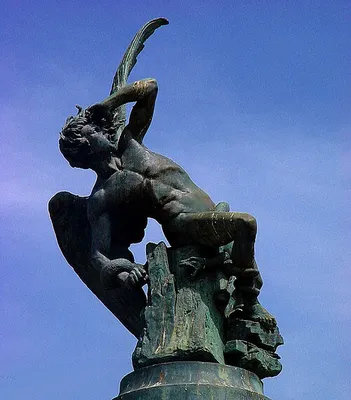
Fallen angels are celestial beings expelled from divine realms for various transgressions, influencing human history and belief systems.
The concept of fallen angels, beings expelled from divine realms, is explored across various religious and cultural traditions. While the specific term 'fallen angel' isn't found in core Abrahamic texts, the idea describes angels cast out for pride, lust, envy, or attempting to usurp divine authority. Early Canaanite beliefs and the Hebrew Bible, particularly Genesis 6:1-4 and apocryphal texts like the Book of Enoch, present narratives of these expulsions. These accounts often link fallen angels to corrupting humanity through forbidden knowledge or tempting them to sin, with their offspring, the Nephilim, being a notable element. Later Jewish and Christian theology developed these ideas, with fallen angels often identified with demons and Lucifer's rebellion. Islamic tradition also features similar motifs, such as Iblis and the angels Harut and Marut. These figures have continued to appear in literature and popular culture, influencing interpretations of good and evil.
Origins and Early Concepts
The notion of celestial beings descending from the divine court can be traced to Canaanite beliefs, where the 'sons of God' (bənē hāʾĔlōhīm) were part of the heavenly assembly. These beings were later integrated into Hebrew tradition, appearing in Genesis 6:1-4, where they are described as mating with human women and begetting the Nephilim. The Book of Psalms also alludes to a divine judgment upon 'gods,' paralleling a fall from immortality. The Book of Isaiah provides a template for fallen angels with the narrative of Hêlêl ben Šāḥar, who is cast down for seeking equality with the divine creator, ʻElyōn. This imagery of a celestial being's descent became foundational for later concepts of fallen angels.
Second Temple Period Developments
During the Second Temple period (roughly 530 BC to 70 AD), the concept of fallen angels became prominent in Jewish pseudepigraphic literature, notably the Books of Enoch and Jubilees. In 1 Enoch, these beings, often called Watchers, are described as falling after becoming infatuated with human women, leading to the corruption of humanity through forbidden arts and the birth of monstrous offspring. Prominent among them are Samyaza and Azazel, who taught illicit practices. The Book of Jubilees presents a similar narrative, with the Watchers commanded by God to descend but transgressing by cohabiting with humans, resulting in demonic offspring and their own punishment. These texts explore the origin of evil, attributing it to supernatural influences from without, a concept that differed from later theological views emphasizing internal moral corruption.
Theological and Islamic Interpretations
Christian theology posits that the fall of angels predates human history, identifying them with Lucifer and his rebellion against God, and equating them with demons. This view emphasizes that evil is a corruption of goodness, not an independent force. The concept served as a philosophical thought experiment on the origin of evil will in rational beings. In Islamic tradition, the Quran references beings reminiscent of fallen angels. The identity of Satan (Iblīs) is debated, with some viewing him as an angel created from fire, while others consider him a progenitor of the jinn. The Quran also mentions Harut and Marut, angels said to have fallen due to critical remarks about humanity.
Key Ideas
- Angels expelled from heaven for transgressions like pride or lust.
- Fallen angels corrupt humanity through forbidden knowledge.
- Offspring of fallen angels and humans (Nephilim) are often monstrous.
- The concept explores the supernatural origin of evil.
- Interpretations vary across Canaanite, Jewish, Christian, and Islamic traditions.
Books by Aryeh Wineman
2 free public domain books · Read online or download