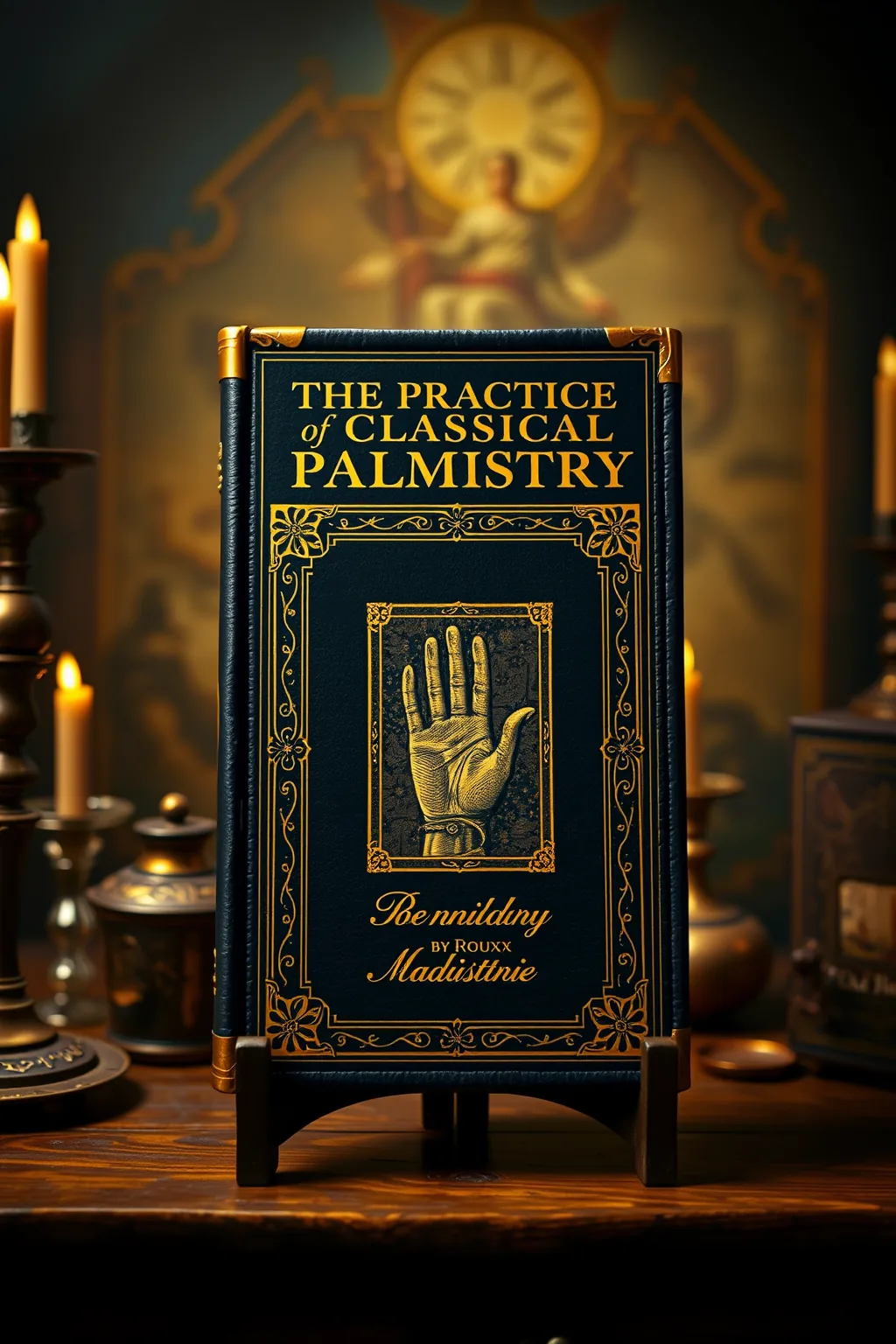
The practice of classical palmistry
 62
62

The practice of classical palmistry



Ophelia Vance, Mystical Literature Reviewer — La Roux Madame's 'The Practice of Classical Palmistry' stands as a beacon of clarity and depth within the often-murky waters of chiromancy. Madame La Roux masterfully deciphers the intricate symbolic language of the palm, presenting a system that is both comprehensive and deeply resonant. Her approach transcends superficial prediction, offering instead a profound exploration of character, life path, and spiritual evolution as revealed through the hand's topography. The work's strength lies in its rigorous adherence to classical principles, making it an indispensable resource for serious students and practitioners seeking authentic esoteric understanding. This is a book for those who yearn to move beyond simplistic interpretations and engage with palmistry as a sacred art.
📝 Description
62
La Roux Madame's 'The Practice of Classical Palmistry' was published in 1922.
'The Practice of Classical Palmistry' by La Roux Madame examines the historical practice of palmistry, tracing its roots and symbolic meanings. The book discusses how palm lines and mounts are interpreted to understand character, potential, and life paths. It connects these physical markings to broader philosophical ideas about human destiny and self-knowledge.
Madame La Roux's writing style aims to demystify the subject, presenting palmistry as a system for personal insight rather than simple prediction. The text covers the specific significations of various hand shapes, finger lengths, and the major and minor lines found on the palm. It encourages a thoughtful engagement with the practice, viewing the hand as a map of an individual's inner life.
Published in the early 20th century, this work belongs to the revival of esoteric interests common in that period. It sits within the Western hermetic tradition, which often sought to find correspondences between the human body, the cosmos, and divine principles. Classical palmistry, as presented here, was seen by some practitioners as a form of natural magic or a method for divining the hidden order of the universe through physical signs.
💡 Why Read This Book?
Uncover the profound cosmic map imprinted upon your palms. 'The Practice of Classical Palmistry' offers a gateway to understanding your inherent strengths, challenges, and life's unfolding narrative through the ancient art of chiromancy. Ideal for spiritual seekers, aspiring practitioners, and scholars of esoteric traditions who wish to delve into a rich, symbolic language of self-discovery and destiny.
⭐ Reader Reviews
Honest opinions from readers who have explored this book.
❓ Frequently Asked Questions
What is classical palmistry?
Classical palmistry refers to the traditional, foundational principles and interpretations of hand reading, focusing on the established lines, mounts, and shapes as understood through historical and esoteric traditions, rather than modern or speculative adaptations.
Is palmistry a form of fortune-telling?
While palmistry can offer insights into potential future trends and predispositions, its core purpose is to reveal character, innate talents, and life lessons, fostering self-awareness and personal growth rather than deterministic prediction.
Can anyone learn palmistry?
Yes, with diligent study, patience, and an open mind, anyone can learn the principles of classical palmistry. This book provides a structured approach for acquiring this ancient skill.
How are the lines on the hand interpreted?
Lines are interpreted based on their depth, clarity, length, and any markings they possess. Each line, such as the Heart Line or Head Line, corresponds to specific aspects of a person's emotional, intellectual, and physical being.
What is the significance of the mounts on the palm?
The mounts, the fleshy pads at the base of the fingers and palm, represent different planets and their associated energies and characteristics. Their prominence or recession indicates the influence of these energies in a person's life.
🔮 Key Themes & Symbolism
The Cosmic Blueprint of the Hand
This book posits the palm as a microcosm reflecting the macrocosm, a divine map etched by celestial forces and karmic threads. Each line, curve, and mound is presented not as a random mark, but as a symbolic representation of cosmic energies and universal principles that influence our earthly existence. It explores how the hand's topography serves as a unique identifier of our soul's journey, revealing our predispositions, challenges, and the grand design of our life's unfolding narrative. The emphasis is on understanding the hand as a sacred text, guiding us towards a deeper connection with the universal consciousness.
Symbolic Language and Universal Archetypes
La Roux Madame studies the rich symbolic language of palmistry, where each feature of the hand corresponds to profound archetypal energies and planetary influences. The book illuminates how these symbols are not arbitrary but are rooted in ancient mystical traditions that understood the interconnectedness of all things. By deciphering this language, readers gain access to a deeper understanding of human nature, the forces that shape our personalities, and the universal patterns that govern our experiences. It's an exploration of how the physical form speaks the language of the spirit, revealing hidden truths about our inner landscape.
The Art of Self-Discovery and Spiritual Evolution
Beyond mere prediction, 'The Practice of Classical Palmistry' is presented as a powerful tool for profound self-discovery and spiritual evolution. By understanding the messages written on their palms, individuals are empowered to confront their inner shadows, embrace their strengths, and navigate their life path with greater wisdom and intention. The book guides readers to view challenges as opportunities for growth and to recognize their inherent potential for transformation. It encourages a conscious engagement with one's destiny, fostering a path towards greater self-awareness, personal responsibility, and spiritual fulfillment.
💬 Memorable Quotes
Direct passages from the work, attributed to the author.
“Within these lines lie the whispers of your soul's ancient wisdom.”
— This highlights the esoteric aspect of palmistry, suggesting that the lines hold intuitive knowledge and insights from past lives or deeper spiritual understanding.
“To read the hand is to commune with the silent language of destiny.”
— This emphasizes palmistry as a form of communication with fate or a higher power, offering a way to understand the unfolding of life's events.
“The mounts are the elements of the gods upon your mortal canvas.”
— This metaphor connects the fleshy parts of the palm (mounts) to planetary influences and divine energies, suggesting they shape our character and life experiences.
“Know thyself, not just through introspection, but through the lines that trace your path.”
— This promotes palmistry as a complementary method of self-knowledge, revealing aspects of oneself that may be hidden even through internal reflection.
💡 Key Ideas
Editorial paraphrase of the work's core concepts — not direct quotes.
The hand is a sacred scroll, penned by the stars themselves.
This quote expresses the core belief that our palms are not random biological features but are divinely inscribed with our life's journey and potential, influenced by celestial energies.
🌙 Esoteric Significance
Tradition
This work is deeply rooted in the Hermetic tradition and the Western Esoteric lineage, drawing parallels with astrological principles and Kabbalistic numerology. It views the hand as a microcosm mirroring the macrocosm, a concept central to Hermeticism ('As above, so below'). The interpretation of lines and mounts often aligns with planetary correspondences, suggesting a universal energetic framework guiding human destiny and character.
Symbolism
The palm is a body of symbols. Lines like the Heart, Head, and Life Lines represent fundamental human faculties and life trajectories. Mounts (Venus, Mars, Jupiter, etc.) symbolize archetypal energies and planetary influences that shape personality. Hand shapes and finger lengths further contribute to the symbolic language, offering a comprehensive system for understanding the interplay of spiritual, mental, and physical energies within an individual.
Modern Relevance
In an age often characterized by disconnection and a search for meaning, classical palmistry offers a profound path to self-understanding and personal empowerment. It provides a tangible connection to ancient wisdom, encouraging introspection and the recognition of one's innate potential. For modern seekers, it serves as a tool for navigating life's complexities, fostering resilience, and cultivating a deeper appreciation for the intricate web of existence that connects us all.
👥 Who Should Read This Book
This important work is a treasure for the dedicated seeker of esoteric knowledge. Beginners will find a clear, foundational guide to the art of palmistry, introducing them to its rich symbolic language. Experienced practitioners and scholars of divination will appreciate its adherence to classical principles and its comprehensive scope, offering depth and nuance. Those on a spiritual journey seeking self-awareness and a deeper understanding of their life's purpose will find clear insights and a roadmap for personal growth. It is a must-read for anyone interested in the ancient arts and the profound wisdom held within the human form.
📜 Historical Context
Emerging from a period rich with occult revival and a burgeoning interest in esoteric philosophies, 'The Practice of Classical Palmistry' by La Roux Madame likely dates from the late 19th or early 20th century. This era saw a surge in the study of ancient traditions, spiritualism, and diverse divinatory arts as a counterpoint to the rapid industrialization and rationalism of the time. Authors like Madame Blavatsky and Arthur Edward Waite were popularizing occult texts, and palmistry, with its roots stretching back to antiquity, found a renewed audience. This book would have been part of a broader movement seeking deeper meaning and spiritual connection, drawing upon established hermetic principles and offering a tangible, personal method for understanding the hidden currents of existence.
📔 Journal Prompts
Reflect on the dominant line on your dominant hand. What does its character suggest about your core motivations or life path?
Examine the mounts on your palm. Which planetary energies feel most prominent in your life, and how do they manifest?
Consider the relationship between your Heart Line and Head Line. How do your emotions and intellect typically interact in decision-making?
If your Life Line shows a significant deviation or marking, how might this symbolize a turning point or major life lesson?
How can the insights gained from your palm's map be applied to actively shape your future and overcome perceived limitations?
🗂️ Glossary
Chiromancy
The practice of reading palms, derived from the Greek words 'cheir' (hand) and 'manteia' (divination). It is a comprehensive system for interpreting the lines, mounts, and shape of the hand.
Mounts
The fleshy pads found at the base of the fingers and palm. Each mount is associated with a specific planet and represents the corresponding characteristics and energies within an individual.
Heart Line
The uppermost horizontal line on the palm, typically starting below the little finger and extending towards the thumb. It governs emotional nature, relationships, and the heart's well-being.
Head Line
The line situated below the Heart Line, running horizontally across the palm. It represents intellectual faculties, mental processes, learning ability, and communication.
Life Line
The curved line originating near the thumb and sweeping around the Mount of Venus towards the wrist. It signifies vitality, physical health, life force, and major life events, not necessarily lifespan.
This book appears in 1 collection
🔮 Readers Also Liked
Browse all →









From the “Palmistry” Collection
View all →







More Free Divination & Tarot Books
View all →