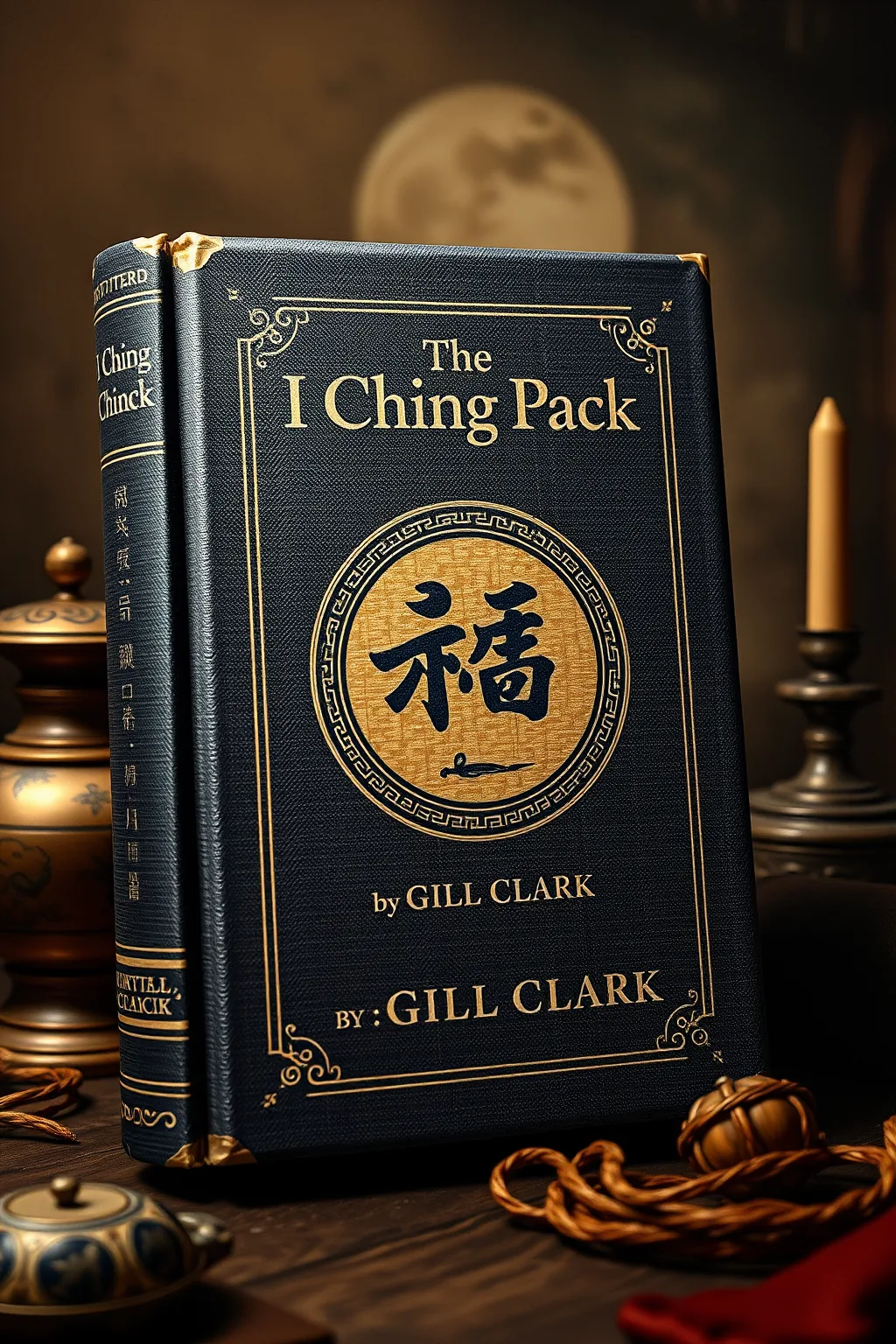
The I Ching Pack
 61
61

The I Ching Pack



Silas Hawthorne (Hermetic Studies Editor) — 'The I Ching Pack' by Gill Clark is a distinguished contribution to the Esoteric Library's collection, offering a lucid yet profound exploration of the ancient Chinese divination system. Clark masterfully demystifies the hexagrams, presenting them not just as predictive tools, but as profound philosophical maps of universal flux. Her commentary is rich with esoteric insights, connecting the I Ching's core principles to broader metaphysical concepts, making it invaluable for serious students of hermeticism and divination. This pack is exceptionally well-suited for practitioners seeking a deeper, more integrated understanding of the Oracle, guiding them towards authentic self-discovery and spiritual alignment. A truly illuminating resource.
📝 Description
61
Gill Clark's 'The I Ching Pack' translates the ancient Chinese oracle for modern practitioners.
This book unpacks the sixty-four hexagrams of the I Ching, the ancient Chinese oracle of change. Gill Clark explains how each hexagram functions as a symbol of universal archetypes and the interplay of Yin and Yang. The text aims to clarify the principles of this divinatory system, showing its use for gaining self-awareness and understanding life's patterns.
Clark's approach focuses on the practical application of the I Ching. It connects the oracle's philosophy, which draws from observing nature, to navigating contemporary challenges. The book encourages readers to find clarity and potential opportunities by understanding these ancient concepts.
The I Ching is one of the oldest Chinese classical texts, used for centuries as a divination tool and a philosophical guide. Its system of sixty-four hexagrams, formed by combinations of broken (Yin) and unbroken (Yang) lines, represents fundamental states of change and interaction in the cosmos. Throughout history, various schools and individuals have interpreted its wisdom, influencing Chinese thought, spirituality, and practices like feng shui and martial arts.
💡 Why Read This Book?
Unlock the secrets of the ancient Oracle of Change. 'The I Ching Pack' offers profound insights into life's patterns, guiding you towards self-awareness and informed decision-making. Ideal for seekers of ancient wisdom, practitioners of divination, and anyone yearning for deeper understanding of life's inherent transformations. Discover the potent symbolism and philosophical depth that has guided humanity for millennia.
⭐ Reader Reviews
Honest opinions from readers who have explored this book.
❓ Frequently Asked Questions
What is the I Ching?
The I Ching, or Book of Changes, is an ancient Chinese divination text and philosophical system. It uses sixty-four hexagrams, formed by combinations of six lines (broken for Yin, solid for Yang), to interpret situations and offer guidance.
How does the I Ching work for divination?
Divination typically involves posing a question and then using a method (like coin tossing or yarrow stalks) to generate a hexagram. This hexagram, along with its changing lines, is then interpreted using the text to provide insight.
Who was Gill Clark?
Gill Clark was a respected author and practitioner in the fields of esoteric studies and divination. Her work is known for its clarity, depth, and accessible approach to complex mystical subjects.
Is this book suitable for beginners?
Yes, 'The I Ching Pack' is designed to be accessible to beginners while offering sufficient depth for experienced practitioners. It provides clear explanations and guidance for newcomers to the I Ching.
What is the philosophical significance of the I Ching?
The I Ching is deeply philosophical, exploring themes of change, balance, cause and effect, and the interconnectedness of all things. It encourages a mindful approach to life, emphasizing adaptability and harmony.
🔮 Key Themes & Symbolism
The Oracle of Change
At its heart, 'The I Ching Pack' looks at the profound concept of constant transformation. The Oracle is presented not as a static prophecy, but as a dynamic reflection of the ceaseless flow of existence, mirroring the ebb and flow of nature and human experience. Each hexagram serves as a snapshot of a particular phase of change, offering guidance on how to navigate these shifts with wisdom and adaptability. Understanding this core principle empowers the reader to embrace life's uncertainties with greater equanimity, recognizing that challenges and opportunities are intrinsically linked within the grand cosmic dance.
Symbolism and Archetypes
This pack unravels the rich symbolic language of the I Ching, where each line and hexagram embodies universal archetypes and fundamental forces. From the primal duality of Yin and Yang to the more complex interplay of the trigrams, the book illuminates how these symbols represent cosmic principles, human relationships, and stages of development. By understanding this potent iconography, readers gain a deeper intuition for the underlying patterns governing their lives and the world around them, fostering a more profound connection to the symbolic dimension of reality.
Practical Divination and Self-Reflection
Beyond its philosophical depth, 'The I Ching Pack' provides practical tools for divination and introspective self-reflection. It guides the reader through the process of consulting the Oracle, enabling them to pose meaningful questions and interpret the resulting hexagrams. This interactive approach encourages a dialogue with the subconscious and the universe, fostering insights that can illuminate personal dilemmas, guide decisions, and promote spiritual growth. The emphasis is on using the I Ching as a mirror for self-discovery and a compass for navigating life's journey with greater consciousness.
💬 Memorable Quotes
Direct passages from the work, attributed to the author.
“The hexagrams are mirrors reflecting the soul's deepest inquiries.”
— This highlights the I Ching's role as a divinatory tool that prompts introspection. The patterns revealed are not external pronouncements but internal landscapes.
“Within the balance of Yin and Yang lies the secret to harmony.”
— This points to the fundamental duality that the I Ching explores, suggesting that understanding and integrating opposing forces is key to achieving equilibrium in life.
“Seek not to control fate, but to understand its unfolding.”
— This emphasizes a philosophical approach to destiny, advocating for awareness and alignment with universal principles rather than forceful attempts to manipulate outcomes.
“The ancient path is a journey of continuous becoming.”
— This speaks to the ongoing nature of spiritual and personal development, framing life as an evolving process rather than a fixed destination.
💡 Key Ideas
Editorial paraphrase of the work's core concepts — not direct quotes.
Change is the only constant, and wisdom lies in embracing its flow.
This quote captures the I Ching's central philosophy: that life is in perpetual motion. True wisdom is found not in resisting change, but in understanding and harmonizing with its natural currents.
🌙 Esoteric Significance
Tradition
The I Ching is a central to East Asian esoteric thought, deeply intertwined with Taoism and Neo-Confucianism. Its esoteric significance lies in its sophisticated system of divination and its exploration of universal principles such as the interplay of Yin and Yang, the cyclical nature of change, and the concept of the Tao. It serves as a profound symbolic language for understanding the subtle energies that govern both the cosmos and human consciousness, offering a path to spiritual insight and alignment with natural order.
Symbolism
The primary symbolism of the I Ching revolves around the sixty-four hexagrams, each a unique combination of six lines representing Yin (broken) and Yang (solid). These hexagrams, derived from eight fundamental trigrams, are rich with archetypal meanings that map the spectrum of human experience and cosmic phenomena. Symbols like Heaven, Earth, Water, Fire, and Thunder are not merely elements but represent dynamic forces and states of being, offering a profound visual and conceptual language for understanding the universe's inherent patterns.
Modern Relevance
In the modern era, the I Ching remains remarkably relevant as a tool for navigating complexity and fostering personal growth. Its emphasis on adaptability, understanding cycles, and making conscious choices resonates deeply in a rapidly changing world. Esoteric practitioners and seekers use it for divination, meditation, and philosophical inquiry, finding its ancient wisdom applicable to contemporary challenges in areas such as psychology, decision-making, and spiritual development. It offers a timeless perspective on balance and harmony.
👥 Who Should Read This Book
This comprehensive pack is a treasure for a diverse audience. Beginners to the I Ching will find clear, accessible guidance that explains the hexagrams and the divination process. Experienced practitioners and scholars of esoteric traditions will appreciate the depth of commentary and the nuanced exploration of symbolism and philosophy. Seekers of ancient wisdom and personal growth will discover a powerful tool for self-reflection and understanding life's inherent transformations. Anyone interested in Chinese philosophy, divination, or developing a more intuitive connection with the universe will find invaluable insights within its pages.
📜 Historical Context
The I Ching, originating in ancient China, boasts a history spanning over three millennia, making it one of the oldest and most enduring texts in the world. Its roots are deeply embedded in shamanistic practices and early cosmological observations, evolving through the Chou Dynasty and significantly influenced by Confucian scholars who integrated its philosophical and ethical dimensions. The text underwent further development during the Han Dynasty, with commentaries solidifying its status as a classic. Throughout its long history, the I Ching has served not only as a divinatory tool but also as a profound philosophical treatise, impacting Chinese thought, art, and governance. Its influence gradually spread across East Asia and, in the modern era, has captivated Western esotericists and scholars alike, offering a unique lens through which to view the dynamics of change and the order of the cosmos.
📔 Journal Prompts
Reflect on a recent situation where change was a significant factor. How did you respond, and how might an I Ching hexagram have offered guidance?
Consider the concept of Yin and Yang in your daily life. Where do you see these opposing forces at play, and how can you foster greater balance?
What question would you pose to the I Ching right now if you were to consult it? Write down your most pressing concern or curiosity.
Explore a hexagram that speaks to you, either through personal experience or intuition. What core message do you feel it holds for you?
How can the principles of the I Ching help you approach future challenges with greater wisdom and adaptability?
🗂️ Glossary
Hexagram
A symbol composed of six horizontal lines, either solid (Yang) or broken (Yin), used in the I Ching for divination and philosophical interpretation. There are 64 unique hexagrams.
Trigram
A symbol composed of three horizontal lines, either solid (Yang) or broken (Yin). There are eight basic trigrams, which combine to form the 64 hexagrams.
Yin
In I Ching philosophy, Yin represents passive, receptive, dark, feminine, and yielding qualities. It is symbolized by a broken line (--) .
Yang
In I Ching philosophy, Yang represents active, creative, light, masculine, and assertive qualities. It is symbolized by a solid line (—).
Tao
The fundamental principle of the universe in Taoist philosophy, often translated as 'The Way.' It represents the natural order, the source of all things, and the path to harmony and balance.
This book appears in 2 collections
🔮 Readers Also Liked
Browse all →








From the “I Ching” Collection
View all →









More Free Divination & Tarot Books
View all →