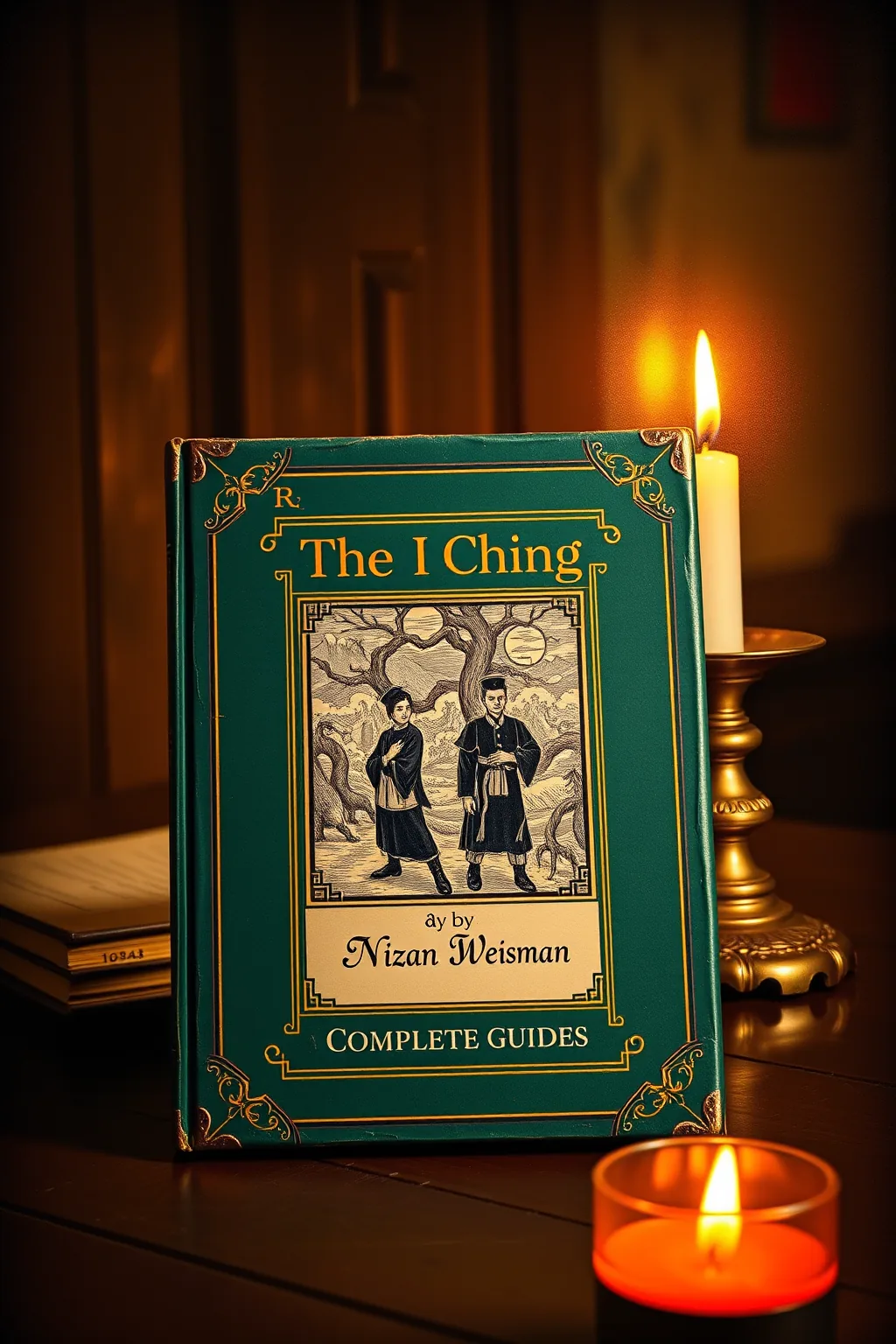
The I Ching (Astrolog Complete Guides)
 61
61

The I Ching (Astrolog Complete Guides)



Celeste Moreau (Divination & Symbolism Reviewer) — Nizan Weisman's 'The I Ching' is a luminous beacon for those seeking to decipher the ancient oracle's profound mysteries. Weisman's approach, rooted in 'Astrolog Complete Guides,' offers a unique synthesis of astrological principles and I Ching wisdom, illuminating the hexagrams with fresh, esoteric insights. The text skillfully guides readers through the symbolic language, revealing its potent application for self-reflection and cosmic alignment. This guide is an indispensable companion for practitioners of divination, scholars of ancient wisdom, and any soul yearning for deeper understanding of life's intricate patterns. Its clarity and depth make it a truly valuable addition to any esoteric library.
📝 Description
61
Nizan Weisman's guide to the I Ching published by Astrolog Complete Guides decodes its 64 hexagrams.
This book examines the I Ching, the ancient Chinese oracle of change. Nizan Weisman breaks down the 64 hexagrams, their symbolic meanings, and their connections to universal forces. The text discusses the interplay of Yin and Yang and the concept of transformation as presented in the oracle. It aims to provide a philosophical understanding of life's complexities rather than just a method for prognostication. The guide is intended for those interested in deep discovery and understanding cosmic patterns.
The author explains how the I Ching can be used to understand destiny and the constant shifts that occur in existence. It is presented as a tool for gaining wisdom and foresight by connecting with a universal flow. The book encourages a contemplative approach to its study, suitable for both scholars and practitioners of divination.
The I Ching is a foundational text within Chinese divination and philosophy, dating back to at least the 11th century BCE. Its system of hexagrams, derived from combinations of yin and yang lines, provides a framework for interpreting change and making decisions. Esoteric traditions often see the I Ching as a mirror to the cosmos, reflecting universal principles and offering guidance through symbolic interpretation. This book engages with that tradition by detailing the structure and meaning of the hexagrams for contemporary readers.
💡 Why Read This Book?
Uncover the timeless secrets of the I Ching, the ultimate oracle of change. This guide offers a unique lens, blending astrological insights with the profound wisdom of the ancient Chinese text. Ideal for seekers of self-knowledge, practitioners of divination, and scholars of esoteric traditions, it provides practical tools for navigating life's transitions with clarity and profound understanding. Discover your personal cosmic blueprint.
⭐ Reader Reviews
Honest opinions from readers who have explored this book.
❓ Frequently Asked Questions
What is the I Ching?
The I Ching, or Book of Changes, is an ancient Chinese classic text that offers a system of divination and wisdom. It comprises 64 hexagrams, each representing a specific situation or pattern of change, used to gain insight into life's challenges and opportunities.
How does this guide differ from other I Ching books?
This guide, part of the 'Astrolog Complete Guides' series, uniquely integrates astrological principles with I Ching symbolism, offering a richer, more nuanced interpretation of the hexagrams and their cosmic correlations.
Can I use the I Ching for daily guidance?
Absolutely. The I Ching is an exceptional tool for daily reflection, providing guidance on immediate situations and long-term perspectives. Its wisdom encourages mindful decision-making and adaptation to life's ever-changing flow.
What are hexagrams?
Hexagrams are the fundamental building blocks of the I Ching. Each is composed of six lines, which can be either solid (Yang) or broken (Yin). These 64 unique combinations represent archetypal situations and transformations.
Is prior knowledge of astrology or the I Ching required?
While prior knowledge can deepen understanding, this guide is designed to be accessible. It introduces concepts clearly, making it suitable for both beginners and those with existing familiarity with esoteric studies.
🔮 Key Themes & Symbolism
The Dynamics of Change
Fundamentally, the I Ching is a profound exploration of flux and transformation. It teaches that change is the only constant, and understanding its patterns allows one to navigate life's inevitable shifts with grace and wisdom. This theme examines the cyclical nature of events, the interplay of forces that drive evolution, and the importance of aligning oneself with the universal flow rather than resisting it. It encourages adaptability, foresight, and the recognition that even in challenging times, opportunities for growth are present.
Cosmic Interconnectedness and Symbolism
This theme highlights the I Ching's intricate web of symbolism, linking human experience to the vast cosmic order. The hexagrams, line statements, and trigrams are not arbitrary but are deeply resonant with universal archetypes and energies, often mirrored in astrological configurations. Understanding these symbols unlocks a deeper perception of reality, revealing how macrocosmic forces influence our micro-cosmic lives. It's an invitation to see the divine intelligence woven into the fabric of existence and to find meaning in the seemingly chaotic.
The Art of Divination and Self-Awareness
Beyond mere prediction, the I Ching serves as a powerful tool for self-discovery and conscious living. This theme explores its application as an oracle, guiding individuals to understand their present circumstances, potential future trajectories, and the underlying causes of their experiences. It emphasizes introspection, mindful inquiry, and the ethical use of divination to foster personal growth, enhance decision-making, and cultivate a more harmonious relationship with oneself and the world.
💬 Memorable Quotes
Direct passages from the work, attributed to the author.
“Every ending is a seed of a new beginning.”
— This profound statement expresses the I Ching's core philosophy of continuous transformation, emphasizing that periods of closure are inherently linked to future growth and renewal.
“The hexagrams whisper secrets of the universal Tao.”
— This evocative phrase suggests that the symbolic language of the I Ching holds profound, hidden truths about the fundamental order of existence, accessible to those who listen closely.
💡 Key Ideas
Editorial paraphrase of the work's core concepts — not direct quotes.
The Book of Changes is a mirror to the soul.
This quote suggests that the I Ching's insights are not external pronouncements but rather reflections of our inner state, helping us to understand our own motivations and potential.
In stillness, one finds the rhythm of the cosmos.
Highlighting the importance of quiet contemplation, this quote implies that true understanding of universal patterns emerges from inner peace and mindful observation.
Wisdom lies not in knowing all, but in understanding change.
This quote underscores the practical application of the I Ching, suggesting that true sagacity is found in the ability to adapt and respond effectively to life's ever-shifting circumstances.
🌙 Esoteric Significance
Tradition
The I Ching is a central to Chinese esoteric traditions, deeply intertwined with Taoism and, to a lesser extent, Confucianism. It embodies a cosmological worldview that sees the universe as a dynamic, interconnected system governed by the principles of Yin and Yang. Within esoteric circles, it's viewed as a living oracle, a conduit for divine wisdom and a map of the soul's journey. Its practice is often linked to meditative states and the cultivation of inner harmony, aligning the practitioner with the natural rhythms of the cosmos.
Symbolism
The symbolism of the I Ching is incredibly rich and layered. The foundation lies in the Eight Trigrams (Bagua), representing fundamental natural forces and archetypes (Heaven, Earth, Thunder, Wind, Water, Fire, Mountain, Lake). These combine to form the 64 Hexagrams, each a unique combination of Yin and Yang lines, depicting specific situations and their inherent potential for change. The symbolism extends to the changing lines within hexagrams, indicating points of transition and transformation, offering nuanced guidance.
Modern Relevance
In the modern era, the I Ching's relevance has only grown. It offers a potent antidote to the fragmentation and uncertainty of contemporary life, providing a framework for understanding complex situations and making mindful decisions. Its principles of adaptability, balance, and acknowledging the inevitability of change resonate deeply with individuals seeking meaning and resilience. For practitioners of divination, astrology, and personal development, the I Ching remains an indispensable tool for self-awareness, guidance, and fostering a deeper connection to the universal energies.
👥 Who Should Read This Book
This guide is a treasure for a diverse range of readers. For the **beginner** seeking to explore the ancient oracle, it offers a clear and accessible entry point. **Scholars** of Eastern philosophy and divination will find its unique perspective and integrated approach invaluable. **Seekers** of spiritual growth and self-understanding will discover clear insights into life's patterns and their personal journey. **Practitioners** of tarot, astrology, and other divinatory arts will find a powerful complementary tool to deepen their practice and expand their interpretive capabilities.
📜 Historical Context
The I Ching's origins are deeply rooted in ancient Chinese civilization, with its earliest components dating back over three millennia. Initially, it served as a divinatory manual for rulers and shamans, seeking guidance from the spirits and natural world. Over centuries, it evolved into a complex philosophical text, heavily influenced by Confucian and Taoist thought. During the Han Dynasty (206 BCE – 220 CE), its importance solidified, becoming one of the Five Classics of Confucianism. Its influence extended far beyond China, gradually spreading to East Asia and, in the 20th century, captivating Western scholars and esotericists. This enduring legacy speaks to its universal applicability and its profound ability to address fundamental human questions about destiny, change, and the nature of reality.
📔 Journal Prompts
Reflect on a recent significant change in your life. Which hexagram might symbolize this transition, and what lessons does it offer?
Consider the balance of Yin and Yang in your current environment. Where do you see imbalances, and how can you restore harmony?
If you were to consult the I Ching for guidance on a current challenge, what question would you ask, and what are your initial expectations of the answer?
Explore the concept of 'timeliness' as presented in the I Ching. How does understanding the right moment influence your actions and decisions?
How can the ancient wisdom of the I Ching inform your approach to navigating uncertainty in your personal or professional life?
🗂️ Glossary
Hexagram
A symbol composed of six stacked lines, each either solid (Yang) or broken (Yin). The 64 hexagrams form the core structure of the I Ching, representing archetypal situations and patterns of change.
Trigram
A fundamental symbol composed of three lines (Yin or Yang). The eight trigrams (Bagua) represent fundamental natural forces and archetypes, serving as building blocks for hexagrams.
Yin
In Taoist philosophy and the I Ching, Yin represents the passive, receptive, dark, feminine principle. It is symbolized by broken lines.
Yang
In Taoist philosophy and the I Ching, Yang represents the active, creative, light, masculine principle. It is symbolized by solid lines.
Tao
The fundamental principle of the universe in Taoism, often translated as 'the Way.' It signifies the natural order, the flow of existence, and the underlying source of all things.
This book appears in 2 collections
🔮 Readers Also Liked
Browse all →








More by Nizan Weisman
All books →
From the “I Ching” Collection
View all →









More Free Divination & Tarot Books
View all →