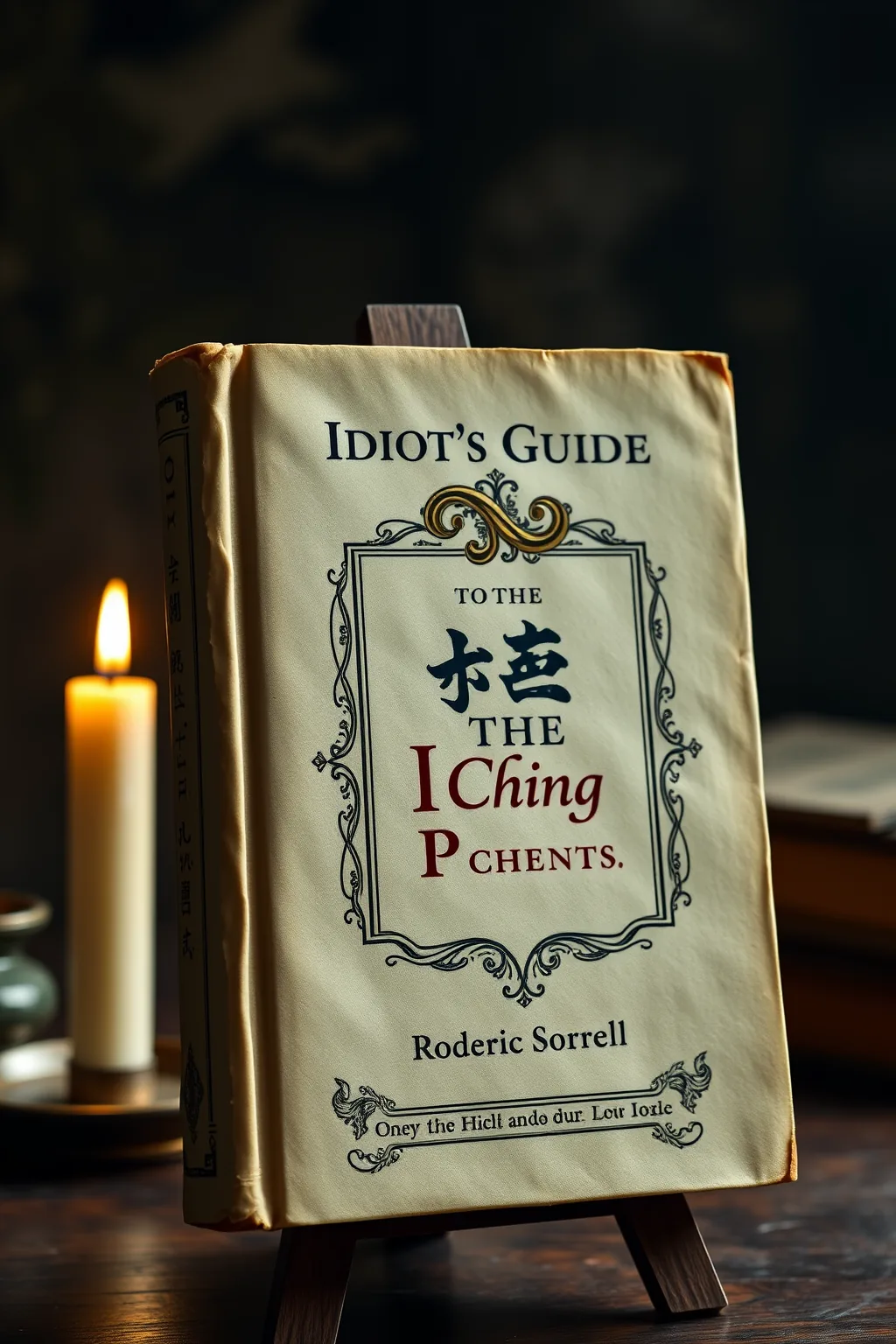
Idiot's Guide to the I Ching
 61
61

Idiot's Guide to the I Ching



Roderic Sorrell's "Idiot's Guide to the I Ching" stands as a luminous beacon in the often-murky waters of divination literature. Sorrell's approach transcends superficial interpretation, delving into the profound philosophical and metaphysical underpinnings of this ancient Chinese oracle. He artfully demystifies the complex system of hexagrams, making its profound wisdom accessible without sacrificing its inherent depth. This guide is a testament to the I Ching's enduring power as a tool for self-reflection and cosmic attunement. Essential for anyone seeking to connect with timeless archetypes and understand the subtle energies governing life's transformations. Highly recommended for serious students of esoteric philosophy and practical divination.
📝 Description
61
Roderic Sorrell's 2009 'Idiot's Guide to the I Ching' explains this ancient Chinese text.
Roderic Sorrell's guide aims to make the I Ching accessible to a general audience. The book breaks down the structure of the I Ching, explaining its 64 hexagrams and the meanings associated with each. Sorrell details how to consult the text for guidance, covering methods of divination and interpretation. He also touches upon the philosophical underpinnings of the I Ching, linking its concepts to broader ideas of change and balance in life. The text seeks to demystify the oracle, presenting it as a tool for self reflection and understanding.
This volume covers the core principles of the I Ching, including the trigrams, lines, and their combinations. Readers will find explanations of the classic commentaries and how they inform the text's interpretation. Sorrell provides practical advice on using the I Ching for decision making and personal growth. The goal is to equip the reader with the knowledge to engage with the oracle effectively and thoughtfully.
The I Ching, or 'Book of Changes,' is one of the oldest Chinese classic texts. Its origins are traced back to the Western Zhou dynasty (c. 1046–771 BCE). Historically, it served as a manual for divination and a philosophical treatise on the nature of reality. The text's cosmology is based on the interplay of yin and yang, represented by broken and unbroken lines that combine to form hexagrams. These hexagrams are seen as symbols of fundamental cosmic situations and processes, offering insights into the dynamics of change and transformation.
💡 Why Read This Book?
Unlock the ancient secrets of the I Ching, a profound oracle of change and destiny. This guide offers clear, accessible pathways to understanding its complex symbolism and philosophical depth. Ideal for seekers of hidden knowledge, spiritual practitioners, and anyone yearning for a deeper connection to the cosmic currents that shape our lives. Discover practical divination techniques and gain profound insights into personal growth and universal truths.
⭐ Reader Reviews
Honest opinions from readers who have explored this book.
❓ Frequently Asked Questions
What is the I Ching, and how does it work?
The I Ching, or 'Book of Changes,' is an ancient Chinese divination text and philosophical system. It uses a series of hexagrams, formed by combining yin and yang lines, to interpret situations and offer guidance on how to act in accordance with the natural flow of the universe.
Is the I Ching only for fortune-telling?
While it can be used for divination, the I Ching is far more than a fortune-telling tool. It's a profound philosophical text offering wisdom on ethics, governance, and understanding the cyclical nature of change, providing insights for navigating life's challenges.
Do I need prior knowledge of Chinese philosophy to read this book?
No, Roderic Sorrell's "Idiot's Guide" is designed for accessibility. It thoughtfully introduces foundational concepts, making the wisdom of the I Ching available to beginners without requiring prior specialized knowledge.
How can the I Ching help me in my daily life?
The I Ching provides counsel on decision-making, understanding relationships, and adapting to changing circumstances. By consulting its insights, you can gain clarity, make more informed choices, and live in greater harmony with the natural order.
What is the role of symbolism in the I Ching?
Symbolism is central. Each hexagram and its constituent trigrams are rich with symbolic meaning, representing archetypal situations and forces. Understanding these symbols unlocks the I Ching's profound guidance and its connection to universal patterns.
🔮 Key Themes & Symbolism
The Oracle of Transformation
This theme explores the I Ching's core principle: change. It explores how the sixty-four hexagrams represent the infinite permutations of human experience and cosmic flux. Readers will learn to perceive the dynamic interplay of forces, understanding that true wisdom lies not in resisting change, but in harmonizing with its natural, inevitable progression. The guide illuminates how to interpret these shifts, offering guidance for navigating life's inevitable transformations with grace and insight.
The Language of Symbols and Archetypes
Explore the profound symbolic language of the I Ching, where simple lines of yin and yang coalesce into powerful hexagrams. This theme unravels the body of imagery and archetypal representations embedded within each symbol, connecting them to universal patterns of existence. Readers will discover how these ancient pictograms serve as keys to understanding the deeper currents of the psyche and the cosmos, offering a visual and intuitive pathway to profound metaphysical truths.
Philosophical Foundations of Destiny
This section illuminates the I Ching's philosophical underpinnings, presenting it not merely as a tool for prediction, but as a profound guide to living in accordance with the Tao. It explores the concepts of destiny, free will, and the interconnectedness of all events, encouraging readers to cultivate mindfulness and ethical conduct. The book emphasizes how understanding these principles can lead to greater personal harmony, wisdom, and a more profound sense of purpose in life.
💬 Memorable Quotes
Direct passages from the work, attributed to the author.
“Wisdom lies in understanding the flow.”
— Emphasizes the importance of adaptability and alignment with natural forces, a central tenet of I Ching philosophy.
“Each hexagram whispers a cosmic truth.”
— This suggests the profound, often hidden, knowledge contained within the I Ching's symbolic structures.
“To know the changes is to know oneself.”
— Connects the study of the I Ching's patterns with the process of self-discovery and personal growth.
“Destiny is not a fixed point, but a path to walk.”
— Underscores the dynamic and actionable nature of the I Ching's guidance, empowering individuals to shape their journey.
💡 Key Ideas
Editorial paraphrase of the work's core concepts — not direct quotes.
The Book of Changes is a mirror to the soul.
This quote highlights the I Ching's introspective nature, suggesting it reflects our inner states and offers insights into our own being.
🌙 Esoteric Significance
Tradition
The I Ching is a central to Chinese esoteric traditions, deeply intertwined with Taoism and Confucianism. It represents a sophisticated system of cosmic divination and philosophical exploration, rooted in the principles of yin and yang and the Five Elements. Within these traditions, it serves as a profound tool for understanding the interconnectedness of Heaven, Earth, and Humanity, offering a path to aligning oneself with the natural order and cultivating spiritual harmony.
Symbolism
At its heart, the I Ching's symbolism lies in its eighty-four hexagrams, each composed of six lines representing either yin (broken) or yang (solid). These lines, combined into eight trigrams and then into 64 hexagrams, form a complex symbolic language. Each hexagram represents a specific archetypal situation, natural phenomenon, or human condition, conveying profound meanings through imagery and associated texts. Understanding this rich symbolic lexicon is key to unlocking the oracle's wisdom and its insights into the dynamic forces governing existence.
Modern Relevance
In the modern era, the I Ching continues to offer profound relevance as a tool for self-awareness, ethical guidance, and navigating complexity. Its emphasis on change, adaptability, and understanding cyclical patterns provides invaluable insights for personal growth, decision-making, and fostering resilience in a rapidly evolving world. Esoteric practitioners and philosophers alike find in its wisdom a timeless source of contemplation, offering a spiritual compass for discerning the subtle energies at play in contemporary life.
👥 Who Should Read This Book
This guide is a treasure for a diverse array of readers. Beginners in esoteric studies will find a clear and welcoming entry point into the ancient wisdom of the I Ching, with Sorrell explaining its complex structure. Seasoned practitioners of divination, tarot, or other oracular arts will discover a rich new layer of symbolic interpretation and philosophical depth to enhance their practice. Scholars of Eastern philosophy and comparative religion will appreciate its scholarly yet accessible approach to a foundational text. Ultimately, any individual seeking profound self-knowledge, guidance in decision-making, or a deeper connection to the universal patterns of existence will find immense value within these pages.
📜 Historical Context
The I Ching's origins trace back to ancient China, with its earliest roots possibly stretching to the Shang Dynasty (c. 1600-1046 BCE). Its core structure, the hexagrams, evolved over centuries, influenced by shamanistic practices, divination rituals, and philosophical discourse. During the Zhou Dynasty (c. 1046-256 BCE), it gained prominence as a classic text, attributed in part to King Wen and the Duke of Zhou. Later, Confucius and his disciples are believed to have expanded upon its philosophical interpretations, solidifying its status as a fundamental text of Chinese thought. By the Han Dynasty (206 BCE – 220 CE), the I Ching was firmly established as one of the "Five Classics," deeply interwoven into the fabric of Chinese governance, ethics, and spiritual life. Its influence has resonated through East Asian cultures and, in modern times, has captivated Western esoteric traditions, offering a bridge between ancient wisdom and contemporary seekers.
📔 Journal Prompts
Reflect on a recent significant change in your life. Which hexagram from the I Ching might best represent this transition, and why?
Consider a recurring challenge you face. How can the principles of the I Ching guide you to a more harmonious approach to this situation?
What does the concept of 'flow' mean to you in the context of your daily life? How can the I Ching help you cultivate greater alignment with this principle?
Identify a core belief you hold. How might the I Ching offer a different perspective or nuance to this belief?
Imagine you are consulting the I Ching for guidance on a future endeavor. What questions would you ask, and what qualities within the hexagrams would you seek?
🗂️ Glossary
Hexagram
A symbol composed of six lines, each being either yin (broken) or yang (solid). There are 64 unique hexagrams in the I Ching, representing fundamental situations and archetypes.
Yin
The feminine, passive, receptive, and dark principle in Taoist philosophy, often represented by a broken line (--) in the I Ching.
Yang
The masculine, active, creative, and light principle in Taoist philosophy, often represented by a solid line (—) in the I Ching.
Trigram
A symbol composed of three lines, each being either yin or yang. There are eight trigrams, which are the building blocks of the hexagrams.
Tao
The fundamental principle of the universe in Taoism, often translated as 'the Way.' It represents the natural, spontaneous order of things.
This book appears in 2 collections
🔮 Readers Also Liked
Browse all →









From the “I Ching” Collection
View all →









More Free Divination & Tarot Books
View all →