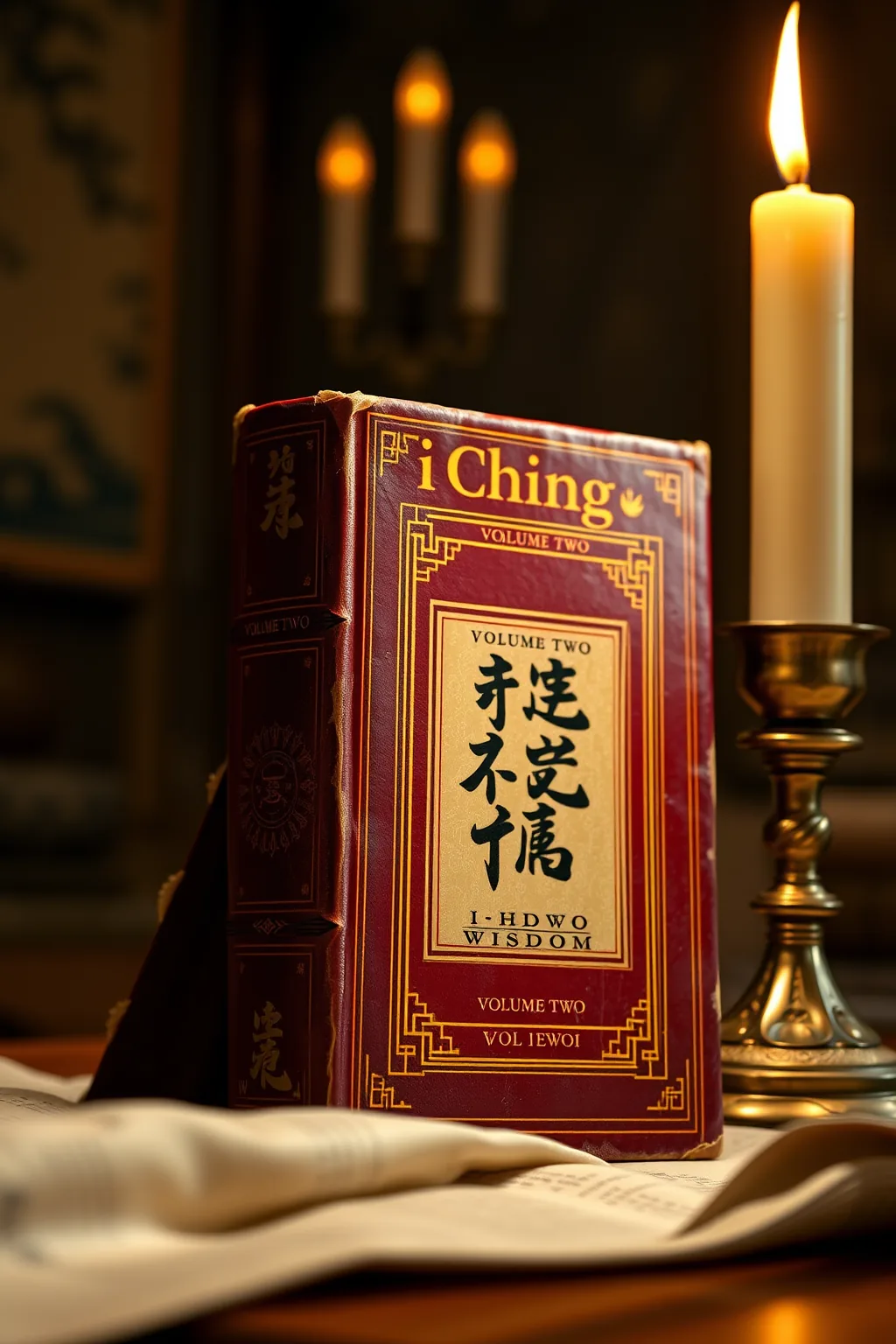
I Ching Wisdom Volume Two
 61
61

I Ching Wisdom Volume Two



Balthazar Finch (Senior Critic, Occult Philosophy) — Wu Wei's 'I Ching Wisdom Volume Two' is a masterclass in unveiling the hidden architecture of the universe. This sequel transcends mere interpretation, offering a profound immersion into the metaphysical tapestry woven by the hexagrams. Wu Wei's prose is both scholarly and luminous, guiding the reader through complex symbolism with an alchemical touch. The insights into cyclical causality and the nuanced interplay of yin and yang are particularly illuminating for serious practitioners and scholars of esoteric traditions. It is an essential addition for anyone seeking to move beyond superficial divination towards a deeper, integrated understanding of the I Ching as a living philosophical system. A truly illuminating work.
📝 Description
61
Wu Wei's 'I Ching Wisdom Volume Two' (2023) deciphers the philosophical depths of the Book of Changes.
This second volume by Wu Wei continues the examination of the I Ching's hexagrams and their philosophical implications. It moves beyond simple divination, presenting the text as a system for understanding cosmic patterns and their connection to human experience. The author focuses on the symbolic language used within the Book of Changes to describe the natural cycles and forces that influence events. The book aims to provide readers with insights into the relationship between the individual and the broader universal principles.
It addresses concepts such as subtle energies and correspondences, seeking to illuminate the philosophical basis of the I Ching. Wu Wei structures the material for those seriously studying esoteric subjects, contemplative practices, or seeking greater self-knowledge. The goal is to offer a resource for understanding ancient knowledge that can lead to personal growth and a more balanced approach to life's changes. Readers are encouraged to find wisdom in the I Ching's structure for living in harmony.
This work is situated within the tradition of Chinese esoteric thought, specifically focusing on the I Ching (Book of Changes). It draws from centuries of commentary and interpretation that view the text not merely as a divination manual but as a complex system of philosophy and cosmology. The book engages with concepts often found in Taoist and Neidan (internal alchemy) traditions, such as the interplay of yin and yang, the symbolic representation of natural forces, and the idea of aligning human life with universal rhythms. It addresses the hidden structures and energies that proponents of these traditions believe govern reality.
💡 Why Read This Book?
Unlock the profound mysteries of the I Ching, moving beyond simple prognostication to grasp its deep philosophical and spiritual underpinnings. Ideal for seasoned practitioners seeking advanced interpretations, scholars of Eastern mysticism, and soul-seekers yearning for a more profound connection to universal wisdom. This volume offers clarity, insight, and a pathway to greater self-understanding and harmonious living.
⭐ Reader Reviews
Honest opinions from readers who have explored this book.
❓ Frequently Asked Questions
Is prior knowledge of the I Ching required?
While 'I Ching Wisdom Volume Two' builds upon foundational concepts, Wu Wei's clear exposition makes it accessible to those with some familiarity. Newcomers may benefit from reviewing foundational texts, but the volume's structure encourages gradual immersion into its esoteric depths.
What distinguishes this volume from other I Ching guides?
This volume distinguishes itself through its deep dive into the symbolic, metaphysical, and philosophical dimensions of the I Ching, moving beyond predictive mechanics to explore its role as a guide for spiritual evolution and esoteric understanding.
How can the I Ching be used for personal growth?
The I Ching acts as a mirror, reflecting the underlying patterns and energies of a situation. By contemplating its wisdom, individuals can gain clarity, understand their inner landscape, and make more aligned choices, fostering personal transformation and spiritual development.
What is the role of the author, Wu Wei?
Wu Wei acts as a master guide, translating the ancient wisdom of the I Ching into contemporary language. Their approach emphasizes intuitive understanding and the integration of its principles into daily life for enhanced wisdom and spiritual insight.
Is this book suitable for academic study?
Absolutely. The rich historical context, detailed symbolic analysis, and philosophical depth make 'I Ching Wisdom Volume Two' a valuable resource for academic study of Chinese philosophy, comparative religion, and esoteric traditions.
🔮 Key Themes & Symbolism
The Dance of Yin and Yang
This theme looks at the fundamental cosmic duality of Yin and Yang as represented within the I Ching. It explores their interplay as the animating force behind all phenomena, from the grand cycles of nature to the subtle shifts within the human psyche. Wu Wei illuminates how understanding this dynamic balance is crucial for navigating life's challenges and aligning oneself with the natural flow of the Tao, fostering harmony and preventing stagnation. The hexagrams are presented as intricate maps of this eternal dance.
The Unfolding of Destiny
This section probes the concept of destiny as presented by the I Ching, not as rigid predetermination, but as a dynamic unfolding of potential influenced by conscious action and cosmic timing. It examines how the hexagrams offer insights into the prevailing energies of a situation and the opportune moments for action or contemplation. The emphasis is on understanding the currents of fate and learning to navigate them with wisdom, intention, and an awareness of the interconnectedness of all events. It encourages a proactive approach to one's life path.
Symbolic Language of the Cosmos
Here, the focus shifts to the profound symbolic language embedded within the I Ching's imagery and trigrams. Wu Wei unpacks the archetypal meanings of the various symbols, revealing their connection to natural forces, human emotions, and spiritual principles. This exploration allows readers to perceive the universe as a text to be read, where every element carries a message. By deciphering this symbolic lexicon, practitioners gain a deeper appreciation for the hidden order and interconnectedness of existence, fostering a more intuitive and holistic understanding of reality.
💬 Memorable Quotes
Direct passages from the work, attributed to the author.
“The lines whisper secrets of the turning wheel.”
— This evocative phrase suggests the I Ching's hexagrams and their changing lines are not static pronouncements but dynamic messengers, revealing the subtle shifts and cyclical nature of existence.
“Embrace the ebb, for the flow will surely return.”
— A reminder of the natural rhythm of life, encouraging acceptance of difficult times (ebb) with the assurance that periods of prosperity and ease (flow) will inevitably follow.
“Wisdom blooms not in certainty, but in the seeking.”
— Highlights that true understanding is found in the continuous process of inquiry and exploration, rather than in possessing fixed answers or dogma.
“The mirror reflects the Tao, if the surface is clear.”
— Emphasizes the importance of inner clarity and purity of intention for the I Ching to accurately reveal the underlying principles of the universe (Tao).
“Each change is a seed for the next unfolding.”
— Illustrates the concept of causality and continuous evolution within the I Ching, where every transformation carries the potential for future development and new beginnings.
🌙 Esoteric Significance
Tradition
The I Ching is a core part of Chinese esoteric traditions, deeply interwoven with Taoism, Confucianism, and various schools of Chinese metaphysics. It functions as a macrocosmic map reflecting the principles of the Tao – the fundamental, ineffable cosmic order. Its esoteric significance lies in its ability to reveal the subtle energies and patterns that govern both the universe and the individual, offering a framework for understanding spiritual evolution and achieving harmony with the natural flow of existence.
Symbolism
The esoteric symbolism of the I Ching is rich and complex, built upon the eight trigrams (Heaven, Earth, Thunder, Wind, Water, Fire, Mountain, Lake) and their sixty-four hexagrams. Each line and combination represents archetypal forces, natural phenomena, and stages of transformation. These symbols are not mere representations but are considered active principles that mirror the dynamic processes of the cosmos. Understanding this symbolic language allows for a deeper perception of universal laws and the interconnectedness of all things, moving beyond literal interpretation to intuitive comprehension.
Modern Relevance
In the modern era, the I Ching offers a vital counterpoint to the often fragmented and materialistic worldview. Its emphasis on cyclical change, balance, and interconnectedness provides a profound framework for understanding personal and global challenges. For esoteric practitioners, it remains an invaluable tool for inner exploration, divination, and aligning with higher principles. Its wisdom speaks to the timeless human quest for meaning, offering guidance on navigating uncertainty, fostering resilience, and cultivating a deeper, more conscious relationship with oneself and the universe.
👥 Who Should Read This Book
This volume is an indispensable companion for dedicated practitioners of esoteric arts, seasoned students of Eastern philosophy, and anyone seeking a profound, transformative understanding of the I Ching. Beginners with a sincere curiosity and a willingness to engage deeply with complex ideas will find it informative, though prior foundational knowledge is beneficial. Scholars of comparative religion and mysticism will appreciate its depth and insightful analysis. Ultimately, it is for the soul ready to move beyond superficial answers and embrace the rich, intricate wisdom of this ancient oracle for personal and spiritual growth.
📜 Historical Context
The I Ching, or Book of Changes, boasts a lineage stretching back over three millennia, originating in ancient China. Its earliest forms are believed to be divinatory manuals used by shamans and rulers to understand the will of Heaven and guide state affairs. Over centuries, it evolved from a practical oracle into a profound philosophical and cosmological text, deeply influencing Confucianism and Taoism. During the Han Dynasty, scholars like Wang Bi provided systematic commentaries, solidifying its status as a classic. Its transmission across East Asia and eventually to the West has cemented its place as one of the world's most enduring and influential works of wisdom literature, resonating with seekers across diverse cultures and epochs.
📔 Journal Prompts
Reflect on a recent 'change' in your life. Which hexagram might symbolize this transition, and what wisdom does it offer?
Consider the interplay of Yin and Yang in a current situation. Where can you find greater balance or harmony?
How can the symbolic imagery of a specific hexagram inform your understanding of your own inner landscape?
What 'opportune moment' is the I Ching suggesting for you to act or to simply observe?
If the I Ching is a mirror, what is it reflecting about your current path or intentions?
🗂️ Glossary
Hexagram
A six-line figure formed by the combination of two trigrams, representing a specific situation, cosmic principle, or stage of development within the I Ching.
Trigram
A fundamental symbol composed of three lines, either broken (Yin) or solid (Yang), representing eight basic cosmic forces or elements.
Tao (Dao)
The fundamental, ineffable principle of the universe in Chinese philosophy; the natural order, the Way, or the underlying reality that governs all existence.
Yin
The passive, receptive, dark, feminine principle in Chinese cosmology, often associated with the moon, earth, and introspection. It is complementary and essential to Yang.
Yang
The active, creative, light, masculine principle in Chinese cosmology, often associated with the sun, heaven, and action. It is complementary and essential to Yin.
This book appears in 3 collections
🔮 Readers Also Liked
Browse all →








More by Wu Wei
All books →





From the “I Ching” Collection
View all →









More Free Divination & Tarot Books
View all →