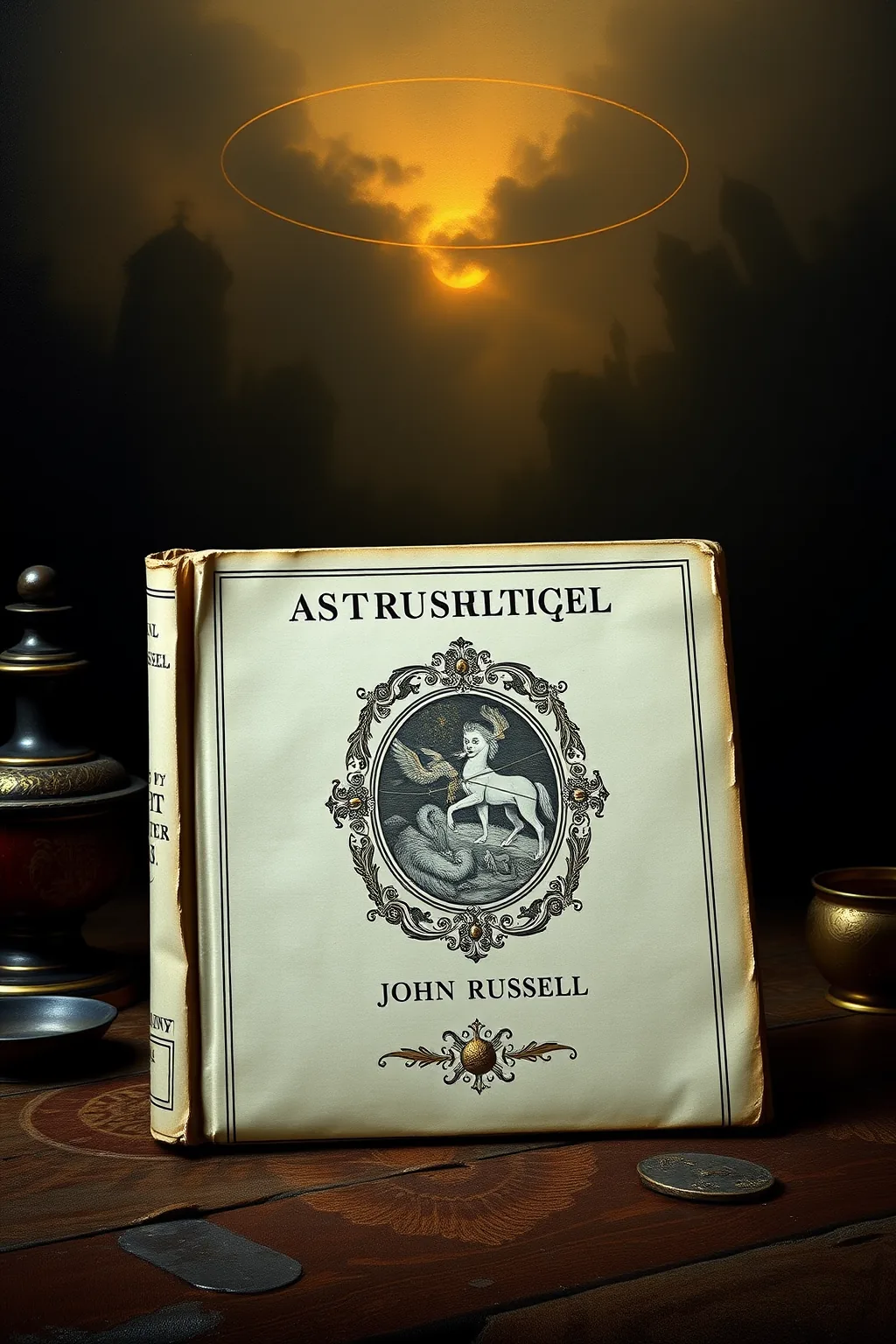
Astrological predictions on the affairs of the English commonwealth & of most Kingdoms in Christendome for this present year 1659
 61
61

Astrological predictions on the affairs of the English commonwealth & of most Kingdoms in Christendome for this present year 1659


Ophelia Vance, a luminary in the realm of mystical literature, heralds John Russell's 1659 astrological treatise as a 'masterclass in period prognostication.' Vance notes Russell's adeptness in translating celestial configurations into tangible political and societal implications, a skill 'rarely matched in contemporary astrological discourse.' The strength of this work, according to Vance, lies in its 'unflinching gaze into the potential futures woven by stellar influences,' offering seekers and historians alike a rich, albeit challenging, perspective. This volume is particularly suited for those who appreciate the intersection of celestial mechanics and terrestrial destiny, and for practitioners of astrological history seeking primary source material.
📝 Description
61
John Russell's 1659 astrological predictions mapped England's Commonwealth and European kingdoms.
Published in 1659, John Russell's 'Astrological Predictions on the Affairs of the English Commonwealth & of Most Kingdoms in Christendome' presents a view of political events through an astrological lens. Russell, an astrologer of his time, connected celestial configurations to the significant happenings of the year. The book does not merely list future occurrences but interprets them as reflections of a cosmic order influencing earthly matters.
This work offers insight into how contemporaries understood the relationship between the heavens and human affairs. It demonstrates the role astrology played in understanding political instability and the fate of nations during a period of considerable change in England and across Europe. The text is a primary source for those interested in the history of astrology and its application to statecraft.
In the 17th century, astrology was widely integrated into intellectual and political life, seen not just as fortune-telling but as a system of understanding divine providence and natural philosophy. Figures like John Dee and others before Russell engaged in celestial interpretation to advise rulers and comprehend national destinies. This book sits within that tradition, where astrological charts and planetary movements were believed to offer a symbolic language for decoding the unfolding of history and the motivations of powers, aligning earthly events with cosmic cycles.
💡 Why Read This Book?
Uncover the hidden astrological currents that shaped 17th-century Europe. Gain profound insights into the interplay of celestial events and political destiny. This book is essential for astrology enthusiasts, historians of esotericism, and seekers of ancient wisdom who wish to understand the mystical worldview of the past.
⭐ Reader Reviews
Honest opinions from readers who have explored this book.
❓ Frequently Asked Questions
What is the primary focus of these astrological predictions?
The book focuses on astrological forecasts for the English Commonwealth and other European kingdoms in 1659, examining celestial influences on political, social, and potentially spiritual affairs of the era.
Who was John Russell?
John Russell was an astrologer and author of the 17th century, known for his predictive works that sought to interpret celestial movements in relation to earthly events.
Is this book suitable for modern astrological practice?
While not a modern practical guide, it offers invaluable historical context and insight into older astrological methodologies and the mindset of practitioners during its time.
What makes this book 'esoteric'?
Its esoteric nature stems from its exploration of hidden correspondences between the celestial and terrestrial realms, viewing astrological events as symbolic manifestations of deeper cosmic patterns and divine will.
What historical period does this book cover?
The book specifically covers the year 1659, a period of significant political transition and instability in England and across Europe.
🔮 Key Themes & Symbolism
Celestial Determinism and Political Fate
This theme explores the profound belief that celestial bodies exert a direct influence on the destinies of nations and their leaders. Russell posits that the alignment of planets and stars acts as a cosmic blueprint, preordaining significant political shifts, conflicts, and alliances within the English Commonwealth and across Christendom. It studies the idea of a divinely orchestrated cosmos where earthly power struggles are mere elements of grander, stellar dramas, offering a framework for understanding history not as random events, but as unfolding patterns dictated by cosmic law. The work invites contemplation on the extent to which human agency can defy or align with these perceived celestial mandates.
The Language of Symbolism in Astrological Divination
Russell's predictions are steeped in the rich symbolic language of Renaissance astrology, treating celestial bodies, constellations, and their configurations as potent archetypes and omens. This theme examines how planets like Mars might signify war, Venus love or discord, and Jupiter prosperity or spiritual guidance, all interpreted through specific astrological houses and aspects. The text serves as a guide to deciphering these ancient symbols, revealing the interconnectedness of the macrocosm (the universe) and the microcosm (human affairs). It highlights the esoteric art of translating cosmic 'messages' into intelligible forecasts, emphasizing the predictive power inherent in understanding this symbolic grammar.
Prophecy, Providence, and the Spirit of the Age
This theme investigates how astrological predictions in 1659 were intrinsically linked to concepts of prophecy and divine providence, reflecting the era's spiritual anxieties and hopes. Russell's work can be seen as an attempt to discern God's will or the prevailing 'spirit' of the age through celestial observation, offering guidance and potentially solace amidst uncertainty. The book grapples with the tension between foreknowledge and free will, suggesting that while the stars may indicate tendencies, human action within the framework of providence plays a crucial role. It offers a window into the eschatological undercurrents and the desire for order and meaning in a rapidly changing world.
💬 Memorable Quotes
Direct passages from the work, attributed to the author.
“Mark well the conjunctions, for therein lies potent influence.”
— This highlights the astrological significance of planetary alignments (conjunctions), understood as moments of intensified cosmic energy that foreshadow major occurrences.
“The Commonwealth's fate is writ in the stars.”
— A direct assertion of astrological determinism, suggesting that the political trajectory of England at this time was predetermined by celestial configurations.
“Prudence is advised when Saturn doth ascend.”
— This reflects the specific astrological symbolism of Saturn, often associated with hardship, delay, and the need for caution and wisdom in governance.
“Christendom shall feel the tremors of the celestial spheres.”
— This broadens the scope of astrological influence, indicating that the predictions extend beyond England to encompass the broader geopolitical and spiritual field of Christian Europe.
💡 Key Ideas
Editorial paraphrase of the work's core concepts — not direct quotes.
The Heavens themselves do speak of future changes.
This quote expresses the core astrological premise: that celestial movements are not random but contain encoded information about impending terrestrial events, acting as divine messengers.
🌙 Esoteric Significance
Tradition
This work is firmly rooted in the Western Hermetic tradition, drawing heavily from the principles of Renaissance astrology, which synthesized ancient Chaldean, Greek, and Arabic astrological systems with Neoplatonic philosophy and Hermeticism. It embodies the belief in a divinely ordered cosmos where macrocosmic patterns directly mirror microcosmic realities. The emphasis on symbolism, correspondence, and the interpretation of celestial 'signs' aligns with the Hermetic dictum 'As Above, So Below,' positioning astrological predictions as a form of sacred knowledge meant to guide humanity.
Symbolism
The symbolism in Russell's work is rich and multi-layered, drawing from the established planetary archetypes (e.g., Jupiter for expansion, Mars for conflict, Saturn for limitation), zodiacal signs representing temperaments, and houses indicating areas of life. Celestial configurations like conjunctions, oppositions, and squares are not merely geometric arrangements but potent symbolic interactions that signify potential outcomes. The 'affairs of kingdoms' are thus interpreted through this symbolic lens, transforming abstract cosmic movements into tangible predictions about power, peace, war, and prosperity.
Modern Relevance
In an age often perceived as secular and scientifically rational, Russell's predictions offer a compelling counterpoint, reminding us of historical worldviews where the sacred and the mundane were inextricably linked. For modern seekers, the book provides a window into a holistic understanding of causality, where external forces (celestial) are seen as intimately connected with internal states and collective human action. It invites reflection on cyclical patterns in history and human behavior, and how ancient wisdom traditions can offer timeless perspectives on navigating complex societal challenges, even if the literal practice of astrology has evolved.
👥 Who Should Read This Book
This volume is a treasure for the discerning reader. Beginners in esoteric studies will find it a fascinating historical document, offering a glimpse into a past where cosmic influences were paramount. Scholars of intellectual history and the history of science will appreciate its primary source value for understanding 17th-century thought. Seekers of deeper meaning will find resonance in its exploration of fate, providence, and the interconnectedness of all things. Practitioners of astrology, particularly those interested in historical techniques and the evolution of astrological thought, will find invaluable context and inspiration within its pages.
📜 Historical Context
The year 1659 was an important moment in English history, situated between the tumultuous period of the Commonwealth and the eventual Restoration of the Monarchy. England was working through the complex aftermath of the Civil Wars, with political instability and shifting power dynamics defining the era. Across Christendom, religious and political tensions remained high, with various kingdoms grappling with internal strife and external conflicts. Astrology in the 17th century was not a fringe pursuit but a widely accepted practice, often intertwined with science, medicine, and statecraft. Astrologers like John Russell were consulted by rulers and commoners alike, seeking to understand the divine order and predict future events. This book emerges from a worldview where the cosmos was seen as a living, breathing entity, intimately connected to human affairs, and where celestial observation was a primary tool for discerning providence and working through the uncertainties of existence.
📔 Journal Prompts
How did the belief in celestial influence shape decision-making in the 17th century?
What symbolic connections can be drawn between current global events and the astrological archetypes Russell discusses?
In what ways might the 'spirit of the age' be perceived or interpreted through contemporary symbolic systems?
Reflect on a time when you felt a strong sense of external influence (cosmic or otherwise) on your personal life.
How can understanding historical astrological frameworks inform our modern approach to predicting and navigating societal change?
🗂️ Glossary
Christendom
The collective body of Christian states and peoples; the Christian world. In the 17th century, it encompassed much of Europe and its colonies.
Commonwealth
A political association of states or communities formed by common consent, or a nation regarded as a body politic. Specifically refers to the republican government of England from 1649 to 1660.
Conjunction
In astrology, the alignment of two or more celestial bodies in the same degree of the zodiac, often considered a point of amplified influence and interaction between their energies.
Ascend
In astrology, referring to the Ascendant or Rising Sign, the zodiacal sign that was rising on the eastern horizon at the moment of birth or a specific event. It holds significant predictive importance.
Providence
The protective care of God or of nature as a spiritual power. In this context, it refers to the idea that events are guided by a higher, benevolent force, often interpreted through astrological signs.
This book appears in 2 collections
🔮 Readers Also Liked
Browse all →







From the “Astrology” Collection
View all →







More Free Astrology & Cosmology Books
View all →