The secret doctrine
 83
83

The secret doctrine
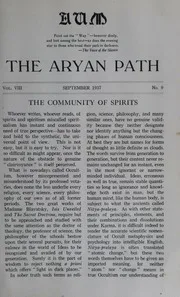
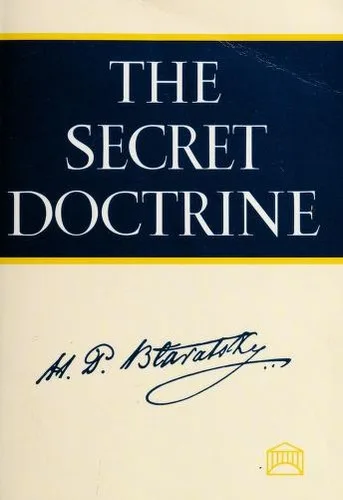
Helena Blavatsky's "The Secret Doctrine" is less a book to be read and more a universe to be mapped, a formidable undertaking first published in 1888. Its ambition is staggering: to present a comprehensive cosmology and anthropology derived from an alleged ancient "Wisdom-Religion." The strength of "The Secret Doctrine" lies in its sheer encyclopedic scope and its attempt to synthesize disparate global mythologies and esoteric traditions into a unified philosophical system. Blavatsky's engagement with scientific theories of her era, while now dated, reveals a mind grappling with the cutting edge of knowledge to support her metaphysical claims. However, the work's primary limitation is its extreme density and often convoluted argumentation, making sustained comprehension a significant challenge. A specific passage detailing the "Seven Chelas" and their cosmic journey illustrates the book's penchant for allegorical depth, but also its potential for obscurity. It remains a foundational text for Theosophy, a significant, albeit difficult, monument of esoteric literature.
📝 Description
83
Helena Blavatsky published "The Secret Doctrine" in 1888, a complex cosmological and anthropological system.
"The Secret Doctrine," first published in 1888 by Helena Blavatsky, outlines a vast system of cosmology and anthropology. Blavatsky aimed to unify global ancient wisdom traditions. The book is organized into three major parts: "Cosmogenesis," which addresses the universe's origins; "Anthropogenesis," detailing human evolution; and "Abstract," which often appears separately. It examines the creation of the cosmos, humanity's development, and the spiritual principles guiding existence, drawing from Eastern philosophies, occult lore, and Blavatsky's interpretation of contemporary scientific ideas.
This work is suited for dedicated students of comparative religion, occultism, and ancient philosophy. Engaging with its dense prose and complex ideas requires patience. Readers interested in the foundational texts of modern Theosophy or the history of esoteric thought in the late 19th century will find substantial content. It is a demanding scholarly pursuit for those seeking a comprehensive metaphysical framework.
Published in 1888, "The Secret Doctrine" emerged during a period of Western spiritual and intellectual upheaval. The late Victorian era saw a rise in interest in spiritualism, Eastern religions like Hinduism and Buddhism, and challenges to scientific materialism. Blavatsky's work offered an esoteric alternative to established religious doctrines and early scientific explanations for human origins. It engaged with contemporary scientific discourse, attempting to connect emerging theories with ancient mystical cosmologies and presenting a distinct model of cosmic and human evolution.
💡 Why Read This Book?
• Understand Theosophy's foundational cosmology: Gain insight into Blavatsky's unique model of cosmic and human evolution, including concepts like Root Races and Rounds, presented in the 1888 first edition. • Explore comparative mythology's esoteric roots: Discover how Blavatsky draws parallels between ancient texts and symbols from diverse cultures to support a universal "Wisdom-Religion." • Engage with 19th-century esoteric thought: Grasp how "The Secret Doctrine" attempted to reconcile ancient spiritual traditions with contemporary scientific and philosophical debates of its time.
⭐ Reader Reviews
Honest opinions from readers who have explored this book.
❓ Frequently Asked Questions
When was "The Secret Doctrine" first published?
"The Secret Doctrine" was first published in two volumes in 1888 by Helena Petrovna Blavatsky, making it a significant work from the late Victorian era of esoteric thought.
What is the main purpose of "The Secret Doctrine"?
Its primary aim is to present a comprehensive cosmology and anthropology based on ancient esoteric traditions, synthesizing wisdom from various cultures and religions into a unified spiritual philosophy.
What are the "Root Races" mentioned in the book?
The "Root Races" are a central concept in Blavatsky's theory of human evolution, describing distinct stages of human development across vast geological periods, preceding modern humanity.
Is "The Secret Doctrine" based on scientific theories?
Blavatsky attempts to integrate her esoteric teachings with the scientific understanding of her time, particularly in areas like geology and biology, though her interpretations are distinctly metaphysical.
Where can I find "The Secret Doctrine"?
"The Secret Doctrine" is in the public domain and widely available online through various esoteric libraries and archives. Physical copies are also readily found.
Who founded the Theosophical Society that inspired this book?
Helena Blavatsky, along with Henry Steel Olcott and William Quan Judge, co-founded the Theosophical Society in 1875, with "The Secret Doctrine" serving as a major exposition of its philosophical tenets.
🔮 Key Themes & Symbolism
Cosmic Evolution
The work posits a cyclical and hierarchical model of cosmic creation, diverging from linear progression. It outlines seven planes of existence and the manifestation of the universe from a primordial, undifferentiated state. This process is guided by impersonal, universal laws and intelligences, presented as a framework for understanding the grand sweep of existence beyond human comprehension, referencing concepts like "Manvantaras" (cosmic days) and "Pralayas" (cosmic nights).
Human Evolution Stages
Central to "The Secret Doctrine" is the concept of Root Races, a complex evolutionary scheme for humanity that spans immense geological epochs. Blavatsky details seven successive Root Races, each with distinct physical and spiritual characteristics, beginning with ethereal beings and progressing through more material forms. This doctrine offers an alternative to Darwinian evolution, emphasizing spiritual and psychic development alongside physical form across vast cycles of time.
The Wisdom-Religion
Blavatsky claims her teachings are derived from a single, ancient, universal "Wisdom-Religion" that underlies all exoteric faiths. "The Secret Doctrine" aims to reveal this hidden source, interpreting ancient scriptures, myths, and symbols from various cultures—including Vedic, Egyptian, and Chaldean traditions—as fragmented expressions of this original, unified esoteric knowledge, highlighting shared archetypes and universal spiritual truths.
Duality and Monism
The text explores the fundamental cosmic principle of duality (Spirit/Matter, Light/Darkness) emerging from an absolute, unmanifest Monad. This interplay forms the basis of all manifested reality. Blavatsky seeks to demonstrate how this principle operates at every level, from the universe's inception to the human constitution, emphasizing that behind apparent separation lies an underlying unity or oneness, a core tenet of philosophical monism.
💬 Memorable Quotes
Direct passages from the work, attributed to the author.
“There is no religion higher than Truth.”
— This concise statement expresses the foundational principle of Blavatsky's work, suggesting that the ultimate pursuit is an objective, verifiable understanding of reality, superior to dogma or creed.
“The appearance of Man is the result of the condensation of the four elements.”
— This highlights the book's perspective on human origins as a process of materialization and condensation from fundamental cosmic principles, rather than a singular divine creation event.
“The Secret Doctrine is the heirloom of the ages.”
— This phrase frames the work not as novel speculation but as a transmission of ancient, enduring knowledge passed down through generations, emphasizing its historical and spiritual lineage.
“Every star is a world, and every world is a star.”
— This illustrates the book's vast cosmological vision, suggesting a universe teeming with life and interconnectedness, where celestial bodies are not merely inert objects but dynamic, living entities.
“The universe is the playground of Spirit.”
— This interpretation emphasizes the active, pervasive role of consciousness or Spirit in shaping and animating the entirety of existence, portraying the cosmos as a field for spiritual play and manifestation.
🌙 Esoteric Significance
Tradition
This work is foundational to the Theosophical tradition, which Blavatsky herself largely established. It draws heavily on Hermetic, Neoplatonic, Gnostic, Kabbalistic, and particularly Hindu (Vedanta and Samkhya) and Buddhist philosophies, reinterpreting them through an occult lens. It departs from many specific traditions by presenting a unique, syncretic synthesis intended to represent a universal, primordial esoteric teaching that predates all known religions.
Symbolism
Key symbols include the Serpent (representing cyclicality, wisdom, and divine energy), the Triangle (often signifying the Trinity or the interplay of Spirit, Matter, and Consciousness), and the Circle (representing the Absolute, the infinite, and cosmic wholeness). Blavatsky meticulously analyzes symbols from diverse cultures, such as the Dzyan stanzas (alleged ancient texts), to illustrate universal principles of creation and evolution.
Modern Relevance
Contemporary esoteric practitioners, occultists, and students of comparative religion continue to reference "The Secret Doctrine." Its concepts have influenced various New Age movements, modern occult orders, and thinkers exploring consciousness, reincarnation, and alternative models of human origins. It remains a touchstone for understanding the development of Western esotericism in the late 19th and 20th centuries.
👥 Who Should Read This Book
['• Students of Theosophy: Those seeking to understand the foundational philosophical and cosmological framework laid out by Helena Blavatsky and the Theosophical Society.\n• Comparative Religion Scholars: Researchers interested in how esoteric traditions interpret and synthesize diverse world mythologies and religious texts.\n• Advanced Esoteric Students: Individuals with a background in occultism or metaphysics looking for a comprehensive, albeit challenging, system of universal spiritual laws and cosmic evolution.', '', '']
📜 Historical Context
Published in 1888, "The Secret Doctrine" emerged amidst a late Victorian intellectual milieu characterized by a fascination with spiritualism, Eastern philosophies, and a challenge to orthodox scientific and religious paradigms. Helena Blavatsky's work sought to synthesize ancient esoteric traditions with contemporary scientific discourse, offering a comprehensive esoteric cosmology. It engaged with evolutionary theory, attempting to present a spiritual alternative to Darwinism. The Theosophical Society, co-founded by Blavatsky in 1875, provided the organizational framework for disseminating these ideas. "The Secret Doctrine" was a direct response to the perceived materialism of the era and a bold assertion of a hidden, universal "Wisdom-Religion." Its reception was polarized; celebrated by occultists and spiritual seekers, it faced skepticism and criticism from mainstream academia and religious institutions, with figures like Max Müller commenting on its complex synthesis of Eastern texts.
📔 Journal Prompts
The seven Root Races and their evolutionary progression across cosmic time.
Blavatsky's interpretation of the Stanzas of Dzyan and their claimed antiquity.
The concept of Manvantaras and Pralayas in cosmic cycles.
The interplay between the spiritual and material planes of existence.
How the "Wisdom-Religion" is presented as the source of global mythologies.
🗂️ Glossary
Root Races
A series of distinct evolutionary stages of humanity, each spanning vast geological epochs and characterized by specific physical, mental, and spiritual attributes, as detailed in Blavatsky's system.
Manvantara
A Sanskrit term referring to a period of cosmic activity or a "day of Brahma," representing a cycle of manifestation and existence within the larger cosmic scheme.
Pralaya
A Sanskrit term signifying a period of cosmic dissolution or "night of Brahma," a state of rest and non-manifestation between cycles of creation.
Theosophy
A mystical-philosophical system founded by Helena Blavatsky, aiming to reveal the universal truths underlying all religions and to promote the study of comparative religion, philosophy, and science.
Monad
In Blavatsky's philosophy, the ultimate, indivisible spiritual principle or spark of divinity, from which all individual consciousness and existence emanates.
Stanzas of Dzyan
Alleged ancient esoteric texts from which Blavatsky claims to have derived the core teachings of "The Secret Doctrine," presented as a source of primordial wisdom.
Planes of Existence
A hierarchical structure of different realms or levels of reality, ranging from the most material to the most spiritual, through which consciousness evolves.
🔮 Readers Also Liked
Browse all →








More by Елена Петровна Блаватская
All books →





More Free Theosophy & Anthroposophy Books
View all →