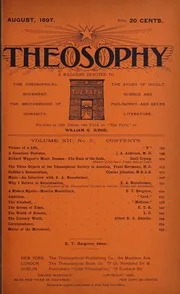
The Key to Theosophy

 76
76

The Key to Theosophy
Blavatsky's The Key to Theosophy functions less as an inviting narrative and more as a deliberate, almost didactic, exposition of Theosophical doctrine. Its strength lies in its directness; Blavatsky addresses the reader as if in conversation, aiming to disabuse them of misconceptions about her movement. The passage discussing the Seven Principles of Man, for instance, offers a structured, albeit dense, framework for understanding human constitution beyond the physical. However, the text's primary limitation is its inherent bias and the sometimes combative tone adopted towards critics or those holding differing views. While it clearly lays out the foundational aims of the Theosophical Society, it assumes a level of receptivity to its specific metaphysical interpretations. It is a foundational text for understanding Theosophy, but not for those seeking a neutral overview of comparative spirituality.
📝 Description
76
Helena Blavatsky published 'The Key to Theosophy' in 1930, aiming to clarify the Theosophical Society's core beliefs.
Helena Blavatsky's 'The Key to Theosophy' directly explains the central tenets of the Theosophical Society. Blavatsky herself intended this book to address common misunderstandings about the Society's objectives and principles for a wider audience. It systematically outlines the Society's three stated objects and elaborates on the ethical and metaphysical foundations of Theosophy. The book is valuable for those investigating the origins of modern esoteric movements, particularly Theosophy. Students of comparative religion and philosophy will find it useful for understanding the synthesis of Eastern and Western thought in the late 19th and early 20th centuries. It also serves as a primary source for those interested in the historical development of occultism.
Theosophy emerged in the late 19th century as an effort to reconcile ancient wisdom traditions with contemporary scientific and philosophical ideas. Blavatsky, with co-founders, sought to establish a universal brotherhood and revive interest in esoteric doctrines. The movement gained attention in the West, drawing from Hinduism, Buddhism, and Neoplatonism, and presenting these through a Western perspective. Theosophy's influence reached figures like Annie Besant and later impacted various New Age movements.
Emerging in the late 19th century, Theosophy represented a significant attempt to synthesize Eastern religious philosophies, Western occult traditions, and contemporary scientific inquiry. Blavatsky and her colleagues aimed to foster universal brotherhood and revive esoteric teachings. The movement attracted considerable attention in the West, a period marked by a perceived spiritual void. Theosophy drew heavily from Hindu and Buddhist concepts, alongside Neoplatonic ideas, reformulating them for a Western audience. Its intellectual currents influenced subsequent spiritual and occult movements.
💡 Why Read This Book?
• Gain a direct understanding of the Theosophical Society's foundational principles, as articulated by Helena Petrovna Blavatsky, offering insights into its three declared objects. • Explore the concepts of Karma and Reincarnation as central tenets of Theosophical philosophy, providing a framework for understanding spiritual causality and cyclical existence. • Comprehend the historical context of Theosophy's emergence in the late 19th century, recognizing its role in the synthesis of Eastern and Western esoteric thought during that era.
⭐ Reader Reviews
Honest opinions from readers who have explored this book.
❓ Frequently Asked Questions
When was The Key to Theosophy first published?
The Key to Theosophy was first published in 1930, several decades after Helena Petrovna Blavatsky's passing in 1891, compiled from her writings and lectures.
What is the main purpose of Helena Blavatsky's The Key to Theosophy?
The primary purpose of The Key to Theosophy is to explain the core principles, aims, and objectives of the Theosophical Society to a general audience, clarifying its mission and dispelling common misconceptions.
Does The Key to Theosophy discuss reincarnation?
Yes, The Key to Theosophy extensively discusses reincarnation as a fundamental doctrine within the Theosophical framework, explaining its role in spiritual evolution and the unfolding of human destiny.
Who were the co-founders of the Theosophical Society mentioned in the context of this book?
While The Key to Theosophy focuses on Blavatsky's teachings, the historical context of the Theosophical Society's founding in 1875 includes figures like Henry Steel Olcott and William Quan Judge.
Is The Key to Theosophy considered an esoteric text?
Yes, The Key to Theosophy is considered a foundational esoteric text, offering an introduction to the complex metaphysical and spiritual teachings of Theosophy, which draws from various ancient wisdom traditions.
What is the concept of Karma as presented in The Key to Theosophy?
In The Key to Theosophy, Karma is presented as the law of cause and effect, governing the cycle of reincarnation and shaping an individual's experiences and future lives based on past actions.
🔮 Key Themes & Symbolism
Universal Brotherhood
The first object of the Theosophical Society, as detailed in The Key to Theosophy, is the formation of a nucleus of Universal Brotherhood of humanity without distinction of race, creed, sex, caste, or color. Blavatsky emphasizes this as the practical application of esoteric knowledge, asserting that recognizing the divine spark in all beings is the path to true spiritual unity and the dissolution of egoic barriers.
Karma and Reincarnation
These two concepts are central to the Theosophical worldview presented in the book. Karma is explained as the immutable law of ethical causation, where every action has a consequence that shapes future experiences. Reincarnation is the mechanism through which this law operates across multiple lifetimes, allowing for the soul's gradual evolution and purification towards spiritual perfection.
The Seven Principles of Man
Blavatsky elucidates the Theosophical model of the human constitution, comprising seven principles or layers of being, ranging from the physical body (Rupa) to the highest spiritual essence (Atma). This framework provides a map for understanding the interplay between the material and the spiritual aspects of human existence and the process of spiritual development.
The Nature of Deity and Masters
The book addresses the Theosophical understanding of God, often described as an impersonal, unmanifest principle rather than a personal creator deity. It also introduces the concept of enlightened beings, known as Masters or Adepts, who have achieved spiritual perfection and guide humanity's evolution from behind the scenes, serving as exemplars and teachers.
💬 Memorable Quotes
Direct passages from the work, attributed to the author.
“The Theosophical Society has three objects. The first is Universal Brotherhood.”
— This statement expresses the Society's primary mission as presented by Blavatsky. It highlights the fundamental importance of fostering unity and equality among all people, irrespective of superficial differences, as the a core part of spiritual progress.
“Karma is the unseen and inexorable law which governs all things.”
— This interpretation emphasizes the pervasive and inescapable nature of Karma within the Theosophical system. It suggests that all events, from the grandest cosmic cycles to individual destinies, are subject to this principle of cause and effect.
“Reincarnation is the doctrine that the Ego, or the individuality, is reborn on this earth again and again.”
— This defines the core mechanism of spiritual evolution in Theosophy. It posits that the essential self, the 'Ego,' does not cease with physical death but undergoes a process of repeated embodiment to learn and grow.
“We must remember that the soul is immortal.”
— This assertion underscores the belief in the eternal nature of the spiritual self. It serves as a foundational premise for understanding the purpose of life, death, and the subsequent rebirths within the framework of Theosophy.
“The Masters are beings who have completed their evolutionary cycle.”
— This describes the advanced spiritual state attributed to the Masters. It implies a profound level of attainment and wisdom, positioning them as guides and exemplars for humanity's own evolutionary journey.
🌙 Esoteric Significance
Tradition
The Key to Theosophy is a foundational text within the Theosophical tradition, a movement Blavatsky herself largely formulated. It draws heavily from Neoplatonism, Gnosticism, Kabbalah, and Eastern philosophies (Advaita Vedanta, Mahayana Buddhism), synthesizing them into a coherent, albeit complex, system. While departing from strict adherence to any single lineage, it aims to present a 'Universal Wisdom' or 'Ancient Path' that underlies all world religions and esoteric schools.
Symbolism
The book frequently references the 'Circle' and 'Triangle' as fundamental symbols. The Circle represents the Absolute, the Unmanifest, the One reality, while the Triangle often symbolizes the manifested Trinity or the three fundamental aspects of existence. The concept of the 'Lotus' also appears, signifying spiritual unfolding and the purity of consciousness emerging from the mire of material existence, mirroring the Seven Principles of Man.
Modern Relevance
Contemporary esoteric thinkers and practitioners continue to engage with Blavatsky's work. The Theosophical Society itself, though evolved, maintains its presence. Elements of Theosophy, particularly its emphasis on karma, reincarnation, universal brotherhood, and the interconnectedness of consciousness, have permeated various New Age philosophies, modern Paganism, and even some secular ethical frameworks. Thinkers exploring comparative mysticism and the history of occultism frequently cite Blavatsky's writings.
👥 Who Should Read This Book
• Students of Helena Blavatsky and the Theosophical Society seeking direct explanations of its core doctrines, including Karma, Reincarnation, and the Seven Principles of Man. • Researchers of comparative religion and Western esotericism interested in the late 19th-century synthesis of Eastern and Western spiritual ideas that influenced subsequent movements. • Individuals exploring philosophical frameworks for spiritual evolution and ethical living, who are drawn to concepts of Universal Brotherhood and the underlying unity of existence.
📜 Historical Context
The Key to Theosophy emerged from a fertile period of esoteric revival in the late 19th century. Theosophy, founded in 1875 by Helena Blavatsky, Henry Steel Olcott, and William Quan Judge, sought to synthesize Eastern spiritual traditions (particularly Hinduism and Buddhism) with Western occultism and philosophy. This era saw widespread interest in spiritualism, mesmerism, and ancient mysteries, partly as a reaction against the perceived materialism of Victorian science. Blavatsky's work, including this explanatory text, challenged established religious and scientific orthodoxies. It engaged with contemporary intellectual currents, offering an alternative cosmology and ethics that resonated with many seeking deeper meaning. Theosophy's reception was mixed, praised by some for its broad spiritual vision and criticized by others for its syncretic claims and Blavatsky's own controversial persona. It stood in contrast to movements like Christian Science, which also gained prominence during this period, offering a distinct path to spiritual understanding.
📔 Journal Prompts
The foundational principle of Universal Brotherhood: how does this concept challenge conventional social divisions?
Reflect on the law of Karma as described in the text. How might understanding cause and effect influence daily choices?
Consider the Seven Principles of Man. Which principle do you feel is most underdeveloped in contemporary society?
The role of Masters in Theosophy: what does this concept suggest about the potential for human spiritual attainment?
Blavatsky's critique of materialism: what are the implications of prioritizing spiritual understanding over material pursuits?
🗂️ Glossary
Theosophy
A syncretic spiritual philosophy founded by Helena Blavatsky, aiming to uncover the universal wisdom underlying all religions and sciences, emphasizing spiritual evolution, karma, and reincarnation.
Karma
In Theosophy, the universal law of cause and effect, governing the consequences of actions and shaping the cycle of rebirths and individual destiny.
Reincarnation
The doctrine that the essential self or soul undergoes repeated cycles of birth, death, and rebirth on Earth to achieve spiritual evolution and purification.
Seven Principles of Man
Theosophical model describing human constitution as composed of seven aspects or bodies, from the physical to the purely spiritual (Atma), representing stages of consciousness and evolution.
Masters (or Adepts)
Highly evolved spiritual beings who have transcended the ordinary human evolutionary path and are said to guide humanity from behind the scenes.
Universal Brotherhood
The first and foremost aim of the Theosophical Society, advocating for the recognition of the fundamental unity and equality of all humankind, irrespective of differences.
Ego (in Theosophy)
The individual, conscious 'I' or personality that reincarnates, distinct from the higher spiritual self (Atma) but seeking to unite with it through evolution.
🔮 Readers Also Liked
Browse all →







More by Елена Петровна Блаватская
All books →





More Free Theosophy & Anthroposophy Books
View all →