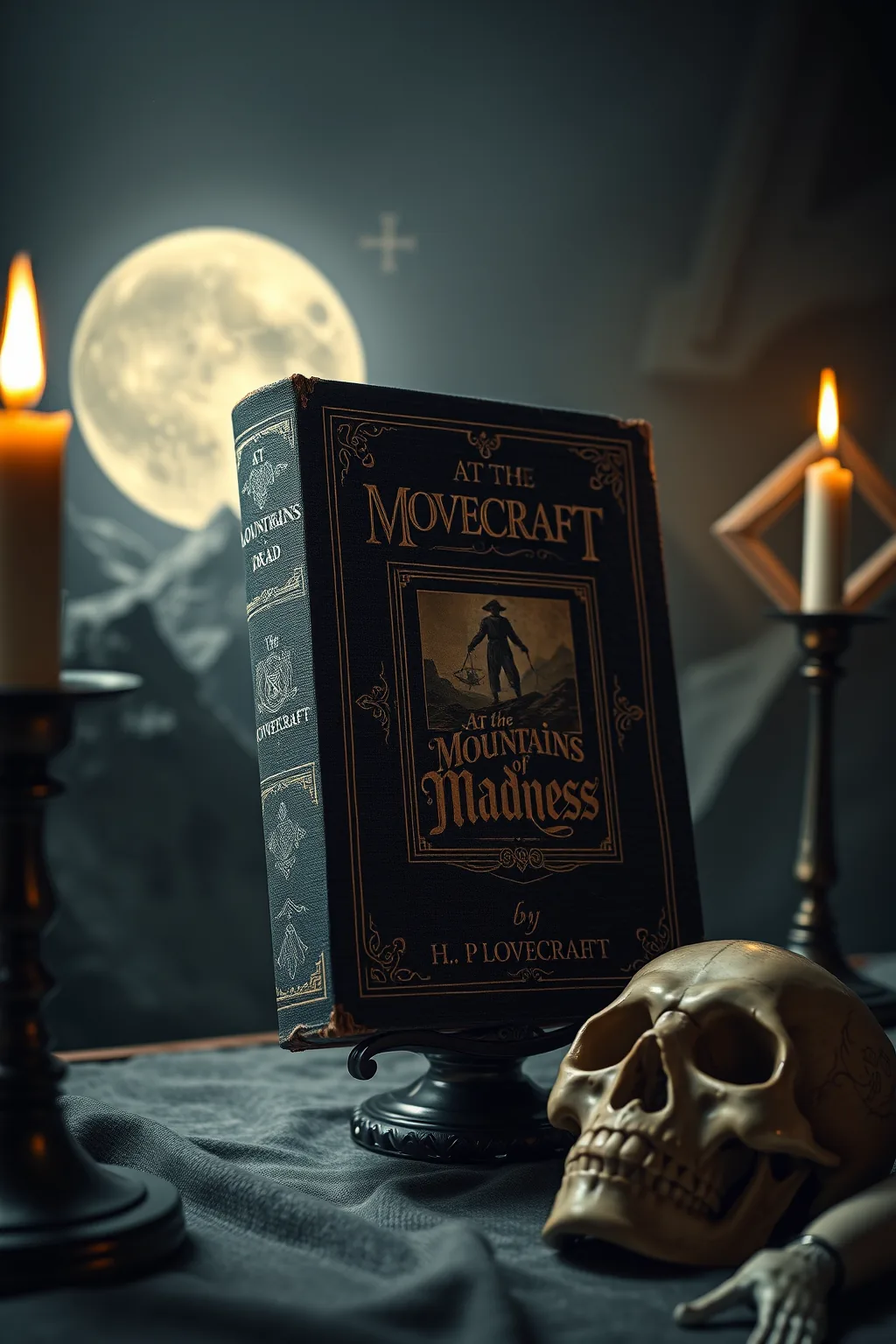
At the Mountains of Madness
 79
79

At the Mountains of Madness


Balthazar Finch (Senior Critic, Occult Philosophy) — 'At the Mountains of Madness' is a profound testament to Lovecraft's unparalleled ability to evoke cosmic dread and the unsettling implications of ancient, alien intelligence. This narrative, framed as a scientific expedition's tragic report, transcends mere horror, offering a chilling glimpse into aeons of cosmic history and the hubris of mortal inquiry. Its strength lies in the gradual unfurling of horrifying revelations, suggesting a universe far more complex and terrifying than our limited understanding allows. It is essential reading for those who appreciate philosophical horror, exploring themes of forgotten civilizations and the existential void. A true masterpiece for the discerning occult scholar.
📝 Description
79
H.P. Lovecraft's 1936 novella chronicles a disastrous scientific expedition to Antarctica.
The narrative unfolds as a recovered manuscript detailing a 1930 expedition by the Miskatonic University to the Antarctic interior. Led by Professor William Dyer, the scientists discover vast, ancient ruins, remnants of a civilization predating humanity. They find evidence of the Elder Things, a powerful alien race that once inhabited Earth, and their biological experiments, including the monstrous shoggoths.
The journal entries describe the growing horror as the expedition uncovers disturbing truths about the planet's history and humanity's negligible place within it. The team's scientific curiosity turns to terror as they confront the sheer scale of the Elder Things' existence and their eventual decline. The story culminates in a desperate flight from the mountains, leaving behind a chilling testament to cosmic indifference and the potential for truly alien horrors to exist beyond human understanding.
At the Mountains of Madness taps into a strain of occult fiction that posits Earth's history is far older and stranger than accepted science allows. It draws on themes found in earlier speculative fiction and occult traditions that imagine non-human intelligences influencing or dominating the planet long before mankind. The narrative's focus on forgotten lore, cyclopean architecture, and the terrifying implications of discovering ancient, alien life aligns with a broader interest in uncovering hidden cosmologies and challenging anthropocentric views of reality.
✍️ Author
💡 Why Read This Book?
For seekers of forbidden knowledge and scholars of the esoteric, 'At the Mountains of Madness' offers a profound descent into cosmic horror. It challenges our perception of reality, revealing the chilling insignificance of humanity against vast, ancient powers. Ideal for those who crave atmospheric narratives that explore the philosophical depths of the unknown, this tale promises to expand your understanding of existence and the terrifying truths that lie beyond.
⭐ Reader Reviews
Honest opinions from readers who have explored this book.
❓ Frequently Asked Questions
What makes 'At the Mountains of Madness' a cosmic horror story?
Cosmic horror, as exemplified here, focuses on humanity's insignificance in a vast, indifferent universe populated by ancient, incomprehensible entities. The terror stems not from immediate threats, but from the dawning realization of our utter powerlessness and the mind-shattering nature of cosmic truths.
Who were the Elder Things?
The Elder Things were an ancient, alien race that predated humanity by millions of years. They were builders, scientists, and explorers, responsible for much of Earth's early geology and the creation of various life forms, including the Shoggoths.
What is the role of the Shoggoths in the story?
The Shoggoths are amorphous, protoplasmic beings created by the Elder Things as laborers. They are immensely powerful and adaptable, eventually developing sentience and rebelling against their creators, becoming a symbol of uncontrolled, primal chaos.
Is this book connected to other Lovecraft stories?
Yes, 'At the Mountains of Madness' is a central piece in H.P. Lovecraft's Cthulhu Mythos, referencing and expanding upon concepts and entities introduced in other tales, creating a cohesive, interconnected universe of dread.
What is the primary philosophical message of the book?
The primary message is the profound insignificance of humanity in the grand scheme of the cosmos, the dangers of unchecked scientific curiosity when it leads to forbidden knowledge, and the inherent fragility of our perceived reality when confronted by the truly alien.
🔮 Key Themes & Symbolism
Cosmic Indifference and Human Insignificance
This theme posits a universe utterly devoid of concern for human existence. Lovecraft suggests that humanity is but a fleeting anomaly in a cosmos governed by vast, ancient forces and entities whose motivations and existence dwarf our own. The narrative instills a profound sense of dread by revealing the superficiality of our understanding and the terrifying realization that our struggles and triumphs hold no cosmic weight, challenging anthropocentric views and forcing contemplation of our true place in the grand, uncaring expanse.
The Peril of Forbidden Knowledge
The pursuit of knowledge, particularly that which lies beyond the conventional boundaries of science and understanding, is presented as a dangerous path. The expedition's discoveries in Antarctica unleash horrors that shatter the minds of the protagonists, illustrating Lovecraft's belief that some truths are too terrible for mortal minds to bear. This theme serves as a cautionary allegory for unchecked curiosity, hinting that the universe holds secrets best left undisturbed, lest they lead to existential ruin and the erosion of sanity.
Ancient Civilizations and Lost Worlds
Lovecraft paints a vivid picture of a pre-human Earth, populated by highly advanced, alien civilizations that have long since vanished or retreated into obscurity. The discovery of cyclopean cities and advanced technology in the Antarctic ice evokes a sense of awe and dread, hinting at a history of the planet far more complex and terrifying than recorded. These lost worlds serve as a backdrop for cosmic revelations, emphasizing the ephemeral nature of even the most powerful empires when faced with the inexorable march of time and cosmic forces.
💬 Memorable Quotes
Direct passages from the work, attributed to the author.
“The horror was not of the body, but of the soul.”
— Lovecraft emphasizes existential dread over physical threat. The true terror lies in the mental and spiritual impact of confronting the incomprehensible and the vast emptiness of the cosmos.
“There are doors which should never be opened.”
— A direct warning against looking at forbidden knowledge. The narrative illustrates the dire consequences of unearthing secrets that humanity is not meant to possess.
“It was a city of the gods.”
— This evokes the immense scale and alien grandeur of the civilization discovered, suggesting a power and antiquity far beyond human comprehension, a place where the unfathomable once held sway.
💡 Key Ideas
Editorial paraphrase of the work's core concepts — not direct quotes.
The most merciful thing in the world, I think, is the inability of the human mind to correlate all its contents.
This quote speaks to the protective ignorance of humanity. Our minds can't process the full, terrifying scope of reality, a blessing that shields us from the madness that understanding it would bring.
We were on the threshold of the greatest discovery in the history of the human race.
This line foreshadows the catastrophic nature of their findings. What appears as a monumental scientific breakthrough is, in fact, the beginning of their undoing.
🌙 Esoteric Significance
Tradition
While not strictly adhering to a single esoteric tradition, 'At the Mountains of Madness' draws heavily from Gnostic themes of a flawed creator, a hidden demiurge, and the inherent deception of the material world. It also echoes Lovecraft's own invented Mythos, which functions as a modern occult cosmology, populated by ancient, malevolent entities and cosmic secrets. The narrative can be interpreted through the lens of Hermeticism, particularly the principle of 'As Above, So Below,' as the alien civilization's ancient machinations reflect on a cosmic scale.
Symbolism
The Antarctic setting symbolizes a primordial, untouched area of ancient truths, a frozen repository of cosmic history. The cyclopean architecture represents the alien, incomprehensible nature of the Elder Things, a stark contrast to human-built structures. The Shoggoths embody chaos, primal energy, and the terrifying potential for creation to turn against its creator, mirroring ancient myths of monstrous offspring. The 'black, glassy stones' and alien artifacts symbolize remnants of a lost, advanced civilization, keys to forbidden knowledge that unlock existential dread.
Modern Relevance
In an age of rapid technological advancement and expanding scientific horizons, Lovecraft's warnings about the dangers of unchecked curiosity and the potential for uncovering truths that destabilize our worldview remain acutely relevant. The story prompts reflection on humanity's place in a universe increasingly understood through science, urging a balance between exploration and humility. It continues to influence modern horror, sci-fi, and philosophical discourse, reminding us that the greatest terrors may not be external monsters, but the chilling realization of our own insignificance and the profound mysteries that lie beyond our grasp.
👥 Who Should Read This Book
This key work is essential for seekers of profound, philosophical horror who are drawn to the existential and the unknown. Scholars of occult literature and Lovecraftian lore will find rich thematic material and a core part of the Cthulhu Mythos. Practitioners of esoteric studies may find resonance in the themes of forbidden knowledge and the vastness of cosmic forces. For beginners to the genre, it offers a deep study in atmospheric dread and intelligent, thought-provoking terror, while seasoned readers will appreciate its intricate world-building and enduring legacy.
📜 Historical Context
Published in 1936, 'At the Mountains of Madness' emerged from the fertile ground of pulp fiction's golden age, a period marked by burgeoning scientific discovery alongside widespread anxieties about humanity's place in an increasingly complex world. The era saw advancements in geology, paleontology, and astronomy, fueling imaginations with possibilities of ancient life and vast cosmic scales, which Lovecraft expertly harnessed. Influenced by scientific theories of the time, such as the vastness of geological time and the potential for life beyond Earth, Lovecraft blended these with occult traditions and a burgeoning interest in the psychological impact of the unknown. His work resonated with a readership grappling with the aftermath of World War I and the looming threat of another, finding solace or catharsis in tales that emphasized cosmic insignificance over human follies. The story's scientific framing, though ultimately overwhelmed by horror, reflects the era's scientific optimism, twisted into a chilling exploration of its potential dangers.
📔 Journal Prompts
Reflect on the feeling of insignificance evoked by the story. How does this concept challenge your personal worldview?
Consider the Elder Things' creation of life. What ethical implications arise from their actions, and how do they mirror human technological ambitions?
Explore the concept of 'forbidden knowledge' in your own life or in broader society. What knowledge do we fear, and why?
Imagine encountering a remnant of an ancient, alien civilization. What would be your immediate emotional and intellectual response?
Write about a place or experience that evokes a sense of profound mystery or ancientness, drawing parallels to the Antarctic setting of the story.
🗂️ Glossary
Cyclopean
Relating to or characteristic of the ancient Greek mythical giants called Cyclopes; immense, colossal, or massive, often referring to ancient megalithic architecture.
Elder Things
An ancient, extraterrestrial race that visited Earth millions of years before humans, responsible for significant geological and biological modifications to the planet.
Shoggoth
Amorphous, protoplasmic beings created by the Elder Things as laborers, known for their adaptability, immense power, and eventual rebellion.
Cthulhu Mythos
A shared universe of cosmic horror fiction created by H.P. Lovecraft and expanded by his successors, featuring ancient deities, alien races, and recurring themes of existential dread.
Miskatonic University
A fictional university in Arkham, Massachusetts, often featured in Lovecraft's stories, known for its extensive library of forbidden tomes and its faculty's involvement in occult studies.
This book appears in 1 collection
🔮 Readers Also Liked
Browse all →





More by H P Lovecraft
All books →

From the “Transcendental Meditation” Collection
View all →

![A LITTLE HISTORY - [ Truth about ] THE SHEPHERDING MOVEMENT](/img/thumb/a-little-history-truth-about-the-shepherding-movement-allan-clare-bill-hamon-ern-baxter-charles-simpson-derek-prince-don-basham-bob-mumford-john-bevere-r-c-sproul-bredesen-juan-carlos-ortiz-bruce-metz.webp)


More Free Supernatural & Occult Fiction Books
View all →