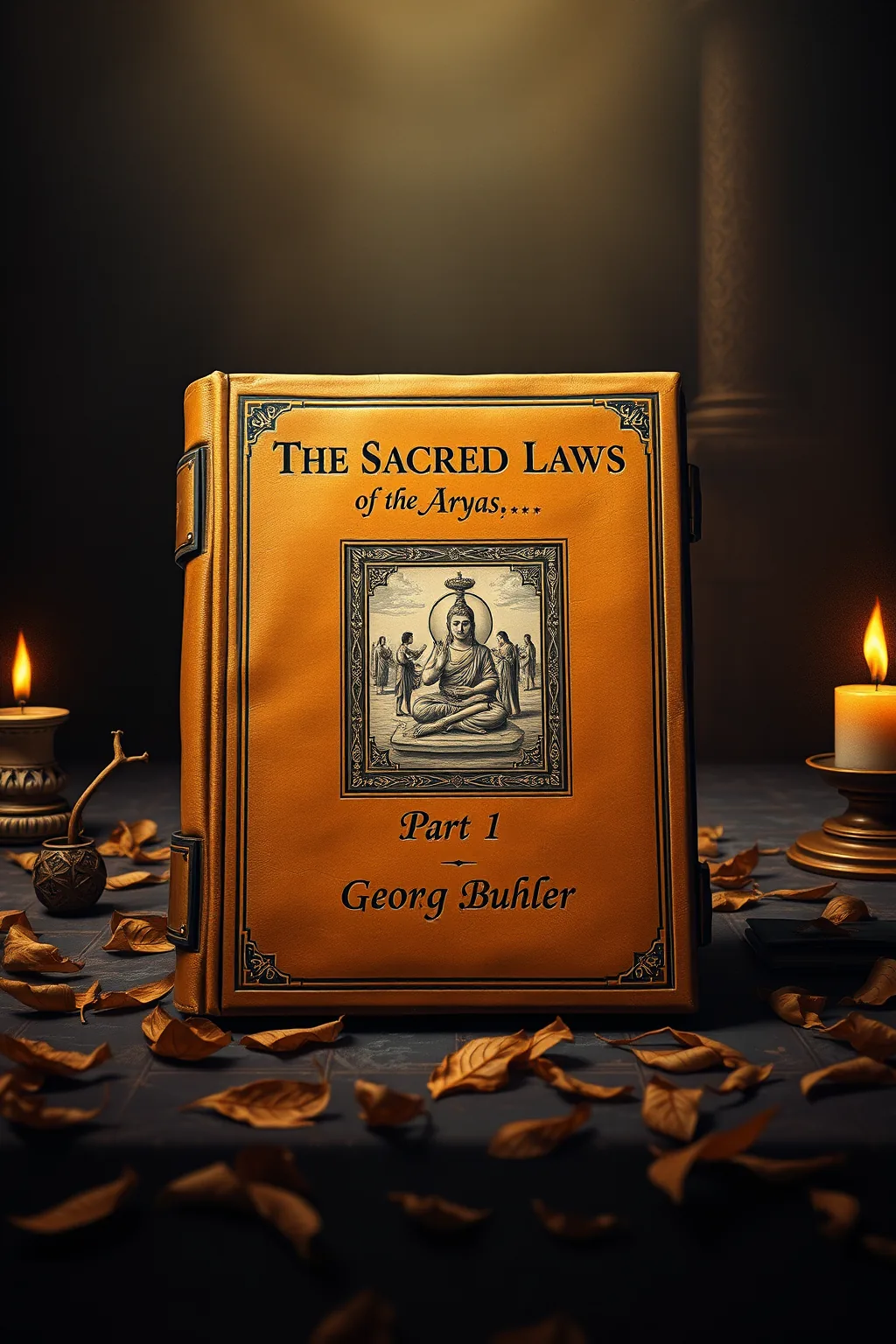
The Sacred Laws of the Âryas, Part 1
 72
72

The Sacred Laws of the Âryas, Part 1



Silas Hawthorne (Hermetic Studies Editor) — A profound revelation, 'The Sacred Laws of the Âryas, Part 1' offers an unparalleled glimpse into the ethical and spiritual architecture of ancient India. Bühler's translation illuminates the intricate tapestry of Dharma, revealing its deep connection to cosmic principles. This work is essential for serious students of comparative religion and esoteric philosophy, providing the bedrock for understanding the yogic and Vedic traditions. Its clarity on custom, ritual, and duty offers practical guidance for those seeking a more ordered and spiritually resonant life. A truly invaluable addition to any serious occult library.
📝 Description
72
Georg Bühler translated 'The Sacred Laws of the Âryas, Part 1' to illuminate ancient Indian concepts of Dharma.
This volume contains translations of the Dharma Sutras from ancient Indian schools, including Apastamba, Gautama, Vâsishtha, and Baudhâyana. These texts detail the principles of Dharma, understood as cosmic order, ethical duty, and righteous conduct within the societal structure. They cover laws pertaining to custom, ritual, and the maintenance of social harmony. The book serves as a direct source for understanding the legal and ethical frameworks that shaped early Indian civilization. It presents a worldview where spiritual realization and ethical living were central.
It is a significant part of the 'Sacred Books of the East' series, aiming to make these foundational texts accessible to a wider audience. The translations focus on preserving the original meaning and intent of the sutras. Readers will find discussions on caste duties, life stages, purification rites, and the consequences of transgressing these laws. The work provides a detailed look into the practical application of religious and moral principles in daily life and governance.
As part of the 'Sacred Books of the East' series, this work situates the Dharma Sutras within a broader scholarly effort to understand Eastern religious and philosophical traditions. These sutras are fundamental to the development of Hinduism, codifying the principles that guide individual behavior and societal organization. They represent an early attempt to systematize religious law and ethics, drawing from Vedic traditions and contributing to later legal and philosophical discourse in India. The text is crucial for tracing the evolution of concepts like karma, moksha, and dharma.
✍️ Author
Georg Buhler
Buhler, Buehler, or Bühler are surnames of German origin. They are derived from the German noun Bühl, meaning "hill", with the suffix -er, and is thus a topographic surname for a person living on or next to a hill.
💡 Why Read This Book?
This seminal work invites you to explore the ancient Indian conception of Dharma, the sacred order governing duty, custom, and ritual. It's essential for understanding the roots of spiritual development and ethical living. Ideal for seekers of universal laws, scholars of ancient traditions, and practitioners aiming to integrate timeless wisdom into their lives.
⭐ Reader Reviews
Honest opinions from readers who have explored this book.
❓ Frequently Asked Questions
What is Dharma as presented in this text?
Dharma, in this context, encompasses the sacred laws, ethical duties, social customs, and righteous conduct prescribed for individuals and society within the ancient Âryan tradition, guiding one toward spiritual fulfillment and cosmic order.
Which ancient Indian schools are represented in this volume?
This volume draws from the teachings of four prominent ancient Indian schools: Apastamba, Gautama, Vâsishtha, and Baudhâyana, offering a comprehensive overview of their respective legal and ethical frameworks.
Is this a religious text or a legal code?
It functions as both. It is a sacred text detailing the 'laws' which are interwoven with religious, ethical, and social principles, guiding adherents toward a life aligned with spiritual truths and societal harmony.
What is the significance of its inclusion in the 'Sacred Books of the East' series?
Its inclusion highlights its status as a foundational and highly influential text within the vast canon of Asian religious and philosophical literature, making its ancient wisdom accessible to a global audience.
Who is Georg Bühler and why is his translation important?
Georg Bühler was a renowned Indologist whose meticulous translation in 1879 made these complex ancient Indian texts accessible to Western scholars and readers, preserving their esoteric essence for future generations.
🔮 Key Themes & Symbolism
The Cosmic Order of Dharma
Dharma, as presented in this ancient text, transcends mere law; it is the fundamental principle that upholds the universe, dictating the natural order and the righteous path for all beings. It encompasses ethical conduct, societal responsibilities, and spiritual duties, forming the bedrock of a life lived in harmony with the cosmos. Understanding Dharma is key to unlocking the secrets of spiritual progression and maintaining balance in both the individual soul and the collective consciousness.
Ritual and Custom as Spiritual Technology
The sacred laws detail intricate rituals and customs that served as spiritual technologies for the ancient Âryas. These practices were not arbitrary but designed to purify the mind, connect with divine energies, and foster a deep sense of community and shared purpose. Through adherence to these prescribed actions, individuals could cultivate inner discipline, purify their karma, and ascend to higher states of consciousness, transforming daily life into a sacred journey.
The Path of Righteous Duty (Karma Yoga)
This volume elucidates the concept of righteous duty, intricately linked with the principle of Karma Yoga. It outlines the specific obligations and responsibilities inherent in various social roles and life stages, emphasizing that fulfilling these duties with detachment and devotion is a path to spiritual liberation. The text guides the reader in understanding how one's actions, performed in accordance with Dharma, contribute to their spiritual evolution and the well-being of the world.
💬 Memorable Quotes
Direct passages from the work, attributed to the author.
“The Veda is the root of Dharma.”
— This aphorism highlights the supreme authority of the Vedas as the ultimate source and foundation for all sacred laws and righteous conduct within the Âryan tradition.
“Custom is the eternal law.”
— This implies that deeply ingrained societal practices and traditions, when aligned with higher principles, possess a sacred and enduring quality, shaping the ethical landscape.
“He who knows the rules of conduct attains the highest.”
— This emphasizes the transformative power of adhering to prescribed ethical and spiritual guidelines, suggesting it leads to ultimate spiritual attainment and enlightenment.
“The study of the Veda is the duty of a Brāhmana.”
— This specifies a core responsibility within the social structure, underscoring the importance of spiritual scholarship and the transmission of sacred knowledge.
“A good man is not one who does not injure others.”
— This profound statement points to a higher standard of ethical conduct, suggesting that true goodness lies not just in abstaining from harm but in actively cultivating compassion and well-being.
🌙 Esoteric Significance
Tradition
This text is central to the Vedic and Puranic traditions of Hinduism, particularly its legal and ethical branches (Dharmaśāstra). Esoterically, it offers insights into the structure of cosmic law, the principles of spiritual evolution through duty (Karma Yoga), and the ritualistic practices believed to facilitate communion with higher realms and accelerated spiritual development.
Symbolism
The laws themselves are symbolic representations of divine order. Rituals symbolize purification and transformation, while concepts like 'Dharma' act as guiding stars for working through the complexities of existence. The hierarchical structure of duties reflects the interconnectedness of all beings and the cosmic web of cause and effect (Karma), pointing towards an underlying spiritual architecture.
Modern Relevance
In a world often characterized by fragmentation and ethical ambiguity, the ancient wisdom contained within 'The Sacred Laws of the Âryas' offers a profound framework for re-establishing personal and societal balance. The emphasis on duty, righteous conduct, and spiritual discipline provides timeless guidance for navigating modern challenges and cultivating a more meaningful, ethically grounded existence.
👥 Who Should Read This Book
This profound work is a rich source for a diverse audience. **Beginners** seeking to understand the ethical foundations of Eastern spirituality will find clear guidance. **Scholars** of comparative religion, Indology, and ancient history will appreciate its scholarly rigor and foundational importance. **Spiritual seekers** yearning to connect with timeless wisdom and explore the concept of Dharma will discover a rich source of inspiration. **Practitioners** of yogic and meditation disciplines will gain a deeper understanding of the cultural and philosophical context that shaped these practices.
📜 Historical Context
Published in 1879, 'The Sacred Laws of the Âryas, Part 1' emerged during a key era of Orientalism and comparative religious studies. As European scholars studied the collection of Eastern philosophies and spiritual traditions, Georg Bühler’s translation of these ancient Indian texts provided crucial access to the foundational principles of Vedic and post-Vedic thought. The 'Sacred Books of the East' series, of which this is a part, aimed to present a comprehensive collection of religious literature from across Asia, fostering cross-cultural understanding and scholarly research. This volume, in particular, illuminated the intricate legal, social, and ethical frameworks that guided ancient Indian society, offering a window into a civilization deeply rooted in spiritual law and cosmic order.
📔 Journal Prompts
Reflect on a personal 'Dharma' – a guiding principle or duty that shapes your actions. How does it align with or differ from the principles presented in the text?
Consider a specific ritual or custom from your own life or culture. What deeper meaning or spiritual significance might it hold?
How can the concept of 'righteous duty' be applied in contemporary secular life to foster greater ethical awareness and contribution?
Explore the relationship between law and spirituality as presented in this text. Where do they intersect, and where do they diverge?
Meditate on the idea of 'cosmic order.' How does understanding your role within this order influence your perception of your daily responsibilities?
🗂️ Glossary
Ârya
An ancient term referring to noble individuals or peoples, often associated with the early Indo-Iranian cultures and their religious and social traditions.
Dharma
The cosmic law, righteousness, duty, ethical conduct, and the natural order that upholds the universe and guides all beings toward spiritual fulfillment.
Veda
The most ancient sacred scriptures of Hinduism, considered divine revelations, forming the foundational texts for spiritual and ethical teachings.
Brahmana
A member of the priestly class in ancient Indian society, traditionally responsible for preserving and transmitting Vedic knowledge and performing rituals.
Karma
The principle of cause and effect, where actions (karma) create consequences that shape an individual's present and future experiences, influencing spiritual evolution.
This book appears in 1 collection
🔮 Readers Also Liked
Browse all →







From the “Transcendental Meditation” Collection
View all →








More Free Spiritual Development Books
View all →