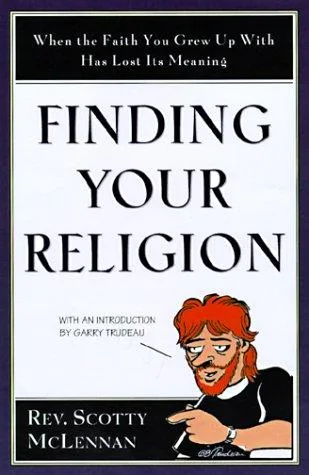
Finding Your Religion
 81
81

Finding Your Religion
Scotty McLennan’s "Finding Your Religion" offers a commendable, if somewhat dated, primer on approaching religious belief with intellectual honesty and personal integrity. Its strength lies in its systematic breakdown of religious components, particularly its use of Ninian Smart’s Seven Dimensions, which provides a robust analytical tool for dissecting any faith tradition. McLennan avoids the pitfalls of proselytizing, instead focusing on the *process* of religious inquiry. However, the book's primary limitation is its earnest, almost pedagogical tone, which can feel a bit dry for readers seeking a more visceral or experiential engagement with spirituality. While the 2000 publication date means some contemporary spiritual movements are not addressed, the fundamental framework remains sound. The section on "Spiritual Autobiography" is particularly valuable, urging readers to integrate their lived experiences with their developing beliefs. Ultimately, "Finding Your Religion" is a solid, if unexciting, resource for the intellectually curious spiritual explorer.
📝 Description
81
### What It Is
"Finding Your Religion" by Scotty McLennan, first published in 2000, serves as a guide for individuals seeking to understand and engage with diverse religious and spiritual paths. The work meticulously explores the landscape of faith traditions, offering a framework for personal spiritual discovery. It’s not a prescriptive text, but rather an invitational one, encouraging readers to engage critically and personally with the world's religious expressions. McLennan positions religious inquiry as an active, ongoing process, distinct from passive adherence.
### Who It's For
This book is designed for the spiritual seeker, the questioner, and anyone feeling adrift in the contemporary religious climate. It appeals to individuals who may find traditional denominational structures unfulfilling or who are curious about the vast spectrum of belief systems beyond their immediate cultural context. It is particularly relevant for those in their late teens and twenties, a demographic often characterized by intense spiritual exploration and a desire for authentic connection. The text also serves those in ministry or spiritual counseling roles, providing resources for understanding the varied spiritual needs of their congregants.
### Historical Context
Published at the turn of the millennium, "Finding Your Religion" emerged during a period of increased interest in comparative religion and New Age spirituality, following the counterculture movements of the 1960s and 70s. The late 20th century saw a growing secularization in some Western societies alongside a simultaneous surge in diverse spiritual practices and a greater accessibility of global religious ideas through media and travel. McLennan’s work offers a reasoned approach to this expanding spiritual marketplace, distinguishing itself from more dogmatic or narrowly focused theological texts. It arrived in a climate where figures like Karen Armstrong were also popularizing accessible histories of world religions.
### Key Concepts
The book introduces several core concepts to aid the reader's spiritual quest. "The Seven Dimensions of Religion," a framework popularized by theologian Ninian Smart, is employed to analyze religious phenomena across belief, ritual, myth, experience, ethics, social organization, and art. McLennan also emphasizes "Spiritual Autobiography," encouraging individuals to construct their own life narratives through a religious lens. The concept of "The Open Way" is central, advocating for a flexible, evolving approach to faith that remains responsive to personal growth and new understandings, moving beyond rigid dogma.
💡 Why Read This Book?
• Learn to dissect any religious tradition using Ninian Smart's "Seven Dimensions of Religion," a framework that breaks down faith into observable components like belief, ritual, and ethics. • Discover the value of "Spiritual Autobiography" as a method for personal reflection, helping you to understand your own faith journey by examining life events through a spiritual lens. • Embrace the concept of "The Open Way," a flexible approach to spirituality that encourages ongoing personal growth and evolving belief, moving beyond rigid dogma.
⭐ Reader Reviews
Honest opinions from readers who have explored this book.
❓ Frequently Asked Questions
When was Scotty McLennan's 'Finding Your Religion' first published?
Scotty McLennan's "Finding Your Religion" was first published in the year 2000, marking its release at the dawn of the 21st century.
What is the 'Seven Dimensions of Religion' framework mentioned in the book?
The 'Seven Dimensions of Religion,' popularized by Ninian Smart, is a framework used to analyze religious traditions across belief, ritual, myth, experience, ethics, social organization, and art.
Does 'Finding Your Religion' promote a specific faith?
No, "Finding Your Religion" does not promote any specific faith. Its aim is to provide tools for understanding and exploring diverse religious and spiritual paths from a personal perspective.
Who is the intended audience for this book?
The book is intended for spiritual seekers, questioners, and individuals curious about different religious traditions, particularly young adults and those interested in comparative religion.
What does McLennan mean by 'The Open Way'?
'The Open Way' refers to McLennan's concept of a flexible, evolving approach to faith that allows for personal growth and adaptation, rather than adherence to strict, unchanging dogma.
What is the significance of 'Spiritual Autobiography' in the book?
The concept of 'Spiritual Autobiography' encourages readers to critically examine their life experiences and construct a personal narrative that integrates their evolving spiritual understanding and beliefs.
🔮 Key Themes & Symbolism
The Seven Dimensions of Religion
McLennan employs Ninian Smart's influential model to dissect religious phenomena. This framework moves beyond simple dogma, breaking down traditions into the ritual, mythical, doctrinal, experiential, ethical, social, and artistic dimensions. By analyzing each component, readers can gain a more nuanced understanding of how religions function both internally and in relation to the world. This analytical approach encourages critical engagement, allowing individuals to identify which aspects of religious life hold personal meaning and which do not, fostering a more informed spiritual discernment.
Spiritual Autobiography
A central theme is the construction of one's own spiritual narrative. McLennan encourages readers to view their lives as a developing story shaped by spiritual inquiry and experience. This involves reflecting on key life events, influences, and moments of insight, and interpreting them through a religious or spiritual lens. The process aims to create a cohesive personal understanding of faith, emphasizing that individual experience is a valid and crucial element in defining one's religious identity, moving away from purely inherited beliefs.
The Open Way
This concept advocates for a dynamic and evolving approach to religion and spirituality. 'The Open Way' suggests that faith is not static but a continuous process of learning, questioning, and adapting. It encourages individuals to remain open to new insights and experiences, rather than becoming rigidly attached to a single doctrine or practice. This perspective fosters a more inclusive and less dogmatic spiritual life, allowing for personal growth and a broader appreciation of diverse belief systems.
Comparative Religious Inquiry
The book fundamentally supports the exploration of multiple religious and philosophical traditions. It provides readers with the tools and encouragement to look beyond their immediate cultural or familial religious background. By presenting religious diversity in an accessible manner, McLennan aims to demystify different faiths and highlight common human spiritual aspirations. This comparative approach is crucial for developing an informed worldview and finding a personal spiritual path that resonates authentically.
💬 Memorable Quotes
“We are all on a spiritual journey.”
— This simple statement underscores the book's core premise: that regardless of current beliefs or affiliations, every individual is on a path of spiritual discovery and development.
“Religion is not just what you believe, but how you live.”
— This highlights the practical, lived aspect of faith, emphasizing that religious commitment is demonstrated through actions, rituals, and ethical conduct, not solely through intellectual assent.
“The meaning of life is found in the search for meaning.”
— This aphorism suggests that the process of seeking purpose and understanding is itself a fundamental and rewarding aspect of the human spiritual experience.
“Understand the parts to understand the whole.”
— This reflects McLennan's analytical approach, advocating for the deconstruction of religious traditions into their constituent elements (like the Seven Dimensions) to achieve a deeper comprehension.
“Your faith should grow with you.”
— This encapsulates the idea of 'The Open Way,' promoting a dynamic and evolving spiritual life that adapts and matures alongside the individual's personal development.
🌙 Esoteric Significance
Tradition
While not strictly aligned with a single esoteric lineage like Hermeticism or Kabbalah, "Finding Your Religion" operates within the broader Western Esoteric Tradition's emphasis on personal gnosis and the exploration of hidden knowledge. It shares the esoteric interest in diverse spiritual systems and the belief that truth can be found across various traditions, rather than being exclusive to one. It departs from some esoteric schools by prioritizing systematic analysis (like Smart's dimensions) over direct initiation or mystical experience as the primary mode of spiritual discovery.
Symbolism
The book itself, while not heavily symbolic in its prose, engages with the symbolic nature of religion. Concepts like "The Open Way" can be seen as symbolic of a path or journey, representing fluidity and continuous movement. The "Seven Dimensions of Religion" act as symbolic categories, providing a map or diagram to navigate the complex territory of human religious expression. The act of "Spiritual Autobiography" itself symbolizes the creation of a personal sacred text, where individual life experiences are imbued with spiritual meaning.
Modern Relevance
In today's landscape of rapid information flow and diverse spiritual offerings online, McLennan's framework remains relevant. Contemporary thinkers and practitioners exploring integral spirituality, multi-faith dialogue, and secular Buddhism often draw upon similar analytical tools to understand their own paths. The emphasis on personal narrative and adaptable belief systems resonates with modern sensibilities that value authenticity and individual experience over rigid adherence to tradition. It provides a foundational understanding for those engaging with the myriad spiritual and quasi-spiritual communities that have emerged since 2000.
👥 Who Should Read This Book
• Young adults (18-30) questioning inherited religious beliefs and seeking a framework to explore diverse spiritual and philosophical traditions outside of traditional dogma. • Individuals interested in comparative religion who wish to understand the core components and functions of various faiths using an analytical, yet accessible, model. • Spiritual directors, counselors, or educators looking for structured methods to help others articulate their personal faith journeys and navigate their spiritual development.
📜 Historical Context
Published in 2000, Scotty McLennan's "Finding Your Religion" arrived as the West grappled with increasing religious pluralism and a concurrent rise in secularism. The late 20th century witnessed a diversification of spiritual practices, influenced by globalization and the New Age movement, making traditional religious frameworks seem insufficient for many. McLennan's work offered a structured, analytical approach to this spiritual marketplace, distinct from the more existentialist inquiries of the post-war era or the dogmatic assertions of established denominations. It engaged with academic frameworks like Ninian Smart's "Dimensions of Religion," providing an accessible lens for understanding diverse traditions. This contrasted with the more fundamentalist resurgence occurring concurrently in some religious circles and offered an alternative to the often syncretic, but less systematically explained, approaches found in some New Age literature. The book provided a reasoned path for those seeking meaning outside conventional religious structures, reflecting a broader societal trend towards individualistic spiritual exploration.
📔 Journal Prompts
Analyze your personal "Spiritual Autobiography" using the Seven Dimensions of Religion.
Reflect on how "The Open Way" philosophy applies to your current beliefs and practices.
Identify three core components of religious expression (e.g., ritual, myth) that hold personal significance for you.
Consider the similarities and differences between your personal spiritual journey and the "Seven Dimensions of Religion."
How can embracing "The Open Way" foster greater understanding of diverse belief systems?
🗂️ Glossary
Seven Dimensions of Religion
A framework, popularized by Ninian Smart, used to analyze religious traditions by examining their ritual, mythical, doctrinal, experiential, ethical, social, and artistic aspects.
Spiritual Autobiography
The process of constructing a personal narrative that interprets one's life experiences and beliefs through a religious or spiritual lens, fostering self-understanding and identity.
The Open Way
McLennan's concept of a flexible, evolving approach to faith and spirituality that allows for continuous growth, questioning, and adaptation beyond rigid dogma.
Comparative Religion
The academic and personal study of different religious traditions to understand their similarities, differences, and unique characteristics.
Dogma
A set of principles or beliefs laid down by an authority as incontrovertibly true; often associated with rigid and unchangeable doctrines.
Secularization
The process by which religion loses its social and cultural significance, with public life and institutions becoming increasingly independent of religious control.
Spiritual Seeker
An individual actively engaged in a personal quest for meaning, purpose, and spiritual fulfillment, often exploring various traditions or philosophies.