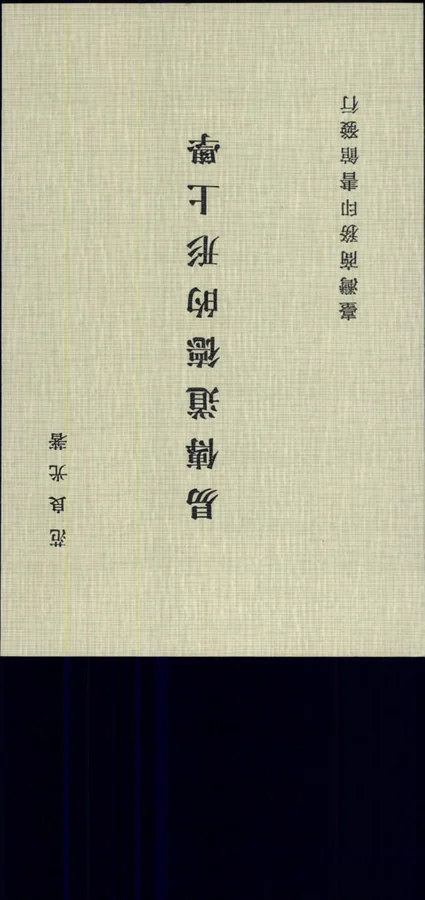
易傳道德的形上學
 76
76

易傳道德的形上學
Fan Liang-Kuang's 易傳道德的形上學 offers a dense, academic approach to the I Ching, moving past its common use as a divinatory tool to explore its metaphysical architecture. The book excels in its detailed exegesis of hexagrammatic relationships and their purported ethical implications, grounding abstract philosophical concepts in the I Ching's rich symbolism. A particular strength lies in its sustained argument for the I Ching as a comprehensive system of cosmic and moral order, a perspective that challenges more fragmented readings. However, the work's academic rigor can also be its limitation; the prose is often dense, requiring considerable concentration and prior knowledge of classical Chinese thought. The section on the metaphysical underpinnings of specific hexagrams, while illuminating, occasionally feels overly speculative without sufficient empirical grounding within the text itself. Ultimately, 易傳道德的形上學 is a valuable, albeit demanding, contribution for those seeking a philosophical rather than purely practical understanding of the Book of Changes.
📝 Description
76
Fan Liang-Kuang's 1990 work examines the metaphysical and ethical dimensions of the I Ching.
Published in 1990, 易傳道德的形上學 (Metaphysics of Yi-Chuan Morality) by Fan Liang-Kuang offers a detailed look at the philosophical foundations of the I Ching. The book moves beyond its use as a tool for divination to investigate how the hexagrams and their imagery represent cosmic principles and guide moral behavior. Fan Liang-Kuang seeks to connect the practical application of the I Ching with its deeper ethical and metaphysical meanings.
This text is aimed at serious students of Chinese philosophy and esoteric traditions who want a deeper understanding of the I Ching. It is particularly relevant for those studying the ethical and metaphysical systems that shaped East Asian thought. While readers familiar with Confucianism and Daoism will find connections, the book requires careful study of its arguments on the I Ching's structure and meaning. It does not serve as an introduction to divination techniques.
Fan Liang-Kuang's book emerged in a period of renewed academic and popular engagement with traditional Chinese thought after the Cultural Revolution. Unlike many popular works that focused on I Ching divination, 易傳道德的形上學 presented a more rigorous philosophical analysis. It connects to a scholarly tradition viewing the I Ching as a philosophical text, a lineage including figures like Zhu Xi. Published in 1990, it coincided with a global interest in ancient texts, distinct from Western esoteric movements.
💡 Why Read This Book?
• Gain a structured understanding of the I Ching's metaphysical framework, moving beyond simple divination to grasp its philosophical underpinnings as presented by Fan Liang-Kuang. • Explore the intrinsic link between cosmic principles and ethical conduct as articulated through the I Ching's hexagrams, offering a unique perspective on moral philosophy. • Appreciate the scholarly approach to classical Chinese texts, specifically Fan Liang-Kuang's 1990 work, which situates the I Ching within a lineage of profound philosophical inquiry.
⭐ Reader Reviews
Honest opinions from readers who have explored this book.
❓ Frequently Asked Questions
What is the primary focus of 易傳道德的形上學 by Fan Liang-Kuang?
The book focuses on the metaphysical and ethical dimensions of the I Ching (Book of Changes), interpreting its hexagrams and symbolism as a system for understanding cosmic order and moral conduct, rather than solely as a tool for divination.
When was 易傳道德的形上學 first published?
易傳道德的形上學 was first published in 1990 by Fan Liang-Kuang, reflecting a period of renewed academic interest in classical Chinese philosophies.
Is this book suitable for beginners learning to use the I Ching for divination?
No, this book is intended for advanced students and scholars of Chinese philosophy and esoteric traditions. It delves into complex metaphysical arguments rather than providing practical divination instructions.
What philosophical traditions does Fan Liang-Kuang engage with in his analysis of the I Ching?
The work engages with the philosophical tradition of viewing the I Ching as a profound text, echoing scholarly approaches similar to those seen in Confucianism and later interpretations by figures like Zhu Xi.
What does the title 易傳道德的形上學 translate to?
The title translates to 'Metaphysics of Yi-Chuan Morality,' indicating its focus on the philosophical underpinnings of the I Ching's ethical teachings.
Does the book discuss the Yin and Yang principles?
Yes, the book explores the dynamics of Yin and Yang as presented within the I Ching's structure and hexagrams, interpreting their interplay as fundamental to both cosmic order and ethical development.
🔮 Key Themes & Symbolism
Hexagrammatic Metaphysics
The work meticulously dissects the structure and relationships of the I Ching's 64 hexagrams, proposing that their symbolic arrangements are not arbitrary but represent fundamental metaphysical principles. Fan Liang-Kuang argues that understanding these interconnections reveals a cosmic blueprint that governs natural phenomena and human affairs. This systematic exploration aims to demonstrate how the sequence and composition of trigrams within hexagrams encode useful insights into universal laws and patterns, moving beyond simple divinatory correspondences.
Cosmic Order and Human Ethics
A core theme is the intrinsic connection between the perceived order of the cosmos (天, Tian) and the practice of human morality (德, De). The book posits that the I Ching, through its depiction of natural cycles and transformations, provides a framework for ethical living. By aligning human actions with these perceived universal rhythms and principles, individuals can achieve moral cultivation. This perspective suggests that ethical behavior is not merely a social construct but a natural consequence of understanding and participating in the cosmic harmony.
Symbolic Language of the I Ching
Fan Liang-Kuang emphasizes the I Ching's symbolic language as a vehicle for transmitting metaphysical and ethical truths. The imagery associated with each hexagram, the lines, and their interactions are interpreted as profound metaphors for fundamental realities. The book studies how these symbols, rooted in observations of nature and human experience, serve as a sophisticated system for philosophical inquiry. Understanding this symbolic lexicon is presented as key to unlocking the deeper wisdom encoded within the text.
The I Ching as a Philosophical System
This work champions the I Ching as a comprehensive philosophical system rather than solely an ancient divination manual. Fan Liang-Kuang situates the text within the broader intellectual history of China, arguing for its role in shaping ethical thought and metaphysical understanding. The book aims to re-establish the I Ching's significance as a source of wisdom for understanding existence and guiding conduct, drawing parallels with classical philosophical inquiries into the nature of reality and the good life.
💬 Memorable Quotes
Direct passages from the work, attributed to the author.
“Moral cultivation is not imposed, but discovered through understanding the patterns of Heaven.”
— This interpretation highlights the book's view that ethics are not external rules but inherent principles discoverable within the natural order. The I Ching, in this context, acts as a guide to perceiving these cosmic patterns and aligning oneself with them for virtuous living.
“Each line and symbol carries metaphysical weight, informing both the nature of reality and the way of man.”
— This statement emphasizes the profound significance attributed to the symbolic elements within the I Ching. It suggests that these symbols are not merely decorative but contain deep philosophical meaning relevant to understanding the universe and guiding human behavior.
“To comprehend the Yi is to comprehend the principles of moral action.”
— This concise idea expresses the book's core thesis: that deep study and understanding of the I Ching's philosophical structure inherently lead to an understanding of ethical principles and how to act virtuously.
💡 Key Ideas
Editorial paraphrase of the work's core concepts — not direct quotes.
The hexagram's structure mirrors the cosmic dance; alignment with this dance is the path of virtue.
This paraphrased concept suggests that the arrangement and interaction of the I Ching's hexagrams are seen as reflections of universal laws. Following these patterns, as understood through the text, is presented as the means to achieve ethical conduct and moral development.
The transformations of Yin and Yang within the hexagrams illustrate the dynamic equilibrium essential for existence.
This paraphrased concept points to the central role of Yin and Yang in the book's analysis. It suggests that the text uses the interplay of these forces, as depicted in the hexagrams, to explain the balance and change inherent in all things.
🌙 Esoteric Significance
Tradition
The work engages with the esoteric dimensions of the I Ching, a text foundational to Chinese philosophical and spiritual traditions. While not strictly aligning with Western esoteric lineages like Hermeticism or Kabbalah, it operates within the broader spectrum of wisdom literature that seeks to uncover universal principles. It interprets the I Ching as a cosmological and ethical system, a perspective shared by various esoteric traditions that seek to understand the macrocosm and its relation to the microcosm of human life.
Symbolism
Key symbols include the trigrams (☰ Qian, ☷ Kun, etc.) representing fundamental forces of Heaven, Earth, and human archetypes, and the hexagrams, which combine trigrams to depict complex situations and transformations. The dynamic interplay of Yin (☷) and Yang (☰) is central, symbolizing the complementary and ever-changing forces that govern the universe and human experience, which the text interprets as foundational to moral order.
Modern Relevance
Contemporary thinkers interested in comparative philosophy, ethics derived from natural law, and the philosophical underpinnings of traditional Chinese medicine or martial arts (like Yi Quan, which shares the 'Yi' character) might find resonance. The work's emphasis on cosmic principles informing ethical conduct appeals to those seeking holistic frameworks beyond purely secular or religious doctrines, influencing academic study and philosophical inquiry into ancient wisdom.
👥 Who Should Read This Book
• Scholars and advanced students of Chinese philosophy and comparative religion seeking rigorous metaphysical interpretations of the I Ching beyond divination. • Individuals interested in understanding the ethical frameworks embedded within classical Chinese cosmology and their philosophical basis. • Practitioners of esoteric traditions who wish to explore the conceptual architecture of foundational East Asian wisdom texts.
📜 Historical Context
Published in 1990, Fan Liang-Kuang's 易傳道德的形上學 emerged during a period of intellectual resurgence in China and increasing global interest in Eastern philosophies. Following the political upheavals of the mid-20th century, scholars and the public began re-engaging with classical texts like the I Ching. While popular culture often focused on its divinatory uses, Fan's work aimed for a deeper philosophical exegesis, aligning with a scholarly tradition that views the I Ching as a foundational text for understanding Chinese cosmology and ethics, a lineage traceable to Neo-Confucian thinkers like Zhu Xi. This academic approach distinguished it from contemporary Western esoteric movements that might have adopted Eastern ideas more syncretically. The book's reception was primarily within academic circles, contributing to the academic discourse on classical Chinese thought, rather than sparking widespread public debate or controversy.
📔 Journal Prompts
The hexagram's structure and its relationship to moral action.
Discovering cosmic patterns and their role in ethical living.
The metaphysical implications of Yin and Yang dynamics as presented in the text.
Interpreting the symbolic language of the I Ching for personal understanding.
Connecting the I Ching's philosophical system to contemporary ethical dilemmas.
🗂️ Glossary
I Ching (易經)
An ancient Chinese divination text and foundational philosophical work, also known as the Book of Changes. It consists of 64 hexagrams, each formed by six lines, used to interpret cosmic patterns and guide human conduct.
Hexagram
A figure composed of six stacked horizontal lines, each line being either Yang (unbroken line) or Yin (broken line). There are 64 unique hexagrams in the I Ching.
Trigram
A figure composed of three stacked horizontal lines, each being Yang or Yin. The eight trigrams (Bagua) form the building blocks of the 64 hexagrams.
Tian (天)
A fundamental concept in Chinese philosophy, often translated as Heaven. It represents the cosmic order, the natural universe, and a supreme guiding principle.
De (德)
A key concept in Chinese philosophy, typically translated as virtue, power, or moral character. It refers to the inner power or virtue gained through self-cultivation and alignment with the Dao or cosmic principles.
Yin and Yang
The dualistic principle of complementary opposites, fundamental to Chinese philosophy. Yin represents passive, dark, feminine qualities, while Yang represents active, light, masculine qualities. Their dynamic interaction underlies all phenomena.
Yi Zhuan (易傳)
The 'Commentaries' or 'Appended Explanations' of the I Ching, traditionally attributed to Confucius and his disciples. These commentaries provide philosophical and interpretive layers to the core text.
This book appears in 1 collection
🔮 Readers Also Liked
Browse all →







From the “I Ching” Collection
View all →








More Free Occult Philosophy Books
View all →