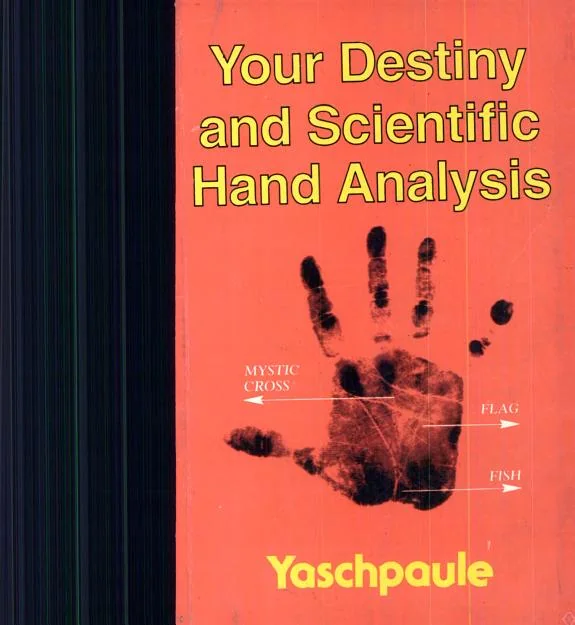
Your Destiny and Scientific Hand Analysis
 73
73

Your Destiny and Scientific Hand Analysis
Yaschpaule’s 1996 volume, 'Your Destiny and Scientific Hand Analysis,' is a deliberate attempt to inoculate palmistry against accusations of mere superstition. The author’s commitment to a methodical, diagram-heavy approach is commendable, particularly in detailing the correspondence between hand features and psychological profiles. A strength lies in its clear, step-by-step exposition, which genuinely aids the novice. However, the assertion of 'science' feels more like a rhetorical strategy than an established fact. While the book meticulously presents its system, it struggles to provide empirical evidence beyond internal consistency, a hurdle inherent in many divinatory arts. The section on the Life Line, for instance, illustrates a potential challenge: interpreting its length and breaks as definitive future markers, a practice that, while detailed, remains speculative. Ultimately, Yaschpaule offers a structured perspective on chiromancy, accessible and reasoned, but stopping short of genuine scientific validation.
📝 Description
73
### What It Is
'Your Destiny and Scientific Hand Analysis' by Yaschpaule presents palmistry not as arcane mysticism but as a rational, observable system. The author aims to demonstrate that the lines, mounts, and shapes of the hand are consistent indicators of character and potential future events. The book demystifies the subject, offering clear explanations and diagrams to support its arguments, making it accessible even to those with no prior acquaintance with esoteric practices. It asserts that hand analysis operates on discoverable principles, akin to natural sciences.
### Who It's For
This work is specifically crafted for the empirically minded individual, particularly those who identify as scientific skeptics. It is also intended for complete novices curious about hand analysis or astrology, requiring no foundational knowledge. The book seeks to bridge the gap between rigorous scientific inquiry and the symbolic language of chiromancy, offering a methodical introduction for the uninitiated and a reasoned defense for the doubtful. It caters to anyone seeking a logical framework for understanding self and destiny.
### Historical Context
Yaschpaule's treatise emerged in 1996, a period when the New Age movement had gained significant traction, yet a considerable intellectual chasm persisted between spiritual exploration and empirical validation. While figures like Carl Jung had begun exploring synchronicity and archetypes, bridging psychology and the symbolic, many occult practices remained relegated to the fringes of academic and public acceptance. This book positions itself against that backdrop, striving to legitimize hand analysis by framing its principles within a scientific, diagram-supported methodology, a stark contrast to more purely intuitive or tradition-bound approaches prevalent at the time.
### Key Concepts
The book introduces core chiromantic concepts such as the interpretation of major hand lines (Life, Head, Heart), the significance of hand mounts (Venus, Jupiter, Saturn, etc.), and the correlation between finger length and personality traits. It elaborates on how the texture, color, and flexibility of the hand also contribute to a holistic reading. Yaschpaule emphasizes the principle of consistency, suggesting that these physical markers are reliable predictors when analyzed systematically, offering a framework for understanding both inherent predispositions and potential life trajectories.
💡 Why Read This Book?
• Gain a systematic understanding of hand analysis principles, moving beyond anecdotal evidence. You'll learn to interpret the specific meanings of the Heart Line and Head Line as presented by Yaschpaule, offering concrete symbols for self-reflection. • Discover how to correlate physical hand characteristics, such as the mounts of Venus and Jupiter, with personality traits, providing a tangible framework for self-awareness as detailed in the book's diagrams. • Explore the author's argument for palmistry as a science, understanding the logical structure Yaschpaule employs to present the subject, which challenges conventional skepticism by focusing on consistent observable patterns.
⭐ Reader Reviews
Honest opinions from readers who have explored this book.
❓ Frequently Asked Questions
What makes 'Your Destiny and Scientific Hand Analysis' different from other palmistry books?
This book distinguishes itself by aiming to present hand analysis as a science, using simple language and numerous diagrams. Published in 1996, it specifically targets scientific skeptics and beginners, requiring no prior knowledge of esoteric subjects.
Is hand analysis presented as a factual science in this book?
Yaschpaule frames hand analysis as a science worthy of serious consideration, presenting its laws in a simple, illustrated manner. The book aims to convince the reader of its scientific basis through a methodical approach.
Who is the intended audience for Yaschpaule's book?
The book is designed for healthy, scientific-minded skeptics and individuals with no prior understanding of hand analysis or astrology. It requires no previous knowledge, making it accessible to a broad audience seeking to understand the subject.
What kind of information can I expect to find about destiny in hand analysis?
The book explains how the lines and features of the hand are presented as indicators of character and potential future events. It offers a systematic method for interpreting these physical markers to understand one's path.
Does the book require any special tools or prior study to understand?
No, 'Your Destiny and Scientific Hand Analysis' is intended for those who do not have the faintest concept of hand analysis. It requires no previous knowledge and is explained in a very simple manner, amply illustrated by diagrams.
When was 'Your Destiny and Scientific Hand Analysis' first published?
The book was first published in 1996, positioning it within the broader discourse on esoteric studies and their potential for empirical investigation during that era.
🔮 Key Themes & Symbolism
Chiromancy as Rational System
Yaschpaule's central thesis is that hand analysis operates on discernible, scientific principles rather than mere chance or superstition. The book meticulously breaks down the interpretation of hand lines, mounts, and shapes, presenting them as consistent indicators of character and life patterns. By employing diagrams and a straightforward explanatory style, the author seeks to validate chiromancy as a discipline worthy of empirical consideration, moving it from the realm of folklore into a more structured, observable framework.
Accessible Esoteric Knowledge
A significant aim of this work is to democratize access to esoteric knowledge. Yaschpaule explicitly targets individuals with no prior exposure to hand analysis or astrology, ensuring the language and concepts are simplified. This approach makes the book a gateway for the scientifically minded skeptic, offering a gentle introduction to the symbolic language of the hand without requiring a leap of faith into established mystical traditions. The focus is on logical progression and visual aids.
Destiny and Determinism
The book explores the concept of destiny as it can be read in the palm. It posits that the physical characteristics of the hand—its lines, creases, and texture—hold clues to an individual's inherent predispositions, talents, challenges, and potential life trajectory. While not strictly deterministic, the analysis presented suggests a strong correlation between hand markings and life events, offering a framework for understanding how one's 'destiny' might be symbolically represented and potentially understood through systematic observation.
💬 Memorable Quotes
“The laws of scientific hand analysis are presented here in a very simple manner, and are amply illustrated by diagrams.”
— This statement encapsulates the book's core objective: to demystify palmistry by presenting its principles clearly and visually. It signals an intent to make the subject accessible and logically demonstrable, appealing to those who prefer empirical evidence and structured learning.
“This book is also intended for those who do not have the faintest concept of what hand analysis or astrology is all about, so that no previous knowledge is required for its understanding.”
— This highlights the author's commitment to beginner accessibility. It assures potential readers that the complex subject matter will be introduced from a foundational level, removing barriers for newcomers curious about esoteric studies.
“This book is designed to convince the healthy and scientific-minded sceptic that hand analysis is a science worthy of serious consideration.”
— This directly states the book's persuasive goal: to bridge the gap between skepticism and belief in palmistry by presenting it through a scientific lens. It targets a specific audience seeking rational explanations for esoteric phenomena.
“The subject of hand analysis has been presented here in a scientific manner.”
— This interpretation emphasizes the author's approach, asserting that the exposition of hand analysis adheres to scientific methods and principles. It's a claim designed to lend credibility and encourage a more objective reception of the material.
“The laws of scientific hand analysis are presented here in a very simple manner.”
— This paraphrased concept underscores the book's pedagogical strategy. It suggests that complex chiromantic principles are broken down into easily digestible components, supported by visual aids for enhanced comprehension.
🌙 Esoteric Significance
Tradition
This work aligns with the Western esoteric tradition that seeks to find correspondences between the microcosm (human being) and the macrocosm (universe). While not explicitly rooted in Hermeticism or Kabbalah, it shares the hermetic principle of 'As Above, So Below' by correlating physical human form with inner states and potential destiny. Its emphasis on systematic analysis and empirical observation, however, departs from more purely mystical or Gnostic traditions, aiming for a rationalist interpretation within the broader esoteric landscape.
Symbolism
Key symbols include the major hand lines: the Life Line (vitality, physical health), the Head Line (intellect, mental patterns), and the Heart Line (emotions, relationships). The various 'mounts' (fleshy pads at the base of fingers and palm) like Mount Venus (love, passion) and Mount Jupiter (ambition, leadership) are also central. Yaschpaule interprets these as symbolic representations of psychological energies and life forces, providing a visual lexicon for understanding human nature.
Modern Relevance
Yaschpaule's attempt to bridge scientific inquiry with esoteric practice continues to influence contemporary discussions. Modern self-help and personal development spheres, which often incorporate psychological profiling and self-discovery tools, find resonance with this book's systematic approach. Thinkers and practitioners exploring the intersection of psychology, symbolism, and personal growth, particularly those who favor structured methodologies over purely intuitive ones, may draw from its foundational principles.
👥 Who Should Read This Book
• Individuals identifying as scientific skeptics interested in esoteric subjects: This book offers a structured, diagram-heavy approach to palmistry, aiming to validate it as a rational system, appealing to those who require logical explanations. • Absolute beginners to palmistry and astrology: As the book requires no prior knowledge, it serves as an accessible entry point into understanding hand analysis, demystifying its core concepts without jargon. • Comparative religion and philosophy students: Those studying different systems of divination and their historical attempts at rationalization will find this work a case study in legitimizing esoteric practices within a scientific framework.
📜 Historical Context
Published in 1996, 'Your Destiny and Scientific Hand Analysis' emerged during a period of burgeoning interest in New Age spirituality, yet also a time when empirical validation remained a significant hurdle for many esoteric practices. While thinkers like Fritjof Capra were exploring the intersection of physics and mysticism in works like 'The Tao of Physics' (1975), and Jungian psychology was gaining traction, fields like palmistry often struggled for academic respectability. Yaschpaule's book directly confronted this by framing chiromancy as a 'science,' employing diagrams and systematic explanations to appeal to a rationalist mindset. This approach stood in contrast to more intuitive or purely tradition-based methods of palmistry. The book aimed to legitimize the practice by presenting its findings as observable and logically consistent, a strategy that resonated with those seeking to reconcile spiritual inquiry with a scientific worldview, even if its claims were debated by traditional scientific communities.
📔 Journal Prompts
The interpretation of the Head Line and its variations.
How the Mount of Venus is depicted as an indicator of emotional capacity.
The author's presentation of the Life Line's significance.
The role of hand shape in determining core personality traits.
The systematic approach to correlating hand features with destiny.
🗂️ Glossary
Chiromancy
The practice of fortune-telling or discerning character and future events through the study of the palm of the hand. It involves analyzing lines, mounts, and other features.
Mounts
The fleshy, raised areas on the palm, named after classical gods (e.g., Mount Venus, Mount Jupiter). Each mount is traditionally associated with specific personality traits, desires, or potentials.
Life Line
A major crease on the palm, typically running from near the thumb in a semicircle towards the wrist. It is traditionally interpreted as relating to vitality, physical health, and major life events.
Head Line
Another prominent line on the palm, usually running horizontally across the middle of the palm. It is interpreted as representing mental faculties, intellect, thinking patterns, and communication style.
Heart Line
A line that typically runs horizontally across the upper palm, below the fingers. It is associated with emotional life, romantic relationships, and how one expresses affection.
Scientific Hand Analysis
A term used by Yaschpaule to describe palmistry when presented with a methodical, diagrammatic, and logically consistent framework, aiming to be considered a science.
Skeptic
An individual who doubts or questions accepted opinions or beliefs, particularly those concerning empirical evidence and scientific validity.