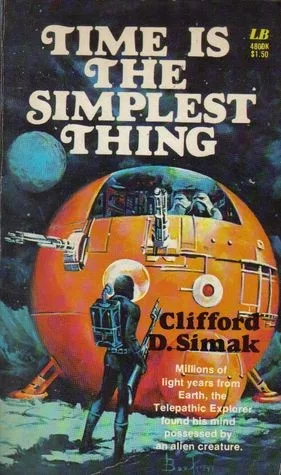
Time Is the Simplest Thing
 75
75

Time Is the Simplest Thing
Simak's exploration of temporal perception in "Time Is the Simplest Thing" offers a gentle yet persistent challenge to our assumptions about reality. The novella’s strength lies in its understated prose and its ability to imbue seemingly simple scenarios with deep philosophical weight. The concept of time as a subjective construct, rather than a rigid framework, is particularly well-handled, allowing for a quiet contemplation of existence. However, the narrative’s deliberate pacing, while effective for its thematic exploration, might feel slow to readers accustomed to more plot-driven science fiction. A standout passage involves the character's evolving understanding of a non-human entity's temporal experience, revealing a profound disconnect that simultaneously highlights both isolation and a shared cosmic mystery. "Time Is the Simplest Thing" succeeds as a contemplative piece on the nature of being.
📝 Description
75
### What It Is
Clifford D. Simak's "Time Is the Simplest Thing" is a speculative fiction novella that, despite its 2017 publication date, grapples with concepts of temporal perception and existential consciousness. It presents a narrative framework where the passage of time is not a linear, immutable constant but a malleable construct influenced by awareness and perspective. The story often employs a quiet, reflective tone, characteristic of Simak's later works, focusing on the internal landscapes of his characters as much as their external circumstances.
### Who It's For
This work is suited for readers of philosophical science fiction who appreciate nuanced character studies and abstract explorations over action-driven plots. Those interested in the nature of consciousness, the subjective experience of reality, and the philosophical implications of advanced or altered states of perception will find fertile ground here. It appeals to those who enjoy Simak's signature blend of gentle melancholy and profound questioning about humanity's place in the cosmos.
### Historical Context
While "Time Is the Simplest Thing" was published in 2017, its thematic concerns echo Simak's earlier explorations in works like "City" (1952). The novella reflects a long-standing interest in the philosophical underpinnings of science fiction, a genre that saw significant intellectual growth throughout the mid-to-late 20th century. Simak, alongside contemporaries such as Isaac Asimov and Robert A. Heinlein, helped shape the genre's capacity for exploring complex societal and philosophical issues, moving beyond simple adventure narratives.
### Key Concepts
The central tenet revolves around the relativity of time, suggesting it is not an objective measurement but a subjective experience. The narrative explores how advanced consciousness or unique perspectives can alter one's relationship with temporal flow. Other concepts include the nature of alien intelligences, the cyclical versus linear progression of existence, and the quiet dignity of beings facing vast, indifferent universes. The story implicitly questions whether linear progression is the only valid mode of existence.
💡 Why Read This Book?
• Gain an understanding of subjective temporality as explored in Simak's narrative, offering a different lens than linear physics. • Experience the philosophical implications of non-human consciousness interacting with human perception of time, as depicted in the interactions with alien entities. • Contemplate the existential quietude Simak evokes, contrasting with the often-bombastic tone of contemporary science fiction, particularly in his depiction of the vastness of space and time.
⭐ Reader Reviews
Honest opinions from readers who have explored this book.
❓ Frequently Asked Questions
What is the publication history of Clifford D. Simak's "Time Is the Simplest Thing"?
Clifford D. Simak's "Time Is the Simplest Thing" was first published in 2017. This publication date marks a later point in Simak's extensive career, allowing for reflection on themes he had explored throughout his decades of writing speculative fiction.
Does "Time Is the Simplest Thing" feature complex scientific concepts?
The novella focuses more on philosophical and existential concepts related to time and consciousness rather than hard scientific explanations. It uses speculative ideas to explore the subjective experience of temporality.
What are the main themes in "Time Is the Simplest Thing"?
The primary themes include the subjective nature of time, the diversity of consciousness, existential reflection, and humanity's place in a vast universe. The narrative questions linear progression as the sole mode of existence.
Is Clifford D. Simak considered a classic science fiction author?
Yes, Clifford D. Simak is widely recognized as a significant author in the golden age of science fiction. His works, including "City" and "Way Station," are noted for their humanism and philosophical depth.
How does "Time Is the Simplest Thing" compare to Simak's earlier works?
While sharing Simak's characteristic gentle tone and focus on humanism, "Time Is the Simplest Thing" delves into more abstract concepts of temporal perception, perhaps reflecting a mature author's contemplation of existence.
What kind of reader would enjoy "Time Is the Simplest Thing"?
Readers who appreciate philosophical science fiction, character-driven narratives, and explorations of consciousness and existential themes would likely find this novella engaging.
🔮 Key Themes & Symbolism
Subjective Temporality
The novella posits that time is not an objective, universal constant but a construct deeply intertwined with consciousness. This concept challenges the reader's everyday perception, suggesting that different beings, or even the same being under altered states, might experience temporal flow differently. Simak uses this idea to explore the isolation and connection between disparate forms of intelligence, where perceived time becomes a barrier or a bridge. The work invites contemplation on whether our linear experience is the only valid one, hinting at cyclical or simultaneous existences beyond our normal grasp.
Existential Isolation
Characters within "Time Is the Simplest Thing" often grapple with a profound sense of isolation, stemming not only from physical distance but from fundamental differences in perception, particularly concerning time. This theme is amplified when encountering alien intelligences whose temporal experiences are vastly divergent from human norms. The narrative evokes a quiet melancholy, exploring the human condition against the backdrop of an immense, indifferent cosmos where understanding and connection are rare commodities. It questions whether true communion is possible across such existential divides.
The Nature of Awareness
Central to the novella is an exploration of what constitutes awareness and how different levels or types of consciousness might interact with reality. Simak suggests that the richness of one's inner life or the unique structure of one's mind can fundamentally alter one's perception of existence and the passage of time. The narrative implicitly argues that awareness is not merely passive reception but an active force shaping subjective reality. This focus on internal states over external action is a hallmark of Simak's later, more introspective science fiction.
Humanity's Cosmic Place
The work reflects on humanity's position within the grander scheme of the universe, often portraying humans as small, perhaps transient, beings contemplating vast, ancient forces. Simak avoids anthropocentric narratives, instead placing human concerns within a much larger, often incomprehensible, cosmic context. The story encourages a humbling perspective, suggesting that our understanding of existence is limited and that other forms of life and consciousness may hold keys to different realities. This perspective fosters a sense of awe and quiet wonder about the unknown.
💬 Memorable Quotes
“Time is what happens when the universe is not paying attention.”
— This quote suggests a philosophical perspective where the conventional flow of time is an emergent property arising from cosmic inattention. It implies that when consciousness or fundamental forces are fully engaged, the linear progression we perceive might cease or transform.
“The universe is full of things that have no name, and will never have.”
— This highlights the limits of human language and conceptualization in understanding the totality of existence. It points to the vastness of the unknown and the inherent difficulty in categorizing or comprehending phenomena that lie outside our current frame of reference.
“They did not measure time; they lived it.”
— This paraphrased concept speaks to a non-linear or deeply integrated experience of temporality, contrasting with the human habit of quantifying and segmenting existence. It suggests a state of being where time is perceived as a continuous flow rather than discrete units.
“Loneliness is a space between stars.”
— This evocative metaphor links existential isolation to the physical vastness of the cosmos. It suggests that the feeling of being alone is not just an emotional state but a fundamental aspect of existence within an immense and largely empty universe.
“The simplest things are the hardest to understand.”
— This statement points to a paradox where fundamental concepts, like the passage of time itself, elude easy comprehension. It suggests that the most basic elements of reality may be the most complex and mysterious upon deeper examination.
🌙 Esoteric Significance
Tradition
While not explicitly aligned with a single esoteric lineage, Simak's work often touches upon themes resonant with Hermeticism and Gnosticism, particularly the idea that perceived reality is a limited or illusory construct. The focus on subjective experience and the search for deeper understanding of existence mirrors Gnostic quests for hidden knowledge. The exploration of consciousness as a primary reality-building force also aligns with certain strands of Western esotericism that emphasize the power of the mind. However, Simak's approach is grounded in speculative fiction rather than ritual or direct mystical practice.
Symbolism
The concept of 'time' itself functions as a primary symbol, representing not just chronological progression but the very fabric of perceived reality and consciousness. 'Vast, empty spaces' symbolize existential isolation and the incomprehensible scale of the cosmos, against which individual consciousness struggles for meaning. 'Non-human intelligences' act as symbols for alternative modes of being and perception, challenging anthropocentric views and representing the potential for radically different forms of awareness that transcend human limitations.
Modern Relevance
Contemporary thinkers in consciousness studies and transhumanism might find resonance in Simak's speculative explorations of altered states and non-human awareness. His gentle critique of anthropocentrism and his emphasis on the subjective nature of reality align with postmodern philosophical inquiries and certain interpretations of quantum physics that suggest observer-dependent realities. Furthermore, writers and artists exploring themes of existentialism, alienation, and the search for meaning in a seemingly indifferent universe continue to draw inspiration from Simak's nuanced approach to these profound questions.
👥 Who Should Read This Book
• Readers interested in philosophical science fiction who appreciate contemplative narratives over fast-paced action. • Students of consciousness studies and existentialism seeking fictional explorations of subjective reality and awareness. • Fans of classic science fiction authors like Ray Bradbury and Arthur C. Clarke who value thoughtful inquiry into humanity's place in the cosmos.
📜 Historical Context
Published in 2017, "Time Is the Simplest Thing" arrived decades after Clifford D. Simak cemented his reputation as a master of contemplative science fiction. His earlier works, such as the Hugo Award-winning "City" (1952), explored themes of post-humanism and the quiet evolution of existence. The era of "Time Is the Simplest Thing's" publication saw a continued interest in philosophical SF, though trends often leaned towards cyberpunk or space opera. Simak’s approach, characterized by its gentle humanism and focus on abstract concepts like consciousness and temporal perception, stood in contrast to the more technologically deterministic narratives prevalent at the time. While not directly engaging with contemporaries like Ursula K. Le Guin, who also explored profound philosophical questions in SF, Simak’s work maintained a unique, introspective voice. His consistent exploration of man's place in the universe, often through the lens of rural settings or quiet contemplation, offered an enduring alternative to more aggressive or overtly political science fiction narratives.
📔 Journal Prompts
The concept of subjective temporality as experienced by the characters.
Reflections on the symbolic meaning of vast, empty spaces.
The nature of awareness in non-human intelligences presented.
Consider the paradox: 'The simplest things are the hardest to understand.'
Humanity's position within the cosmic scale depicted.
🗂️ Glossary
Subjective Temporality
The philosophical concept that an individual's perception and experience of the passage of time are unique and can differ significantly from objective, chronological measurement.
Existential Isolation
A profound sense of aloneness and detachment arising from the perceived meaninglessness or indifference of the universe and the difficulty of genuine connection with others.
Non-human Intelligence
Forms of consciousness or sentience that do not originate from or conform to human biological and cognitive structures.
Cosmic Scale
The vastness of the universe in terms of size, age, and the sheer number of celestial bodies and potential phenomena, often used to contextualize human existence.
Linear Progression
The concept of time moving forward in a straight line, from past to present to future, as opposed to cyclical, simultaneous, or non-sequential models of existence.
Malleable Construct
Something that can be shaped or altered, implying that time, in this context, is not a fixed entity but can be influenced or changed.
Awareness
The state or ability to perceive, feel, or be conscious of events, objects, or sensory patterns; a fundamental aspect of subjective experience.