The second coming of Christ

 82
82

The second coming of Christ
Paramahansa Yogananda's 'The Second Coming of Christ' offers a perspective that challenges conventional Christian eschatology by reframing Jesus's role through an Eastern spiritual lens. The work's strength lies in its ambitious attempt to synthesize the teachings of Jesus with the yogic path to enlightenment, presenting Christ as an avatar embodying universal divine consciousness. Yogananda's interpretation of Jesus's miracles, for instance, is often explained through psychic and spiritual powers attainable through advanced yogic practice, particularly the control of 'prana' or life force. This approach, while potentially jarring for traditionalists, provides a compelling framework for those seeking to reconcile their Christian faith with broader spiritual philosophies. However, the book's singular focus on Yogananda's interpretation can sometimes feel like a closed system, where evidence is consistently filtered through the yogic paradigm. A more critical engagement with alternative scholarly or theological viewpoints is notably absent. The passage discussing Jesus's interactions with his disciples, detailing Kriya Yoga initiations, exemplifies this fusion, offering a unique, albeit specific, understanding of spiritual transmission. Ultimately, Yogananda's work provides a profound spiritual commentary for those open to a non-dualistic Christology rooted in Eastern mysticism.
📝 Description
82
Published posthumously in 1984, Yogananda's 'The Second Coming of Christ' reinterprets Jesus through yogic philosophy.
Paramahansa Yogananda's 'The Second Coming of Christ' offers his unique perspective on Jesus's life and teachings, viewed through the framework of yogic principles and Eastern spirituality. The book was published in 1984, after Yogananda's death. It does not function as a historical account but instead provides a spiritual interpretation. The aim is to show the universal truths within Jesus's message, presenting him as an avatar and a master of hidden knowledge.
This work is for those who desire a mystical and deeper appreciation of Jesus Christ, moving beyond standard religious explanations. It will appeal to readers interested in comparing different religions, especially where Christianity intersects with traditions like Yoga and Vedanta. Those already familiar with Yogananda's writings or the Self-Realization Fellowship will recognize his characteristic style and viewpoint. The book also speaks to individuals investigating the idea of divine consciousness and its human embodiment, irrespective of their own religious background.
Yogananda, a key figure in bringing Kriya Yoga to the West, developed this interpretation from his extensive lectures. 'The Second Coming of Christ' follows his influential 'Autobiography of a Yogi'. The book emerged as New Age thought was growing, providing a Christian lens that also embraced universal themes. It sought to connect Western and Eastern spiritual ideas, offering a path for those exploring alternative spiritualities.
💡 Why Read This Book?
• Gain insight into Yogananda's unique interpretation of Jesus's teachings, understanding Christ as an embodiment of divine consciousness accessible through yogic science, as detailed in the early chapters. • Explore the concept of 'Kriya Yoga' as a method for spiritual realization, presented as a universal path that Yogananda believed Jesus himself taught, offering a practical, internal approach to divinity. • Discover a comparative spiritual perspective that bridges Christian theology with Eastern philosophies, particularly relevant when Yogananda discusses the universality of salvation across different faiths.
⭐ Reader Reviews
Honest opinions from readers who have explored this book.
❓ Frequently Asked Questions
When was Paramahansa Yogananda's 'The Second Coming of Christ' first published?
Paramahansa Yogananda's 'The Second Coming of Christ' was first published in 1984, several decades after his passing in 1952, compiled from his extensive lectures and writings.
What is the main purpose of Yogananda's 'The Second Coming of Christ'?
The book's primary aim is to present Jesus Christ as an avatar of universal divine consciousness and to reveal the underlying yogic principles within his teachings, bridging Eastern and Western spiritual traditions.
Does 'The Second Coming of Christ' offer a traditional Christian theological view?
No, it offers a distinct interpretation through the lens of yogic philosophy and Eastern mysticism, viewing Jesus's teachings and life through concepts like Kriya Yoga and divine omnipresence.
Who was Paramahansa Yogananda?
Paramahansa Yogananda (1893-1952) was an Indian guru who brought the teachings of Kriya Yoga to the Western world, founding the Self-Realization Fellowship.
What is Kriya Yoga as discussed in the book?
Kriya Yoga, as presented by Yogananda, is an advanced meditation technique focused on controlling life force (prana) to accelerate spiritual evolution and achieve direct communion with God.
Is this book suitable for someone new to Yogananda's teachings?
While accessible, prior familiarity with Yogananda's 'Autobiography of a Yogi' or Self-Realization Fellowship principles can enhance understanding of the specific yogic terminology and concepts presented.
🔮 Key Themes & Symbolism
Christ Consciousness as Universal
The work posits that Jesus embodied the Christ Consciousness, not as a singular divine entity, but as an example of the omnipresent divine intelligence accessible to all. Yogananda interprets Jesus's life and teachings as a demonstration of how to realize this universal awareness through spiritual discipline. This concept reframes the 'second coming' not as a future event, but as an ongoing potential for humanity to awaken to its inherent divinity, aligning with yogic ideals of self-realization.
Yogic Science of Jesus's Teachings
A central theme is the assertion that Jesus's miracles, parables, and spiritual insights are deeply rooted in the science of Yoga. Yogananda explains phenomena like divine manifestations and Jesus's ability to heal through yogic principles such as pranayama (breath control) and the mastery of subtle energies. The book suggests that Jesus taught Kriya Yoga, a specific meditation technique, to his disciples, thereby offering a path to direct experience of God through internal practices.
Avataric Manifestation
Yogananda presents Jesus within the framework of the 'avatar' concept, a being who descends to Earth to guide humanity. This perspective emphasizes Jesus's role as a spiritual teacher and exemplar, not solely divine in the traditional Western sense, but a perfected soul who demonstrates the highest human potential. The book explores the idea that avatars appear throughout history to re-establish spiritual truths, with Jesus being a paramount example for the current age.
Unity of Religions
Underlying the interpretation of Jesus's message is the theme of religious unity. Yogananda argues that the core truths taught by Jesus are universal and are echoed in other spiritual traditions, particularly those originating in India. The book seeks to show that the esoteric teachings of Christianity, when understood through a yogic lens, are fundamentally compatible with Vedanta and other paths to enlightenment, promoting a holistic view of spirituality.
💬 Memorable Quotes
Direct passages from the work, attributed to the author.
“The Christ is not a person but a consciousness.”
— This expresses Yogananda's central thesis: Christ is an omnipresent divine intelligence, a state of being that Jesus Christ, as an avatar, perfectly embodied and taught humanity how to attain through spiritual practice.
“The Bible is a book of Yoga.”
— This statement highlights Yogananda's perspective that the Christian scriptures, when interpreted through yogic principles, reveal profound techniques for spiritual realization and direct experience of God, aligning biblical narratives with Eastern practices.
“The kingdom of heaven is within you.”
— This well-known saying of Jesus is presented by Yogananda as a direct reference to the inner spiritual realms and the potential for divine consciousness residing within every individual, achievable through meditation and self-awareness.
“Jesus taught Kriya Yoga to his disciples.”
— This interpretation suggests that Jesus's spiritual instructions included advanced techniques akin to Kriya Yoga, emphasizing that his teachings were not just theological but also practical methods for achieving spiritual liberation and communion with God.
“Miracles are the result of mastery over prana.”
— Yogananda explains Jesus's miraculous acts not as supernatural events, but as demonstrations of profound control over life force (prana), a concept central to yogic philosophy, suggesting that such abilities are latent within all humans.
🌙 Esoteric Significance
Tradition
This work firmly sits within the Neo-Vedanta and Kriya Yoga traditions, as transmitted by Paramahansa Yogananda and his lineage. It draws heavily on the Advaita Vedanta philosophy of non-duality and the practical yogic methods of Raja Yoga, specifically the Kriya Yoga system. While presented through the lens of Christian scripture, its underlying metaphysical framework—the nature of consciousness, the path to liberation, and the concept of God realization—is distinctly yogic and Vedantic, seeking to reveal the universal principles common to all great religions from this specific viewpoint.
Symbolism
The book engages with Christian symbolism by reinterpreting it through a yogic lens. The 'cross' can symbolize the material body and the five ascending planes of consciousness (represented by the four limbs and the vertical axis). 'Water' often represents the subtle astral energies or the purifying force of spiritual awareness. The 'dove' is frequently associated with the Holy Ghost, understood as the divine vibration or cosmic sound (Om) that initiates creation and spiritual awakening, a concept central to yogic cosmology.
Modern Relevance
Contemporary spiritual seekers, particularly those interested in the intersection of Eastern and Western mysticism, continue to draw from Yogananda's work. Thinkers and practitioners in the fields of comparative religion, consciousness studies, and integral spirituality often reference his synthesis. Schools of thought that emphasize meditation as a path to understanding divine nature, such as various modern yoga and mindfulness movements, echo the practical methodologies he advocated, seeking to find universal spiritual truths applicable to modern life.
👥 Who Should Read This Book
• Students of comparative religion seeking to understand how Eastern spiritual philosophies can illuminate Western religious figures and texts. • Practitioners of Yoga and meditation interested in exploring the potential esoteric connections between their practices and the teachings of Jesus Christ. • Individuals on a spiritual quest who are drawn to a non-dualistic understanding of divinity and seek to reconcile Christian faith with universal spiritual principles.
📜 Historical Context
Paramahansa Yogananda, a disciple of Swami Sri Yukteswar Giri, was instrumental in bringing the teachings of Kriya Yoga to the West, beginning his mission in the United States in 1920. His book 'Autobiography of a Yogi' (1946) achieved widespread acclaim, popularizing Indian spiritual thought. 'The Second Coming of Christ' was published posthumously in 1984, compiled from his extensive lectures and writings delivered over decades. This period saw a burgeoning interest in Eastern religions and mysticism, fueled by figures like Aldous Huxley and the Beat Generation's engagement with Zen Buddhism and Vedanta. Yogananda's work offered a unique synthesis, presenting a Christian narrative through an Eastern, yogic framework. This approach contrasted with both traditional Western theological interpretations and the more secular philosophical explorations of Eastern thought prevalent at the time. While figures like Swami Prabhupada were establishing Hare Krishna centers and other gurus were focusing on meditation, Yogananda's unique bridge-building resonated with a segment of Western seekers looking for spiritual depth within familiar cultural contexts, though it also faced skepticism from orthodox religious scholars.
📔 Journal Prompts
The Christ Consciousness as an omnipresent reality.
Interpreting Jesus's miracles through the lens of Kriya Yoga.
The 'kingdom of heaven' as an internal state of being.
Reflections on the avataric nature of spiritual teachers.
Universal truths underlying the world's great religions.
🗂️ Glossary
Avatar
In Hindu tradition, a divine being or a perfected soul who descends to Earth to guide humanity. Yogananda applies this concept to Jesus Christ, viewing him as an embodiment of divine consciousness sent to reveal spiritual truths.
Christ Consciousness
The omnipresent divine intelligence or cosmic consciousness that permeates all creation. Yogananda posits that Jesus Christ perfectly manifested this consciousness and taught others how to attain it.
Kriya Yoga
An advanced yogic meditation technique focused on controlling life force (prana) through specific breathing exercises and mental focus, aimed at accelerating spiritual evolution and achieving union with the divine.
Prana
The vital life force or energy that sustains all living beings. In yogic philosophy, control over prana is central to physical health, mental clarity, and spiritual development.
Self-Realization Fellowship (SRF)
An organization founded by Paramahansa Yogananda in 1920 to disseminate his teachings on Kriya Yoga and spiritual science worldwide.
Vedanta
A school of Hindu philosophy based on the Upanishads, emphasizing the underlying unity of existence and the ultimate reality of Brahman. Yogananda's teachings are deeply rooted in Advaita (non-dual) Vedanta.
Om
The primordial cosmic sound or vibration, often considered the audible creative force of God in yogic and Hindu traditions. It represents the manifestation of the Absolute into the relative universe.
🔮 Readers Also Liked
Browse all →









More by Yogananda Paramahansa
All books →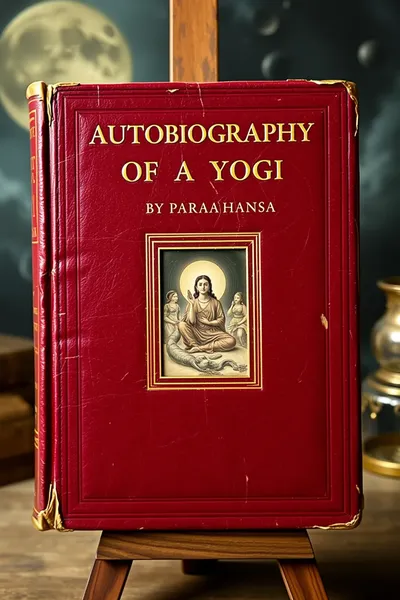





More Free Occult Philosophy Books
View all →