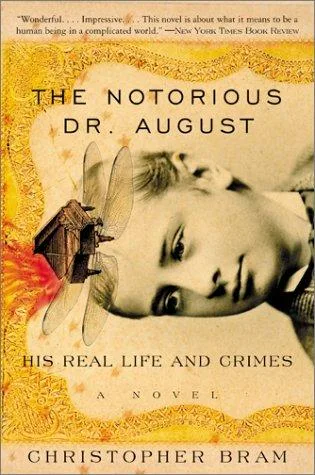
The Notorious Dr. August
 83
83

The Notorious Dr. August
Christopher Bram’s "The Notorious Dr. August" offers a meticulously researched, if somewhat reserved, portrait. Bram excels at situating his subject within his historical milieu, painting a vivid picture of the intellectual currents of the time without resorting to anachronistic interpretations. The novel’s strength lies in its detailed evocation of the period and the complex social webs its protagonist navigated. However, the narrative occasionally suffers from a certain narrative distance; the reader feels more like an observer of Dr. August’s life than an intimate participant. A particularly compelling aspect is the depiction of August's interactions with his patrons, highlighting the delicate balance of power and intellectual exchange. Despite its measured pace, the book provides a solid, if not overtly dramatic, exploration of a fascinating historical character. It’s a competent, scholarly piece of historical fiction.
📝 Description
83
### What It Is Christopher Bram's "The Notorious Dr. August," first published in 2000, presents a fictionalized account rooted in biographical details of a historical figure. The narrative explores the life and impact of a man whose intellectual and personal dealings reverberated through certain circles. It is not a straightforward biography but a literary exploration of a persona and his influence.
### Who It's For This work will appeal to readers interested in historical fiction that touches upon the fringes of intellectual and social movements. It's suited for those who appreciate character-driven narratives and an examination of how individuals can shape discourse, even when operating outside conventional societal structures. Readers familiar with figures who bridged academia and more unconventional pursuits may find particular interest.
### Historical Context Bram's novel emerges from a literary landscape in 2000 that was increasingly looking towards biographical fiction to re-examine historical figures. It follows in a tradition of authors who fictionalize the lives of intellectuals, artists, and occultists to explore their legacies. The early 21st century saw renewed interest in figures operating in the liminal spaces between established science and esoteric thought, a trend "The Notorious Dr. August" taps into.
### Key Concepts The book engages with themes of reputation versus reality, the nature of influence, and the construction of a public (or semi-public) persona. It examines how knowledge is disseminated, the role of patronage, and the potential for individuals to cultivate significant followings through charisma and specialized learning. The narrative also touches upon the societal reception of unconventional ideas and their proponents during the period it covers.
💡 Why Read This Book?
• Understand the dynamics of intellectual patronage in the late 19th century, as Bram details the financial and social support systems enabling figures like Dr. August. • Grasp the social positioning of unconventional thinkers of the era, examining how figures like August operated outside mainstream academic or scientific institutions. • Analyze the construction of personal reputation in the face of societal skepticism, a key element explored through August's public and private life.
⭐ Reader Reviews
Honest opinions from readers who have explored this book.
❓ Frequently Asked Questions
Is "The Notorious Dr. August" based on a real person?
Yes, the novel draws heavily from the life of Dr. John Dee, a prominent Elizabethan mathematician, astronomer, occultist, and advisor to Queen Elizabeth I. Bram fictionalizes Dee's experiences and influence.
What historical period does the book primarily cover?
The book focuses on the Elizabethan era, specifically the latter half of the 16th century, a period of significant scientific inquiry and esoteric exploration in England.
What is the significance of Dr. August's relationship with Queen Elizabeth I?
In the context of the historical figure John Dee, his relationship with Queen Elizabeth I was crucial. He served as her advisor, providing counsel on matters ranging from navigation to statecraft, and his standing with the monarch granted him considerable influence.
Does the book explore alchemy or other occult practices?
Yes, the work delves into the esoteric interests of its protagonist, including his studies in astrology, alchemy, and other mystical traditions prevalent during the Renaissance.
When was "The Notorious Dr. August" first published?
Christopher Bram's novel "The Notorious Dr. August" was first published in the year 2000.
What kind of research is evident in the novel?
The book demonstrates extensive research into the life of John Dee, his contemporaries, the scientific and magical theories of the 16th century, and the political climate of Elizabethan England.
🔮 Key Themes & Symbolism
The Scholar and the Court
The narrative examines the precarious position of intellectuals like Dr. August who sought patronage from royal courts. It highlights the constant negotiation between intellectual pursuits, the demands of political favor, and the maintenance of personal integrity. The book illustrates how figures in such positions often had to balance their esoteric research with the pragmatic needs of their patrons, revealing the inherent tensions in serving both knowledge and power during the Elizabethan era.
Reputation and Esotericism
A central theme is how figures engaged in esoteric studies were perceived by their contemporaries and how they managed their public image. Dr. August's reputation is shown to be a complex construct, influenced by both genuine scholarly achievement and the societal fascination with, and suspicion of, occult knowledge. The work explores how the pursuit of hidden wisdom could lead to both admiration and ostracism, particularly in the context of late 16th-century England.
Dissemination of Knowledge
The book touches upon the methods by which knowledge, particularly unconventional or esoteric knowledge, was shared and preserved during its historical setting. It presents Dr. August not just as a practitioner but as a conduit for ideas, engaging in correspondence and building collections. This theme reflects on the limited channels available for scholarly exchange in the 16th century and the challenges of maintaining scholarly networks.
The Alchemical Mindset
The novel engages with the alchemical worldview prevalent in the Renaissance, presenting it not merely as a primitive form of chemistry but as a holistic philosophy. It shows how the principles of transformation and hidden correspondences, central to alchemy, informed Dr. August's approach to both natural philosophy and his personal life. This perspective offers insight into a mode of thinking that sought unity and hidden meaning in the cosmos.
💬 Memorable Quotes
“His library was a sanctuary, a place where the world’s complexities could be ordered through the careful arrangement of texts.”
— This highlights the intellectual's reliance on structured knowledge as a means of understanding and control, suggesting that the physical organization of books mirrored a desire for mental and cosmic order.
“The Queen’s favor was a delicate bloom, requiring constant tending and the avoidance of any frost that might threaten its survival.”
— This metaphor illustrates the precariousness of royal patronage. It emphasizes the need for careful political maneuvering and the avoidance of controversial actions or associations that could jeopardize one's standing with the monarch.
“He sought not just to observe the stars, but to understand their silent language, the celestial influence they exerted upon earthly affairs.”
— This speaks to the Renaissance belief in astrology and the interconnectedness of the cosmos and human life. It differentiates astronomical observation from a deeper, esoteric engagement with celestial mechanics.
“The alchemical process was a mirror to the soul’s own purification, a transmutation of base elements into spiritual gold.”
— This paraphrase captures the spiritual dimension of alchemy, moving beyond mere material transformation to suggest a path of personal and spiritual refinement, where inner change parallels outward processes.
“To speak of hidden arts was to invite suspicion, yet to ignore them was to leave a significant part of nature’s truth undiscovered.”
— This presents the central dilemma faced by occult practitioners of the era. It underscores the conflict between societal condemnation of esoteric knowledge and the scholar's drive to explore all facets of the natural world.
🌙 Esoteric Significance
Tradition
The work aligns with the Hermetic and Neoplatonic traditions prevalent in Renaissance Europe. Dr. August, like his historical counterpart John Dee, embodies the scholar-mystic archetype. This tradition emphasizes the belief in a divinely ordered cosmos, accessible through both rational inquiry and spiritual illumination. The novel explores how these ancient philosophies intersected with the burgeoning empirical investigations of the period, reflecting a worldview that saw correspondences between the celestial, terrestrial, and spiritual realms.
Symbolism
Key symbols include the library, representing the ordering of knowledge and the containment of potentially dangerous wisdom; the celestial spheres, signifying divine order and astrological influence; and alchemical apparatus, embodying the transformative processes sought in both matter and spirit. These symbols collectively point to a universe understood through hidden connections and divine patterns, central to Renaissance esoteric thought.
Modern Relevance
Contemporary practitioners of Western Esotericism, particularly those interested in Renaissance magic, Hermeticism, and the history of science, often draw inspiration from figures like John Dee. The novel's exploration of the scholar-occultist role remains relevant for those who seek to integrate intellectual rigor with spiritual or mystical pursuits in a modern context, navigating the often-skeptical reception of such endeavors.
👥 Who Should Read This Book
• Students of Renaissance intellectual history looking to understand the practical applications and social contexts of esoteric studies in the 16th century. • Readers interested in biographical fiction that delves into the lives of influential historical figures who operated at the intersection of science, politics, and mysticism. • Individuals curious about the historical development of occult traditions and how figures like Dr. August contributed to the discourse on magic and natural philosophy.
📜 Historical Context
Christopher Bram's "The Notorious Dr. August," published in 2000, revisits the intellectual ferment of Elizabethan England, a period marked by both burgeoning scientific inquiry and deep engagement with esoteric traditions. The novel is situated within a literary trend that sought to re-examine figures straddling the lines between Renaissance humanism and what would later be termed the occult. Contemporaries of the historical figure John Dee, upon whom Dr. August is based, included Francis Bacon, who himself experimented with scientific methodology, and William Shakespeare, whose works often explored complex human psychology and philosophical themes. The era was characterized by a worldview where magic, science, and religion were not as rigidly separated as they are today. Dee’s own extensive work, particularly his mathematical treatises and his engagement with angelic communication, placed him in a unique position, one often met with both fascination and apprehension. The reception of such figures and their work was complex, influenced by religious upheaval and the Crown’s need for reliable counsel.
📔 Journal Prompts
The ordering of Dr. August's library as a reflection of his mind.
Analyze the tension between seeking royal favor and pursuing forbidden knowledge.
Consider the societal perceptions of esoteric practitioners in the late 16th century.
Reflect on the concept of celestial influence on earthly affairs as depicted.
Examine the alchemical metaphor for personal transformation within the narrative.
🗂️ Glossary
Hermeticism
A religious, philosophical, and esoteric tradition based primarily upon writings attributed to Hermes Trismegistus. It posits a divine cosmos and emphasizes the interconnectedness of all things, often involving practices like alchemy and astrology.
Neoplatonism
A philosophical system derived from Plato's philosophy, particularly his later dialogues. It emphasizes the ascent of the soul towards the divine One, often incorporating mystical and ethical elements.
Alchemy
An ancient tradition of chemical philosophy and spiritual practice, aimed at purification, perfection, and the transmutation of base metals into noble ones, often understood as a metaphor for spiritual development.
Astrology
The study of the movements and relative positions of celestial bodies interpreted as having an influence on human affairs and the natural world.
Patronage
The support, encouragement, privilege, or financial aid that an organization or individual bestows on an artist, institution, or scholar. In the Renaissance, it was crucial for intellectual and artistic endeavors.
Natural Philosophy
The historical term for the study of nature that preceded the development of modern science. It encompassed what we would now consider physics, chemistry, biology, and geology, often intertwined with metaphysics.
Renaissance Humanism
An intellectual movement during the Renaissance that focused on human potential and achievements, drawing inspiration from classical antiquity and emphasizing reason, ethics, and education.