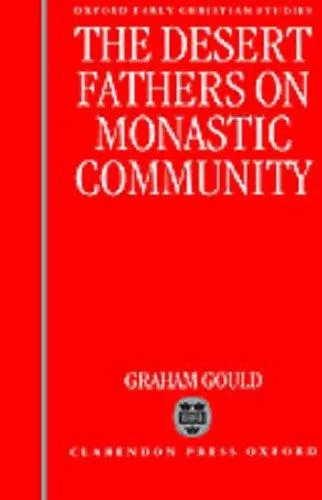
The desert fathers on monastic community
 78
78

The desert fathers on monastic community
Gould's rigorous analysis of the desert fathers' communal experiments provides a vital corrective to romanticized notions of early asceticism. He deftly unpacks the pragmatic challenges and innovative solutions these hermits developed for living together in the harshness of the Egyptian desert. A particular strength lies in his detailed examination of Pachomian monasticism, showcasing its structured, almost bureaucratic, approach to spiritual discipline. The work's limitation, perhaps inherent to its scholarly focus, is a relative sparseness of direct engagement with the mystical experiences that fueled these communities; the emphasis remains firmly on structure and sociology. The discussion of the *diabolos* as a force within the community, manifesting as internal strife or external temptation, offers a stark look at their adversarial spiritual landscape. This is an indispensable, if dry, exploration of monastic foundations.
📝 Description
78
### What It Is Graham Gould's "The Desert Fathers on Monastic Community" examines the formative period of Christian monasticism, specifically the lives and organizational structures of early ascetics in the Egyptian desert. Published initially in 1993, the work moves beyond simplistic hagiography to analyze the practical realities of communal living among these pioneers.
### Who It's For This study is essential for scholars of early Christianity, religious history, and those interested in the philosophical underpinnings of communal living. It appeals to readers seeking to understand the roots of Western contemplative traditions and the practical application of ascetic ideals.
### Historical Context The book emerges from a period of renewed academic interest in early Christian history and monastic origins. Gould's work situates the desert fathers, figures like Antony the Great and Pachomius, within the broader late antique world, a time of significant religious and social flux in the Roman Empire. It contrasts with purely theological interpretations by focusing on the socio-economic and organizational aspects of their settlements.
### Key Concepts Gould explores concepts such as the 'apophatic' (negative theology) as it informed their ascetic practices, the development of the 'rule' or structured way of life, and the psychological dynamics of enclosed communities. The pursuit of *hesychia* (stillness or quietude) and the struggle against *logismoi* (thoughts or demonic suggestions) are central to understanding their daily existence and the communal structures designed to support this spiritual warfare.
💡 Why Read This Book?
• Understand the organizational genius behind early Christian communes, learning how figures like Pachomius established rules and structures to foster spiritual discipline in the Egyptian desert around the 4th century. • Explore the practicalities of *hesychia* (stillness) and the ascetic methods used to combat *logismoi* (demonic thoughts), gaining insight into the disciplined mindset required for communal spiritual growth. • Grasp the socio-historical context of late antiquity, recognizing how the desert fathers' communities responded to Roman societal shifts and established precedents for later Western contemplative orders.
⭐ Reader Reviews
Honest opinions from readers who have explored this book.
❓ Frequently Asked Questions
What historical period does "The Desert Fathers on Monastic Community" primarily cover?
The book focuses on the 4th century CE, the formative era of Christian monasticism in the Egyptian desert, detailing the lives and organizational principles of early ascetics like Antony the Great and Pachomius.
Who were the key figures discussed in relation to monastic community formation?
Graham Gould extensively discusses figures such as Antony the Great, often considered the father of Christian monasticism, and Pachomius, who is credited with establishing the first structured, communal monastic settlements (coenobia).
What does the term 'apophatic' mean in the context of the desert fathers?
Apophatic refers to a negative theology or approach that emphasizes what God is *not*, rather than what God is. For the desert fathers, this often translated into ascetic practices aimed at emptying the self and transcending conceptual understanding.
How did the desert fathers view internal struggles or negative thoughts?
They viewed internal struggles, termed *logismoi*, as akin to demonic suggestions or temptations that needed to be actively combatted through prayer, vigilance, and communal support within their structured environments.
What is 'hesychia' as practiced by the desert fathers?
Hesychia is a Greek term meaning stillness or quietude. For the desert fathers, it represented a state of profound spiritual peace achieved through ascetic discipline, prayer, and detachment from worldly distractions.
What is the significance of Pachomius in the history of monasticism?
Pachomius is significant for developing the first organized monastic communities, or coenobia, in the early 4th century. He established rules, communal living arrangements, and a hierarchical structure for monks living together.
🔮 Key Themes & Symbolism
The Genesis of Communal Asceticism
Gould meticulously traces the evolution from solitary hermitages to structured monastic settlements. He highlights how the practical needs of shared life—food, shelter, prayer schedules—necessitated the development of rules and leadership, moving beyond individualistic austerity. This shift, particularly evident in Pachomian foundations, demonstrates an early attempt to institutionalize spiritual discipline within a communal framework, laying groundwork for future monastic orders.
Spiritual Warfare and Psychological Discipline
The book examines the desert fathers' intense focus on combating inner demons, or *logismoi*. Gould details how communal living was often seen as a crucible for this struggle, where external support and shared vigilance aided the individual's fight against temptation and distraction. This emphasis on psychological self-mastery through rigorous practice and communal accountability is a core tenet explored.
The Quest for Hesychia in Community
Central to the desert fathers' ethos was the pursuit of *hesychia*, or stillness. Gould illustrates how the structured environment of the monastery, despite its communal demands, was designed to facilitate this inner quietude. The text explores the paradox of seeking solitude within a community, achieved through shared prayer, regulated work, and a collective turning away from the profane world.
Organizational Innovation in Austerity
This work reveals the surprising administrative and organizational prowess of early monks. Figures like Pachomius were not merely ascetics but also practical leaders who devised systems for managing resources, assigning tasks, and maintaining order among large groups. Gould's analysis underscores how these early communities were laboratories for social and spiritual organization.
💬 Memorable Quotes
“The desert fathers developed communal rules to manage daily life and foster spiritual discipline.”
— This paraphrase highlights the practical necessity behind the ascetic movement's shift towards organized living. It emphasizes that structure and rules were not an afterthought but integral to the pursuit of their spiritual goals in a shared context.
“Antony the Great is often seen as a foundational figure for Christian monasticism.”
— This statement underscores Antony's pivotal role in the early development of the monastic tradition. His life and example, even if initially solitary, inspired the formation of later, more organized communities.
“The struggle against *logismoi* was a constant concern for desert monks.”
— This captures the internal dimension of asceticism, focusing on the disciplined mental and spiritual battle required. It suggests that monastic life was as much about inner conflict resolution as it was about external austerity.
“Pachomius established the first structured coenobia, or communal monasteries.”
— This points to a specific, verifiable organizational innovation attributed to Pachomius, marking a significant departure from earlier eremitical (solitary) forms of monasticism and setting a precedent for communal living.
“The pursuit of *hesychia*, or stillness, was a primary aim.”
— This emphasizes the ultimate spiritual goal of the desert fathers. It suggests that the disciplined, often harsh, communal lifestyle was a means to achieve a profound state of inner peace and contemplative union.
🌙 Esoteric Significance
Tradition
While rooted in early Christianity, the desert fathers' practices hold significant resonance within esoteric traditions focused on inner transformation and spiritual discipline. Their emphasis on self-mastery, the rigorous purification of the mind, and the pursuit of direct spiritual experience aligns with Hermetic, Gnostic, and later mystical lineages that seek union with the divine through internal work rather than solely external ritual.
Symbolism
The desert itself serves as a potent symbol of spiritual desolation and purification – a place stripped bare where the soul confronts its true nature and divine presence. The *logismoi* (errant thoughts) represent the psychic debris and karmic patterns that must be purged. The communal structure, paradoxically, symbolizes the integrated self, where different facets of the psyche (disciplined thought, prayerful awareness) work in concert under a higher will.
Modern Relevance
Contemporary contemplative practices, mindfulness movements, and even certain therapeutic approaches to psychological well-being echo the desert fathers' techniques for mental discipline and emotional regulation. Thinkers in the field of transpersonal psychology and those exploring secularized forms of monasticism draw inspiration from their methods for achieving inner peace and focused awareness in a chaotic world.
👥 Who Should Read This Book
• Students of early Christian history and comparative religion seeking a factual account of monastic origins beyond devotional narratives. • Practitioners of contemplative spirituality interested in the historical roots of ascetic discipline, mental prayer, and communal spiritual formation. • Scholars of ancient social structures and organizational development looking at innovative models of community building in challenging environments.
📜 Historical Context
Graham Gould's work emerges from the late 20th-century academic landscape, a period marked by robust scholarship on late antiquity and early Christian movements. Following foundational works by figures like Henri Leclercq and studies on the Nag Hammadi library, interest in non-canonical Christian traditions and the social history of early Christianity was high. Gould's focus on the practical, organizational aspects of desert monasticism offers a counterpoint to purely theological or hagiographical accounts prevalent earlier. His analysis of Pachomian communities, for instance, engages with the socio-economic realities of the time, a context shaped by the Roman Empire's transition and the rise of new religious expressions. While not directly engaging in polemics, his work implicitly addresses earlier, more romanticized views of asceticism by grounding it in the tangible challenges of communal life. The period saw scholars like Peter Brown exploring the social world of late antiquity, providing a rich backdrop for Gould's specific focus.
📔 Journal Prompts
The practicalities of communal life for Pachomian monks.
The nature of *logismoi* as experienced by the desert fathers.
The symbolic meaning of the desert in early Christian asceticism.
The role of rules and structure in achieving *hesychia*.
Antony the Great's influence on the concept of monastic community.
🗂️ Glossary
Apophatic
Relating to negative theology; an approach to understanding God or the divine by emphasizing what it is *not*, rather than what it is, to avoid limiting concepts.
Asceticism
A lifestyle characterized by severe self-discipline and abstinence from all forms of indulgence, typically for religious or spiritual reasons.
Coenobia
Communities of monks living together under a common rule and leadership, as distinguished from hermitages or solitary monastic dwellings.
Desert Fathers
Early Christian monks and hermits who lived primarily in the Scetis desert of Egypt in the 4th and 5th centuries, known for their spiritual wisdom and ascetic practices.
Hesychia
A Greek term meaning stillness, quietude, or tranquility; a central spiritual goal for many Eastern Orthodox mystics and desert fathers.
Logismoi
Greek term for thoughts, particularly those considered sinful, distracting, or demonic, which early monks were taught to combat.
Rule (of St. Pachomius)
A set of regulations and principles governing the life of monks within a community, aimed at fostering order, discipline, and spiritual growth.