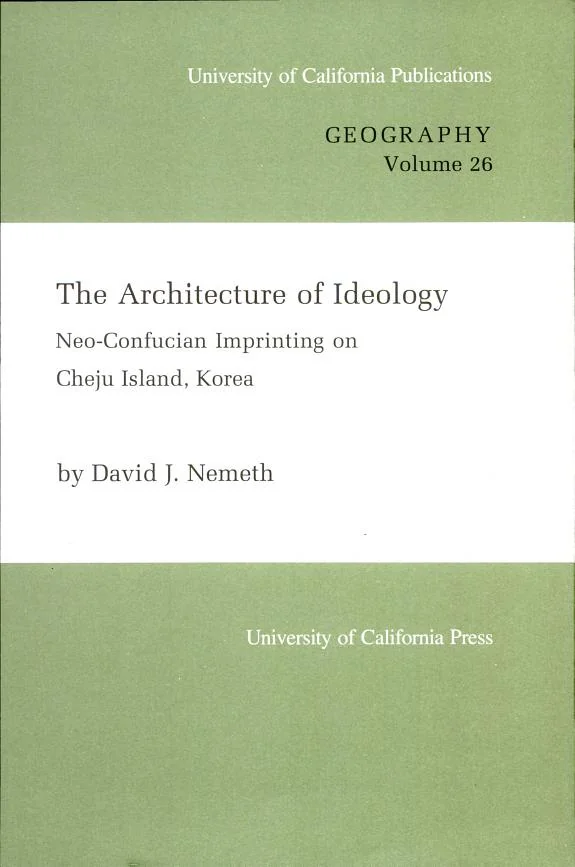
The Architecture of Ideology
 81
81

The Architecture of Ideology
David J. Nemeth’s *The Architecture of Ideology* offers a compelling reframing of Cheju Island’s historical development. By foregrounding the deliberate imposition of Yi dynasty Neo-Confucian ideology onto the island’s landscape, Nemeth effectively dismantles the idea of Cheju as merely an 'island of exile' defined by natural hardship. The book's strength lies in its meticulous linkage of abstract political philosophy to concrete spatial planning. The section detailing how surveying practices, informed by cosmological principles, were used to shape settlements is particularly illuminating, demonstrating a practical application of abstract thought. A limitation, however, is the density of the theoretical framework, which may require readers to engage in supplementary reading to fully grasp the nuances of Yi dynasty Neo-Confucianism. The argument that the island's built environment and quality of life were actively conserved through sustained political commitment is well-supported. Ultimately, this is a significant contribution to understanding the materialization of ideology.
📝 Description
81
### What It Is The Architecture of Ideology examines how state ideology, specifically Neo-Confucianism during Korea's Yi dynasty (1392-1910), actively shaped the built environment and perceived habitability of Cheju Island. The author challenges the notion of Cheju as inherently undesirable by demonstrating the deliberate application of cosmological principles, akin to feng-shui, to organize its landscape and settlements. This work analyzes the material manifestations of political and philosophical commitments.
### Who It's For This text is for scholars and enthusiasts of East Asian history, urban planning, architectural theory, and the sociology of knowledge. It will appeal to those interested in how abstract belief systems become embedded in physical space and influence human settlement patterns. Readers seeking to understand the intersection of governance, ideology, and environmental design will find value here.
### Historical Context The book situates its analysis within the Yi dynasty, a period marked by the dominance of Neo-Confucianism as the state ideology. This intellectual framework, emphasizing order, hierarchy, and the harmonious relationship between humanity and the cosmos, provided the conceptual scaffolding for state actions. The period saw significant developments in surveying and cartography, enabling the systematic application of principles like those employed on Cheju.
### Key Concepts The central argument revolves around the concept of 'ideology as architecture,' where abstract belief systems are translated into tangible structures and spatial arrangements. The work explores how Cheju Island, often viewed negatively, was deliberately engineered as a viable habitat through the application of principles mirroring feng-shui. This involved not just physical construction but the creation of a social and political landscape designed to align with Neo-Confucian ideals of order and harmony.
💡 Why Read This Book?
• Learn how Yi dynasty Neo-Confucian state ideology (1392-1910) actively engineered Cheju Island’s built environment and habitability, moving beyond simplistic geographical determinism. • Understand the practical application of surveying techniques informed by cosmological principles, akin to feng-shui, in shaping human settlements and quality of life. • Gain insight into how abstract philosophical systems are translated into tangible urban and rural planning, revealing the deep connection between governance and spatial organization.
⭐ Reader Reviews
Honest opinions from readers who have explored this book.
❓ Frequently Asked Questions
What is the primary argument of The Architecture of Ideology regarding Cheju Island?
The book argues that Cheju Island's viability as a habitat was not merely a result of its natural environment but was actively constructed through the imposition of Yi dynasty Neo-Confucian state ideology, utilizing principles similar to feng-shui to shape its built environment.
What historical period does The Architecture of Ideology focus on?
The book primarily focuses on the Yi dynasty in Korea, which lasted from 1392 to 1910, a period characterized by the dominance of Neo-Confucianism as the state ideology.
How does the book connect ideology to physical space?
It demonstrates how Neo-Confucian ideals of order, hierarchy, and cosmic harmony were translated into tangible spatial planning and architectural decisions on Cheju Island, influencing settlement patterns and land use.
What role did surveying play in the island's development?
Surveying, informed by cosmological principles and Neo-Confucian thought, was a critical tool used to systematically organize Cheju Island's landscape, settlements, and infrastructure, thereby conserving its habitability.
Who is David J. Nemeth?
David J. Nemeth is the author of The Architecture of Ideology, a scholar who analyzes the intersection of ideology, history, and spatial planning, particularly within East Asian contexts.
What does the book suggest about Cheju Island's historical perception?
The book challenges the perception of Cheju Island as inherently a harsh or undesirable place, suggesting this view overlooks the deliberate efforts made by the Yi dynasty state to make it a viable habitat through ideological planning.
🔮 Key Themes & Symbolism
Ideology Embodied in Space
This theme explores the tangible manifestation of abstract political and philosophical systems within the physical landscape. The book details how Neo-Confucianism, as the dominant ideology of Korea's Yi dynasty, was not merely a set of abstract principles but a directive force that actively shaped the built environment of Cheju Island. Through deliberate planning and the application of surveying techniques influenced by cosmological beliefs, the state translated its worldview into roads, settlements, and land use, demonstrating how ideological frameworks become inscribed upon the territory.
Cheju Island as Engineered Habitat
Contrary to prevailing negative perceptions of Cheju Island as a place of exile and harsh conditions, this theme highlights the island's intentional development as a viable habitat. The work posits that the Yi dynasty, through its state ideology, employed sophisticated methods, including feng-shui-like surveying, to organize and conserve the island's resources and settlement patterns. This perspective shifts the focus from natural determinism to human agency, emphasizing the role of political will and ideological commitment in creating and maintaining habitable environments.
Neo-Confucianism and Spatial Order
This theme examines the specific influence of Neo-Confucianism on the spatial organization of Cheju Island during the Yi dynasty (1392-1910). The text elucidates how core Neo-Confucian tenets—such as hierarchy, balance, and the pursuit of cosmic harmony—were translated into concrete architectural and urban planning strategies. The application of surveying science to align settlements with cosmological principles is presented as a direct consequence of this ideological imperative, revealing a deep connection between philosophical thought and the material construction of society.
The Science of Surveying and Ideological Control
The book underscores the critical role of surveying as both a scientific practice and an instrument of ideological control. During the Yi dynasty, advancements in surveying techniques enabled the state to systematically map and manage territory, including remote areas like Cheju Island. This technical capability, when coupled with Neo-Confucian ideology, allowed for the deliberate imposition of order and the creation of a built environment that reflected and reinforced state power and philosophical ideals. The work illustrates how scientific tools can be harnessed to serve ideological ends.
💬 Memorable Quotes
“The island’s perceived deficiency was, in fact, a canvas for ideological construction.”
— This statement encapsulates the core argument: Cheju Island's environmental challenges were not simply endured but were actively addressed and framed by the ruling ideology, becoming the basis for deliberate planning and development.
“Yi dynasty state ideology did not merely govern people; it sculpted their environment.”
— This highlights the active, physical impact of Neo-Confucianism, suggesting that its influence extended beyond social and political structures to directly mold the physical landscape and built world of the populace.
“Cosmological surveying became a method for conserving habitability.”
— This points to the practical application of what might be considered esoteric knowledge (cosmological principles) through systematic surveying, demonstrating its instrumental role in maintaining and improving living conditions on the island.
“The built environment reflects sustained political commitment to a guiding philosophy.”
— This interpretation emphasizes that the physical structures and organization of space are not accidental but are enduring evidence of a state's dedication to a particular ideology and its vision for society.
“Cheju Island’s development challenged its status as solely an 'island of exile'.”
— This suggests that the deliberate planning and construction on Cheju, driven by state ideology, actively worked against its historical designation, creating a more complex reality than its reputation implied.
🌙 Esoteric Significance
Tradition
While not explicitly aligned with a single Western esoteric lineage, *The Architecture of Ideology* engages with principles resonant in traditions that seek cosmic harmony and order. Its examination of feng-shui and the application of cosmological surveying connects to Hermetic and Taoist concepts of aligning human endeavors with natural and celestial patterns. The work bridges the esoteric concern for universal order with the pragmatic application of state power and urban planning.
Symbolism
The book implicitly engages with the symbolism of order and balance inherent in Neo-Confucianism and feng-shui. The deliberate arrangement of settlements, roads, and potentially even agricultural fields on Cheju Island can be seen as symbolic acts, representing the imposition of a rational, hierarchical, and harmonious cosmic order onto the physical world. The island itself, as a site of exile, becomes a symbol of the state's power to transform perceived negative spaces into ordered, functional territories.
Modern Relevance
Contemporary urban planning, critical geography, and studies of cultural landscapes continue to draw on methodologies that analyze the intersection of ideology and spatial form. Scholars exploring the impact of political systems on urban development, the role of belief systems in shaping environments, and the critical analysis of historical planning practices find Nemeth's work relevant. It informs discussions on how power structures manifest spatially and how seemingly natural environments are often the product of deliberate cultural and ideological interventions.
👥 Who Should Read This Book
• Scholars of East Asian history and sociology interested in the material impact of Neo-Confucianism beyond social structures. • Urban planners and architectural theorists examining the influence of ideology on built environments and settlement patterns. • Students of comparative religion and philosophy seeking concrete examples of how cosmological beliefs are translated into practical governance and landscape design.
📜 Historical Context
Published in 1987, David J. Nemeth's *The Architecture of Ideology* emerged during a period of increasing academic interest in the relationship between culture, power, and the built environment. The book's focus on Yi dynasty Korea (1392-1910) places it within scholarship examining the enduring influence of Neo-Confucianism on East Asian societies. This era was characterized by a complex interplay of state-sponsored ideology and practical governance, with significant developments in cartography and surveying contributing to state control. While not directly engaging with a specific contemporary scholar in the text, Nemeth’s work implicitly participates in broader debates about Orientalism and the interpretation of non-Western urbanism, challenging simplistic narratives of development. The intellectual climate of the late 20th century was increasingly open to analyzing how abstract belief systems, such as Confucianism and its cosmological underpinnings, could be translated into material realities, moving beyond purely political or economic explanations of historical change.
📔 Journal Prompts
The deliberate shaping of Cheju Island's built environment by Yi dynasty ideology.
Cosmological surveying as a tool for conserving habitability.
Challenging the 'island of exile' perception through ideological construction.
The translation of Neo-Confucian principles into spatial order.
How state ideology actively sculpts the physical environment.
🗂️ Glossary
Yi dynasty
The Korean dynasty that ruled from 1392 to 1910, during which Neo-Confucianism was the dominant state ideology and heavily influenced governance and culture.
Neo-Confucianism
A revived form of Confucianism that became the dominant state ideology in Korea during the Yi dynasty, emphasizing ethics, social hierarchy, and the harmonious integration of humanity with the cosmos.
Cheju Island
Korea's largest island, historically known as a place of exile, which the book examines as a site where state ideology actively shaped its habitability and built environment.
Feng-shui
An ancient Chinese philosophical system concerning the harmonization of human existence with the surrounding environment, often applied to the placement and design of buildings and settlements. The book uses it as an analogue for surveying principles applied on Cheju.
Cosmological surveying
The practice of surveying and planning based on principles derived from a specific understanding of the cosmos and its perceived order, as applied by the Yi dynasty on Cheju Island.
Built environment
The human-made surroundings that provide the setting for human activity, ranging in scale from buildings to parks to neighborhoods and cities.
Ideology
A system of ideas and ideals, especially one which forms the basis of economic or political theory and policy, which the book argues was actively translated into physical structures.