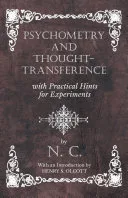
Psychometry and Thought-Transference with Practical Hints for Experiments - With an Introduction by Henry S. Olcott
 79
79

Psychometry and Thought-Transference with Practical Hints for Experiments - With an Introduction by Henry S. Olcott
N. C.'s "Psychometry and Thought-Transference" offers a fascinating glimpse into an early attempt to systematize psychic investigation. The inclusion of Henry S. Olcott's introduction grounds the work within the Theosophical milieu, lending historical weight to its claims. A particular strength lies in the detailed experimental suggestions, which, despite their age, demonstrate a serious effort to apply scientific rigor to subjective phenomena. However, the work occasionally lapses into an earnestness that overlooks potential psychological biases, a common pitfall in early psychical research. The discussion on "Discovery of Psychometry" provides a clear, if dated, overview of how the concept gained traction. It's a valuable historical document for understanding the intellectual landscape of psychic exploration.
📝 Description
79
### What Psychometry Entails This volume investigates psychometry, the alleged capacity to discern information about a person or object through tactile contact with associated inanimate items. It details various methodologies and examines historical instances, offering practical guidance for conducting experiments. The work contextualizes these phenomena within the scientific and psychological frameworks prevalent at the time of its original conception.
### Who Should Explore This Text Individuals interested in the history of parapsychology, early psychic research, and alternative epistemologies will find this book particularly relevant. It caters to those curious about the potential for non-sensory perception and the methods developed to explore such claims, including skeptics looking to understand historical perspectives and practitioners seeking foundational knowledge.
### Thematic Threads and Historical Roots The book traces the origins and development of psychometric practices, exploring its perceived fascination, safety protocols, and ease of application. It situates the subject within a broader discourse on psychic phenomena, referencing its connection to spiritualism and the burgeoning interest in the mind's latent capabilities during the late 19th and early 20th centuries.
### Practical Experimentation and Analysis Central to the text is a pragmatic approach to experimental design. It provides 'Practical Hints for Experiments,' suggesting methods for individuals to test psychometric abilities themselves. This focus on empirical exploration, however rudimentary by modern standards, underscores the authors' intent to move beyond mere speculation toward verifiable observation.
💡 Why Read This Book?
• Learn about the foundational concepts of psychometry as explored in the late 19th/early 20th century, including the specific "Discovery of Psychometry" section, to understand its historical emergence. • Gain practical, albeit vintage, techniques for conducting psychometric experiments by examining the "Practical Hints for Experiments" chapter, offering unique methodological insights. • Understand the historical context of psychic research by referencing Henry S. Olcott's introduction and its connection to the Theosophical Society's influence on early parapsychology.
⭐ Reader Reviews
Honest opinions from readers who have explored this book.
❓ Frequently Asked Questions
What is psychometry according to N. C.'s book?
Psychometry, as detailed in the book, is the purported ability to gain knowledge about a person or object by touching an inanimate item associated with them. It explores how impressions or information are supposedly imprinted on objects.
Who was Henry S. Olcott and why is his introduction important?
Henry S. Olcott was a co-founder and the first president of the Theosophical Society. His introduction lends historical and philosophical context, aligning the book's subject with the broader spiritual and philosophical inquiries of the late 19th century.
Does the book offer scientific evidence for psychometry?
The book attempts to reconcile psychometric claims with contemporary science and psychology of its era. While it presents methods for experimentation, it reflects the scientific understanding and limitations of its original publication period, rather than modern empirical validation.
What kind of experiments are suggested in 'Psychometry and Thought-Transference'?
The 'Practical Hints for Experiments' section outlines methods for individuals to test their psychometric abilities. These often involve handling personal items and attempting to glean information about their owners without prior knowledge.
When was 'Psychometry and Thought-Transference' originally published?
The original publication date is not explicitly stated in the provided details, but the current edition is dated December 1, 2020, indicating it's a modern reprint of an older work, likely from the late 19th or early 20th century given the context.
What is thought-transference as discussed in the book?
Thought-transference, alongside psychometry, refers to the alleged ability to transmit or receive thoughts directly from one mind to another, without the use of the ordinary senses. The book explores this as a related psychic phenomenon.
🔮 Key Themes & Symbolism
The Tactile Sense and Imprinted Information
This work posits that inanimate objects can retain an imprint or 'aura' from their associated individuals, which can be perceived through touch. The book details how this 'psychic residue' is believed to contain information about the object's history or owner. It explores the idea that the human nervous system, particularly through the hands, acts as a sensitive receiver for these subtle impressions, challenging conventional sensory limitations and suggesting a deeper connection between matter and consciousness.
Historical Case Studies in Psychic Phenomena
The text examines notable historical instances and anecdotal evidence related to psychometry and thought-transference. By referencing past occurrences and individuals who claimed these abilities, the author seeks to build a case for their existence and study. This approach situates the subject within a lineage of psychic exploration, drawing from spiritualist movements and early parapsychological investigations to demonstrate the persistent interest and reported manifestations of these phenomena.
Methodology for Psychic Experimentation
A significant portion of the book is dedicated to providing practical guidance for individuals wishing to explore psychometry and thought-transference through experimentation. It outlines specific techniques, precautions ('Safety and Ease of Pursuit'), and observational methods. This emphasis on empirical testing, even within the subjective realm, reflects an early attempt to apply systematic inquiry to esoteric subjects, encouraging readers to become active investigators rather than passive recipients of information.
Theosophical and Spiritualist Underpinnings
With an introduction by Henry S. Olcott, a prominent figure in the Theosophical Society, the book is implicitly linked to the spiritualist and esoteric currents of the late 19th and early 20th centuries. It engages with concepts prevalent in these movements, such as the nature of consciousness, unseen forces, and the potential for human psychic development, offering a framework for understanding these abilities within a broader spiritual cosmology.
💬 Memorable Quotes
“Its Fascination, Safety, and Ease of Pursuit”
— This phrase suggests the author's view that psychometry is not only intriguing but also accessible and safe for practitioners, framing it as a readily available faculty for exploration rather than a dangerous or overly complex discipline.
“Compiler's Preface”
— This indicates a section where the compiler or editor of the text explains their role in gathering and presenting the material, likely addressing the source of the information and their editorial approach to the subject matter.
“Discovery of Psychometry”
— This section title implies a historical account of how the concept and practice of psychometry first emerged or gained recognition, tracing its origins and early proponents.
“Its Fascination, Safety, and Ease of Pursuit”
— This suggests the author's perspective that psychometry is an engaging subject that can be explored without significant risk and is relatively straightforward to attempt, encouraging broader participation.
“Practical Hints for Experiments”
— This title highlights the book's focus on actionable advice, providing readers with concrete steps and guidance on how to conduct their own investigations into psychometric phenomena.
🌙 Esoteric Significance
Tradition
This work aligns closely with the Theosophical and broader Spiritualist traditions of the late 19th and early 20th centuries. It explores psychic faculties as inherent potentials within human consciousness, a concept central to Theosophy's teachings on spiritual evolution and latent human powers. It departs from purely materialistic scientific views by suggesting that information can be accessed through non-physical means, fitting within esoteric frameworks that posit interconnectedness and subtle energies.
Symbolism
While not heavily symbolic in a traditional esoteric sense, the 'object' in psychometry functions as a potent symbol. It represents a tangible link to the intangible – the human consciousness, memories, and experiences associated with it. The 'touch' itself becomes a symbolic act, a bridge between the physical and the psychic, facilitating the transfer of information that transcends ordinary sensory perception.
Modern Relevance
Contemporary practices in energy healing, intuitive development, and even some fringe psychological research echo the foundational ideas presented here. Modern intuitives and psychics who work with objects or people's belongings draw upon the same principles explored in this vintage text. It provides historical context for current discussions on consciousness, subtle energies, and the potential for non-local information transfer, relevant to fields like consciousness studies and parapsychology.
👥 Who Should Read This Book
• Students of late 19th/early 20th-century psychical research seeking primary source material on psychometry and telepathy. • Individuals interested in the historical intersection of spiritualism, Theosophy, and early parapsychology, particularly given Henry S. Olcott's contribution. • Those curious about historical methodologies for exploring psychic phenomena, offering a glimpse into early attempts at experimental design in esoteric fields.
📜 Historical Context
Published in an era marked by intense interest in spiritualism and the burgeoning field of psychical research, N. C.'s "Psychometry and Thought-Transference" emerged during a period when figures like Helena Blavatsky and Arthur Conan Doyle were popularizing the unseen world. The late 19th century saw numerous societies dedicated to investigating phenomena beyond conventional scientific understanding. Henry S. Olcott's involvement, as a key figure in the Theosophical Society founded in 1875, places this work firmly within that intellectual current. This was also a time when psychology was developing as a discipline, leading to attempts to reconcile psychic experiences with emerging theories of the mind, though often with differing methodologies. While scientific establishments remained largely skeptical, the public appetite for exploring telepathy and clairvoyance was substantial, fueled by mediums, séances, and publications that debated the limits of human perception.
📔 Journal Prompts
The 'Discovery of Psychometry' and its purported origins.
The 'Practical Hints for Experiments' and personal testing protocols.
Henry S. Olcott's introduction and its connection to Theosophical concepts.
The perceived 'Fascination, Safety, and Ease of Pursuit' of psychometric abilities.
The historical context of 'Thought-Transference' alongside psychometry.
🗂️ Glossary
Psychometry
The alleged ability to acquire information about a person or event by touching an object associated with them. It's based on the idea that objects can retain psychic impressions.
Thought-Transference
The direct transmission of thoughts or ideas from one mind to another without the use of the conventional senses; often used interchangeably with telepathy.
Theosophical Society
An organization founded in 1875 by Helena Blavatsky and others, dedicated to the study of comparative religion, philosophy, and science, and the investigation of the latent laws governing the universe and the latent powers in humanity.
Parapsychology
The study of alleged psychic phenomena and other paranormal claims, including precognition, telepathy, and psychokinesis, often attempting to apply scientific methods to these subjects.
Spiritualism
A religious movement based on the belief that the spirits of the dead living in the spirit world can communicate with living people, often through a medium. It gained significant popularity in the 19th century.
Aura
In esoteric traditions, a field of subtle energy surrounding a living being or object, believed to contain information about its state or history.
Latent Powers
Abilities or capacities that are present but not yet active or developed; in the context of the book, referring to psychic or intuitive faculties.