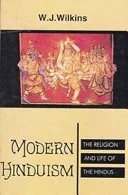
Modern Hinduism
 74
74

Modern Hinduism
Wilkins’s approach to "Modern Hinduism" is commendably systematic, dissecting a vast subject into digestible components. The strength lies in its clarity when explaining intricate philosophical schools like Advaita Vedanta. However, the sheer breadth attempted means that some areas, particularly the regional variations of folk Hinduism, feel somewhat compressed. The section discussing the impact of the Ramakrishna Mission, for instance, provides a solid overview but could benefit from more detailed case studies. For readers seeking an academic overview that avoids sensationalism, Wilkins delivers a valuable, if occasionally generalized, survey of Hindu traditions in the modern era.
📝 Description
74
### What It Is William Joseph Wilkins's "Modern Hinduism," first published in June 2002, offers a comprehensive examination of the diverse religious landscape of India. It moves beyond simplistic categorizations to explore the evolving nature of Hindu practices and philosophies.
### Who It's For This work is intended for students of comparative religion, scholars of South Asian studies, and individuals seeking a nuanced understanding of one of the world's oldest and most dynamic spiritual traditions. It is suitable for those with some foundational knowledge who wish to deepen their comprehension.
### Historical Context Published in the early 21st century, "Modern Hinduism" engages with academic discourse that had been evolving for decades, particularly influenced by scholars like F. Max Müller in the late 19th century who began to systematically translate and analyze Vedic texts. Wilkins's work builds upon this foundation, reflecting a later academic era grappling with post-colonial perspectives and the globalization of Indian religious thought.
### Key Concepts The book systematically breaks down complex ideas, addressing the vast pantheon of deities, the philosophical underpinnings of Vedanta, the devotional intensity of Bhakti movements, and the influence of yoga and tantra. It also considers the impact of social reform movements and contemporary challenges faced by Hinduism.
💡 Why Read This Book?
• Gain a structured understanding of Hindu philosophical schools, such as the distinct tenets of Vishishtadvaita Vedanta, which offer alternative views on the soul's relationship with the divine. • Comprehend the historical development of Bhakti movements, tracing their origins and significant figures like Chaitanya Mahaprabhu, to appreciate their enduring impact on devotional practices. • Examine the influence of the Arya Samaj, a significant reform movement founded in 1875, and its role in shaping contemporary Hindu identity and practice.
⭐ Reader Reviews
Honest opinions from readers who have explored this book.
❓ Frequently Asked Questions
When was William Joseph Wilkins's "Modern Hinduism" first published?
William Joseph Wilkins's "Modern Hinduism" was first published in June 2002. This edition offers a contemporary perspective on the evolving traditions of Hinduism.
What is the primary focus of "Modern Hinduism"?
The book focuses on the diverse and evolving religious landscape of India, examining practices, philosophies, and movements within Hinduism from an academic standpoint.
Does "Modern Hinduism" cover ancient Vedic traditions?
While the work builds upon the foundations of ancient traditions, its primary focus is on "modern" Hinduism, exploring how these ancient roots manifest and adapt in contemporary contexts.
Is "Modern Hinduism" suitable for beginners?
It is suitable for those with some foundational knowledge. While it strives for clarity, the depth of topics covered may be more accessible to readers already familiar with basic religious studies concepts.
What is the historical context of "Modern Hinduism"?
Published in 2002, the book engages with academic scholarship that evolved significantly after the mid-20th century, reflecting on post-colonial analyses and the global spread of Hindu thought.
Are specific deities discussed in "Modern Hinduism"?
Yes, the book addresses the vast pantheon of Hindu deities, exploring their significance and the various ways they are worshipped across different traditions and regions.
🔮 Key Themes & Symbolism
The Vedantic Schools
Wilkins meticulously details the major Vedantic schools, including Shankara's Advaita Vedanta, Ramanuja's Vishishtadvaita, and Madhva's Dvaita. The work emphasizes how these philosophical frameworks, particularly Advaita's concept of non-dualism (Brahman as the sole reality), continue to influence modern Hindu thought and practice, providing a conceptual basis for understanding the universe and individual consciousness within Hindu cosmology.
Bhakti and Devotion
The book examines the profound impact of Bhakti movements, highlighting their emphasis on intense personal devotion to a chosen deity (Ishta-devata). It traces the historical development of these movements, from early Tamil saints to figures like Chaitanya Mahaprabhu in Bengal, illustrating how this emotional and devotional approach offers a direct path to the divine, often transcending caste and ritualistic barriers.
Reform Movements
"Modern Hinduism" analyzes the role of significant reform movements, such as the Brahmo Samaj and the Arya Samaj, which emerged in the 19th century. These movements sought to purify Hinduism by rejecting idolatry and caste distinctions, advocating for monotheism and social reform, thereby shaping the identity and trajectory of Hinduism in the modern era and influencing subsequent generations.
Yoga and Tantra
The work explores the integration and modern interpretations of Yoga and Tantra within Hinduism. It discusses how these practices, often misunderstood in the West, are viewed within their traditional context as paths to spiritual liberation and self-realization, involving disciplined physical, mental, and ritualistic techniques.
💬 Memorable Quotes
“The vast majority of Hindus are not philosophers, but are deeply religious.”
— This statement underscores that for most adherents, Hinduism is experienced through practice, devotion, and cultural participation rather than abstract philosophical contemplation.
“Bhakti offers a more accessible path to the divine for the common person.”
— This highlights the role of devotional movements in democratizing spiritual access, emphasizing love and surrender over complex rituals or esoteric knowledge.
“The concept of Maya, or illusion, is central to understanding the Advaita Vedanta perspective.”
— This points to Maya as a critical philosophical concept for comprehending the Advaita view that the perceived world is not ultimately real, but a manifestation of Brahman.
“Modern Hinduism shows a remarkable capacity for adaptation and synthesis.”
— This suggests that the tradition's ability to absorb and integrate new ideas and external influences is key to its continued vitality and relevance.
“Social reform became intertwined with religious revival in the 19th century.”
— This observation connects the efforts of movements like the Arya Samaj to both spiritual renewal and the addressing of societal issues prevalent at the time.
🌙 Esoteric Significance
Tradition
While "Modern Hinduism" is primarily an academic text, it touches upon elements that resonate with esoteric traditions by exploring the philosophical depth of Vedanta and the practices of Yoga and Tantra. It positions these within the broader Hindu context, offering a scholarly lens on traditions that often have esoteric interpretations concerning consciousness, cosmology, and liberation.
Symbolism
The book addresses the symbolism of the Om (Aum) mantra, representing the primordial sound and the essence of ultimate reality in Hinduism. It also discusses the multi-faceted symbolism of deities like Shiva (destruction and regeneration) and Vishnu (preservation), explaining their roles within the cosmic drama and their significance in devotional practices.
Modern Relevance
Contemporary practitioners and scholars interested in the philosophical underpinnings of Yoga and Vedanta, particularly the non-dualistic aspects of Advaita Vedanta, find Wilkins's work a valuable reference. It informs modern discussions on Hindu identity, the global spread of Hindu philosophy, and the adaptation of ancient practices in Western spiritual contexts.
👥 Who Should Read This Book
• Students of comparative religion seeking a structured overview of major Hindu traditions and their modern manifestations. • Researchers in South Asian studies interested in the historical development and contemporary landscape of religious practices in India. • Individuals curious about the philosophical schools of Vedanta and the devotional aspects of Bhakti movements, desiring an academic yet accessible introduction.
📜 Historical Context
Published in 2002, William Joseph Wilkins's "Modern Hinduism" entered a field of study shaped by post-colonial scholarship and a growing global interest in Eastern religions. This era saw a move away from the Orientalist perspectives of scholars like Sir Edwin Arnold in the late 19th century, who often presented Hinduism through a romanticized lens. Wilkins's work reflects a more critical and analytical approach, engaging with the complexities of religious practice and belief in a rapidly changing India. Contemporaries like Diana L. Eck, whose work on Indian cities and pilgrimage was influential, provided comparative frameworks. The academic reception of such works generally favored nuanced, socio-historical analyses over purely theological interpretations, acknowledging the diverse lived realities of Hinduism.
📔 Journal Prompts
The concept of Maya and its implications for perceiving reality.
The role of Bhakti movements in fostering devotion among diverse populations.
The influence of 19th-century reform movements like the Arya Samaj on Hindu identity.
The philosophical distinctions between Advaita, Vishishtadvaita, and Dvaita Vedanta.
The significance of the Om mantra as a symbol of ultimate reality.
🗂️ Glossary
Advaita Vedanta
A major school of Hindu philosophy, founded by Adi Shankara, which posits that Brahman (the ultimate reality) is the only reality, and the phenomenal world is illusory (Maya).
Bhakti
A devotional movement within Hinduism emphasizing intense love and surrender to a personal God, often seen as a more accessible spiritual path.
Brahman
The ultimate, unchanging reality or absolute cosmic spirit in Hinduism, considered the source and sustainer of all existence.
Ishta-devata
A devotee's chosen deity, who is worshipped as a manifestation of the supreme God. This concept is central to Bhakti traditions.
Maya
A Sanskrit term often translated as 'illusion', referring to the power that conceals the true nature of reality and projects the phenomenal world in Hinduism, especially in Advaita Vedanta.
Tantra
A diverse set of practices and philosophies within Hinduism and Buddhism that often involves ritual, meditation, and esoteric techniques aimed at spiritual transformation.
Vishishtadvaita
A school of Vedanta philosophy, propounded by Ramanuja, which interprets Brahman as a qualified non-dual reality, where the soul and matter are distinct but inseparable aspects of God.